
360奇酷手机

Search documents
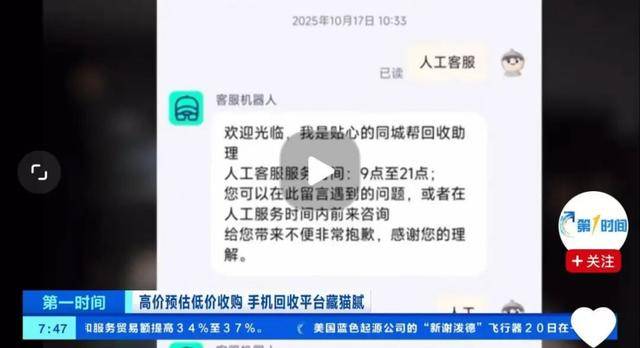
曝光淘宝合作方“同城帮”猫腻,系360、苏宁等投资手机回收平台
Sou Hu Cai Jing· 2025-12-30 10:01
Group 1 - The core issue highlighted is the deceptive practices of the mobile phone recycling platform "Tongchengbang," which is associated with Taobao, where consumers face inflated initial price estimates followed by significant price reductions upon actual purchase [1][3] - Consumers reported that after agreeing to the estimated price and sending their phones for inspection, the platform cited various defects to justify lowering the buyback price, leading to disputes when consumers sought to cancel orders and retrieve their devices [1][3] Group 2 - The customer service representative from the recycling platform acknowledged that there is a price reduction margin of approximately 30-40%, indicating that such practices are not uncommon and are considered a problem within the platform [3] - "Tongchengbang" is owned by Beijing Qili Software Technology Co., Ltd., which was established in 2015, with major shareholders including Zheng Liqun (43.15%), Qihoo 360 (22.23%), and Suning.com (19.23%) [3] - Zheng Liqun has a notable background, having worked for Motorola for 15 years and later held senior positions at Baidu and Qihoo 360, where he developed the O2O platform "360 Tongchengbang" [3]


“消失”的10大国产手机品牌
Hu Xiu· 2025-09-06 10:57
Group 1 - The smartphone market is becoming increasingly competitive, with major players like Huawei and Apple launching new high-end devices [2][3][7] - Huawei's market share is projected to reach 18.1% by Q2 2025, reclaiming the top position in the domestic market, followed closely by Vivo and OPPO [7][8] - The combined market share of Huawei, Xiaomi, OPPO, and Vivo accounts for approximately 66% of the Chinese smartphone market, indicating a strong domestic dominance [8] Group 2 - The history of the Chinese smartphone industry has seen over 87 brands disappear, with a survival rate of less than 15% [9] - The transition from feature phones to smartphones has been marked by significant technological advancements and fierce competition among domestic brands [10][30] - The rise and fall of brands like Bird and Gionee illustrate the challenges faced by companies that failed to adapt to the smartphone era [38][37] Group 3 - Brands targeting niche markets, such as Doro and Meitu, initially gained traction but ultimately struggled to maintain their market positions due to lack of technological innovation [40][50] - The entry of cross-industry players like Haier and 360 into the smartphone market has often resulted in failure due to inadequate market understanding and execution [51][53][60] - The experiences of companies like Meizu and Smartisan highlight the importance of balancing product quality with market demands, as both faced significant challenges due to misalignment with consumer expectations [71][84] Group 4 - The evolution of the smartphone industry in China reflects a shift from marketing-driven strategies to a focus on technology and innovation [70][91] - The current landscape is characterized by a new generation of leaders aiming to redefine the rules of the smartphone market, moving away from being mere followers [92][93]

