400Lite

Search documents
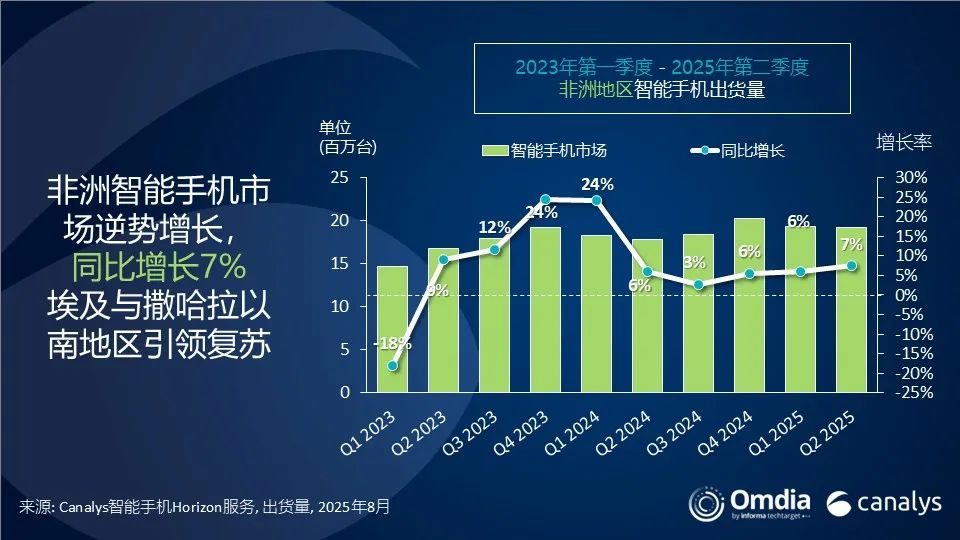
Canalys:第二季度非洲智能手机市场实现稳健增长 出货量达到1920万部
Zhi Tong Cai Jing· 2025-08-22 02:53
Core Insights - The African smartphone market is experiencing robust growth, with a year-on-year increase of 7% in Q2 2025, reaching a shipment volume of 19.2 million units, making it one of the best-performing regions globally [1][6] - Key markets such as Egypt, Nigeria, and South Africa are driving this growth due to easing inflation pressures and improved currency stability, enhancing consumer purchasing power [1][2] Regional Performance - Egypt leads the North African market with a 21% year-on-year growth, supported by local production capabilities meeting high demand during the Eid al-Fitr promotional season [2] - Nigeria rebounded by 10% due to inflation easing and a stable naira, while South Africa saw a 2% increase, with 5G smartphone shipments surging by 63% [2] - Kenya showed resilience with a slight decline of 2%, whereas Algeria and Morocco faced declines of 27% and 7% respectively due to weak demand and stricter import restrictions [2] Market Dynamics - Demand for ultra-low-cost smartphones is reshaping the African market, with models priced under $100 experiencing a 38% surge, leading to a decrease in average selling prices [4] - Transsion maintained its leading position with a 6% growth, while Xiaomi saw a significant 32% increase, capturing a 14% market share [4][7] - Samsung's market presence expanded through localized distribution and retail, achieving a 3% growth, while Honor's sales surged by 161% due to successful entry and mid-range models [4][7] Future Outlook - The African smartphone market is projected to grow by 3% in 2025, outpacing the overall sluggish global market amid rising component costs [6] - The rural market is becoming a new competitive focus, driven by limited traditional banking services, which is promoting mobile payments and digital services [6] - The region is transitioning from a consumer market to a production and assembly base, with countries like Egypt and Ethiopia leading the way in establishing local supply chains [6]



“重新竞聘上岗”!荣耀,大消息
第一财经· 2025-05-13 04:07
Core Viewpoint - Honor is undergoing significant organizational restructuring and strategic adjustments following the appointment of a new CEO, Li Jian, with a focus on enhancing competitiveness in the Chinese market and expanding into AI technology [1][3]. Group 1: Organizational Changes - Honor has completed a personnel restructuring in key positions within China, involving 38 key role supervisors, with 45% of these positions seeing changes and 24% of the new leaders being born in the 1990s [1][3]. - The internal restructuring plan, referred to as the "Eagle Plan," was initiated by the new CEO Li Jian, who aims to create a more agile organizational structure to respond to market demands [3][4]. - The recruitment process for these positions was conducted transparently, with live broadcasts allowing participation from all employees, emphasizing a merit-based approach [3]. Group 2: Market Position and Performance - Honor's market share in the Chinese smartphone market was reported at 15% in the previous year, a decline of 1 percentage point compared to 2023, with a year-on-year growth rate of -3% [4]. - Despite the challenges, Honor's sales have shown signs of recovery in Q1, driven by new product launches such as the Power and GT Pro, which have helped the brand return to the top three in weekly sales in the Chinese smartphone market [6]. Group 3: Strategic Focus on AI - Honor plans to invest over $10 billion in building an AI terminal ecosystem over the next five years, marking a significant commitment to AI development [1][7]. - The company has established new departments focused on AI and software, as well as new business model expansion and incubation, indicating a strategic shift towards becoming a global AI terminal ecosystem company [7][8]. - Analysts suggest that the future competition among smartphone manufacturers will increasingly revolve around AI-enhanced products and data, necessitating a shift from traditional hardware-focused strategies [8]. Group 4: International Expansion - Honor's overseas sales surpassed 50% by the end of last year, with significant growth in markets such as Africa, where market share increased by 283% year-on-year in Q1 [9]. - The company is actively seeking to capture more international market share, particularly in the Asia-Pacific region, where it aims to compete directly with leading high-end brands [9].

独家 |荣耀新增AI新产业部门,中国区关键岗位“竞聘上岗”
Di Yi Cai Jing Zi Xun· 2025-05-13 03:55
Group 1 - The core viewpoint of the article revolves around the organizational restructuring and strategic adjustments at Honor following the appointment of a new CEO, Li Jian, in January 2023 [1][3] - Honor has implemented a personnel adjustment plan called the "Eagle Plan," which involved a competitive reappointment process for 38 key positions in the China region, resulting in 45% of the position holders being changed, with 24% of them being born in the 1990s [2][3] - The company has established a new AI industry department and designated AI-related research and development as a primary focus, with plans to invest over $10 billion in building an AI terminal ecosystem over the next five years [2][7] Group 2 - Honor's market share in the Chinese smartphone market was 15% last year, ranking fifth, which represents a decline of 1 percentage point compared to 2023, with an annual growth rate of -3% [4] - Following a series of financing rounds, Honor's shareholder base has expanded to 23, including various investment institutions, indicating a critical period for market development [5] - In Q1 2024, Honor's sales rebounded, with new products like Power and GT Pro contributing to its return to the top three in the Chinese smartphone market for the first time since Q2 2024 [5][6] Group 3 - Honor's strategy includes a significant shift towards AI, with an annual investment of approximately 15 billion RMB in AI, marking one of the largest commitments among smartphone manufacturers [7] - The company aims to transition from a smartphone manufacturer to a global AI terminal ecosystem company, emphasizing the need to embrace the AI era and collaborate with internet and AI enterprises [7] - Honor's overseas sales accounted for over 50% of its total sales by the end of last year, with a notable 283% growth in market share in the African market year-on-year [8]