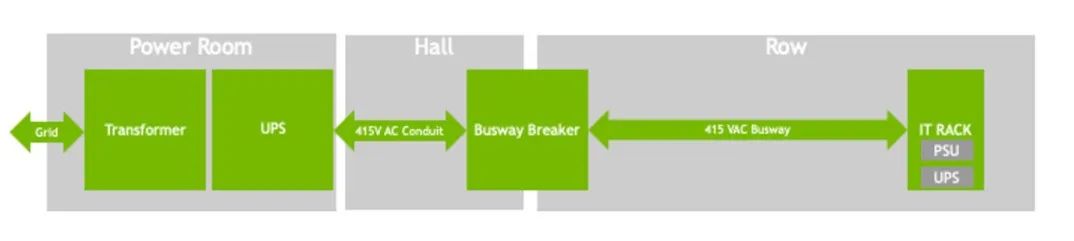
800V高压直流(HVDC)架构

Search documents
这些电源大厂和英伟达合谋一件大事
3 6 Ke· 2025-05-28 02:02
Core Insights - The automotive industry is increasingly adopting 800V architecture as a standard for faster charging and improved energy efficiency, with some companies even exploring 1000V systems [1][2] - In the AI data center sector, traditional power supply systems are becoming inadequate as power demands exceed 200kW, prompting a shift towards high-voltage direct current (HVDC) architectures [1][3] - NVIDIA is leading the transition to 800V HVDC power infrastructure for data centers, collaborating with major industry partners to support IT racks of 1 MW and above [3][4] Automotive Industry - The shift to 800V architecture in electric vehicles (EVs) allows for reduced current and heat loss, enhancing energy efficiency [1] - The increase in voltage from 400V to 800V can lower heat loss to one-fourth of the original amount, making it more efficient [1] AI Data Center Sector - Major tech companies like Google, Microsoft, Amazon, and Meta are adopting 400V DC systems, while NVIDIA is pushing for a more aggressive 800V HVDC approach [1][3] - The new 800V HVDC architecture significantly improves energy distribution efficiency and allows for direct power conversion on AI chips [4][5] Industry Collaborations - NVIDIA is partnering with key players in the semiconductor and power systems sectors, including Infineon, TI, and Delta, to develop the 800V HVDC infrastructure [3][4][5] - Infineon and Navitas have announced their involvement in supporting NVIDIA's 800V HVDC data center power infrastructure [4][5] Technical Advancements - The 800V HVDC architecture simplifies power delivery by reducing the number of AC/DC conversion stages, improving overall efficiency by 5% [8] - This architecture allows for a significant reduction in copper usage, with a 45% decrease in wire thickness, addressing sustainability concerns [8][9] Challenges and Future Outlook - The transition to 800V systems faces challenges such as high reliability requirements for components and the need for industry-wide standards [15] - Despite the challenges, the shift to 800V is seen as a necessary evolution to meet the increasing power demands of AI workloads in data centers [15][16]