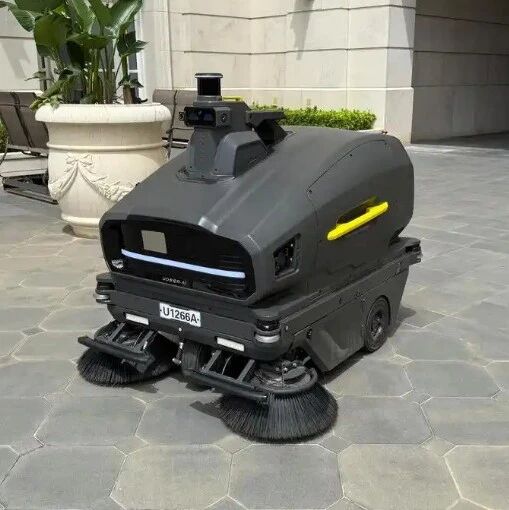
AI巡逻车

Search documents
深圳市坪山区龙田街道:深入推进“街区制”改革绘就市容环境品质新画卷
Xin Lang Cai Jing· 2025-12-28 19:25
Core Viewpoint - The article highlights the implementation of the "block system" reform in Longtian Street, Pingshan District, Shenzhen, focusing on enhancing urban governance through community participation and technological integration, aiming for high-quality urban development and improved resident satisfaction [1]. Group 1: Urban Governance and Management - Longtian Street promotes a "7210" urban environment governance model, emphasizing 70% service, 20% management, and 10% enforcement, with a goal of achieving "zero complaints" to enhance urban quality [2]. - A "governance iron triangle" is established, integrating party leadership, law enforcement support, and operational maintenance, with personnel deployed to communities to create a closed-loop process of inspection, feedback, resolution, and summary [2]. - A total of 28,829 urban environment issues have been resolved, significantly improving the order of the street environment [2]. Group 2: Technological Empowerment - Longtian Street has set up an AI sanitation command center, collaborating with companies like Huafu Environment and Shenzhen Sait to create the first AI sanitation robot application demonstration project in Pingshan District [3]. - The deployment of AI patrol vehicles, fixed cameras, and drones has established a "five-dimensional integrated" perception network, automating cleaning and patrol operations [3]. - This innovation enhances the efficiency of urban governance and establishes a modern governance system characterized by "full perception, efficient collaboration, and precise policy-making" [3]. Group 3: Community Participation and Long-term Management - The "block system" serves as a starting point for deepening the concept of "self-governance and co-governance," transitioning from short-term remediation to long-term management [4]. - Over 5,400 square meters of idle land in Zhukeng Community have been revitalized to create a leisure "back garden" for residents, with a "2.0 version" upgrade project initiated [4]. - By collecting public opinions and scientifically introducing flower planting mechanisms, the area has been transformed into a vibrant ecological space, enhancing community satisfaction and achieving a "two-way response" between government governance and public approval [4]. Group 4: Future Development - Longtian Street plans to continue deepening the "block system" reform with higher standards and practical measures to modernize grassroots governance, aiming to create a happy home for residents and depict a vivid picture of urban high-quality development intertwined with public welfare [5].
2025物业机器人奇点已至?
机器人大讲堂· 2025-09-25 10:07
Core Viewpoint - The property robot sector is poised for significant growth, with expectations of technological maturity and cost optimization leading to a breakthrough in market penetration by 2025, fundamentally transforming property management efficiency, cost, and user experience [1][3][20]. Group 1: Key Developments in Property Robots - Property robots have rapidly integrated into communities, becoming essential tools for property management, with capabilities such as cleaning and patrols [1]. - Leading property management companies have collaborated with robot manufacturers to establish operational data, algorithm adaptations, and multi-functional product upgrades, laying the groundwork for large-scale implementation [3][12]. - The current low penetration rate of property robots indicates a pre-explosion phase, with expectations for high-frequency, low-speed applications to achieve over 10% market penetration within the next year [4]. Group 2: Economic Drivers for Adoption - The property management industry faces significant labor cost pressures, with personnel costs constituting approximately 70% of total expenses, necessitating the adoption of robots to reduce costs and improve service quality [6][9]. - Robots can replace 1-2 cleaning staff, eliminating additional costs such as social security and accommodation, leading to substantial long-term savings [6]. - The introduction of robots has resulted in improved service efficiency, transitioning from reactive to proactive service models, enhancing overall operational effectiveness [7][9]. Group 3: Technological and Cost Breakthroughs - Advances in technology and cost reductions are critical for the widespread adoption of property robots, with key components like laser radar seeing price drops from tens of thousands to thousands of yuan [11]. - The integration of AI algorithms and lower-cost camera modules has significantly improved the robots' ability to accurately identify obstacles and enhance operational efficiency [11]. - The scaling of production by leading companies is expected to further reduce costs, with estimates suggesting a 20%-30% decrease in hardware costs as production volumes increase [12]. Group 4: Innovative Business Models - New business models, such as leasing instead of outright purchases, have emerged, allowing property management companies to reduce financial burdens and operational risks associated with technology obsolescence [15]. - The collaborative model between robots and human staff enhances service quality, with robots handling routine tasks while humans focus on specialized cleaning [16]. - Flexible pricing models linked to service usage rather than personnel numbers are being introduced, allowing property management companies to better align costs with service delivery [18]. Group 5: Future Market Potential - The property management sector in China generated revenues of 1.69 trillion yuan in 2023, with labor costs exceeding 56%, indicating a substantial market opportunity for property robots [19]. - The future of property robots is expected to encompass multifunctional capabilities, integrating cleaning, inspection, security, and customer service into a single platform [19]. - Leading property management firms are transitioning from buyers to co-developers of robotic solutions, fostering deeper collaboration with technology providers to enhance product offerings [19].