AMD Radeon显卡

Search documents
OpenAI疯狂囤货,山姆・奥特曼的DRAM灰色交易
阿尔法工场研究院· 2025-12-08 00:06
Core Insights - The article discusses a significant surge in DRAM memory prices, particularly a 156% increase in the price of a 32GB DDR5 memory kit within a month, attributed to a combination of market panic, AI-related demand, and supply chain issues [2][3]. Group 1: Market Dynamics - OpenAI signed unprecedented agreements with Samsung and SK Hynix on October 1, securing 40% of global DRAM supply, which caught the industry off guard [5][6]. - The secrecy surrounding these agreements led to widespread panic among competitors and suppliers, as they were unaware of the scale and timing of OpenAI's actions [7][9]. - The lack of safety stock in the market was exacerbated by tariff confusion, declining prices, and halted second-hand DRAM manufacturing, leaving the market vulnerable [11][12]. Group 2: Impact on Products - The immediate impact of the memory shortage is categorized into different levels of urgency for various products: - S Level: Memory itself is in critical shortage, with prices skyrocketing [15]. - A Level: Solid State Drives (SSDs) are at risk due to their price lagging behind DRAM changes [16]. - B Level: NVIDIA graphics cards have some buffer but are still at risk, especially high-capacity models [19]. - C Level: Laptops and smartphones are currently safe but may face issues once inventory runs out [20]. - D Level: PlayStation is well-prepared due to prior procurement [21]. - E Level: Products without memory, like CPUs, may see price drops due to decreased demand [22]. Group 3: Future Considerations - The article emphasizes that even if the memory shortage is alleviated, the market will remain chaotic for at least the next 6 to 9 months due to long delivery cycles for DDR5 [15]. - There is a call for deeper investigation into OpenAI's financial practices and their impact on the memory market, highlighting concerns over their aggressive accumulation of resources [22].


美股芯片巨头 深夜大跌!
Shang Hai Zheng Quan Bao· 2025-08-06 16:27
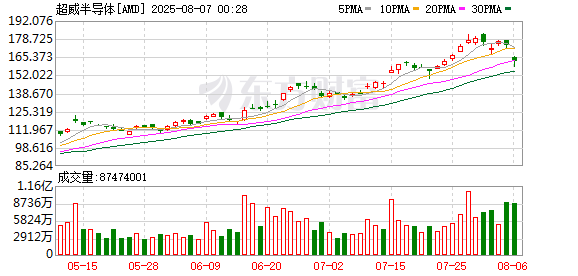
Core Viewpoint - AMD reported strong revenue growth in Q2 2025, driven by demand for computing and AI products, despite facing challenges related to export controls on its MI308 data center GPUs [2][11]. Financial Performance - Q2 2025 revenue reached $7.685 billion, a 32% increase year-over-year from $5.835 billion in Q2 2024, and a 3% increase from $7.438 billion in Q1 2025 [4][6]. - Gross profit for Q2 2025 was $3.059 billion, up 7% from $2.864 billion in Q2 2024, but down 18% from $3.736 billion in Q1 2025 [4]. - The gross margin was 40%, down 9 percentage points year-over-year and down 10 percentage points quarter-over-quarter [4]. - Operating expenses increased by 23% year-over-year to $3.193 billion [4]. - Net income for Q2 2025 was $872 million, a 229% increase from $265 million in Q2 2024, and a 23% increase from $709 million in Q1 2025 [4][6]. Segment Performance - Data center revenue was $3.2 billion, a 14% increase year-over-year, driven by strong demand for AMD EPYC processors [11]. - Client and gaming segment revenue reached $3.6 billion, a 69% increase year-over-year, with client revenue hitting a record high of $2.5 billion [11]. - Embedded segment revenue was $824 million, down 4% year-over-year due to fluctuations in end-market demand [11]. Future Outlook - AMD expects Q3 2025 revenue to be approximately $8.7 billion, a year-over-year increase of about 28% and a quarter-over-quarter increase of about 13% [11]. - The company anticipates a Non-GAAP gross margin of around 54% for Q3 2025 [11]. - AMD's CEO expressed optimism about expanding AI business to hundreds of billions in revenue, highlighting strong interest in the next-generation MI400 series [13][14].