AutoGen框架

Search documents
“一人一团队”来了,企业预测2026年将成多智能体“上岗”元年
第一财经· 2026-01-05 11:07
Core Insights - The article discusses the critical transformation period for enterprise-level AI, highlighting the shift from single-tool usage to multi-agent collaboration, with 2026 predicted to be the year of large-scale deployment of enterprise multi-agents [2] - It emphasizes that multi-agents must incorporate three key elements: Team Operations, Business Disruption, and Business Reconstruction (TAB), with China positioned as a global leader in this transition [2] - The article notes that companies are increasingly integrating AI capabilities closer to management levels, moving beyond frontline applications [2] Group 1 - The concept of multi-agents evolving from "one person, one tool" to "one person, one team" is outlined, indicating a significant shift in how AI is utilized within organizations [2] - The article mentions that the past year has seen practical implementations of AI across various industries, including energy, mining, manufacturing, aquaculture, and retail, indicating a growing acceptance and integration of AI technologies [2] - The article highlights the competitive landscape, with major players like Microsoft and Google making strides in multi-agent frameworks, while domestic companies like Volcano Engine are also making significant advancements [3] Group 2 - The article discusses the differences in approach between large companies and startups, noting that large firms often struggle with understanding customer needs, leading to delivery issues and mismatched expectations [3] - It points out that startups are more agile in exploring new models to reduce delivery costs and improve communication with clients, which can lead to more successful project outcomes [3] - The article raises the debate on whether "model equals product," suggesting that while large models may dominate, there will still be a distinction between models and applications in the short to medium term [4] Group 3 - The article asserts that agents possess capabilities such as memory, tool invocation, and multi-agent adversarial analysis, which single models typically lack, especially in enterprise contexts [4] - It suggests that while the ultimate goal may be to achieve a state where "model equals agent," the timeline for reaching this level of AGI remains uncertain [4]

“一人一团队”来了,企业预测2026年将成多智能体“上岗”元年
Di Yi Cai Jing Zi Xun· 2026-01-05 09:33
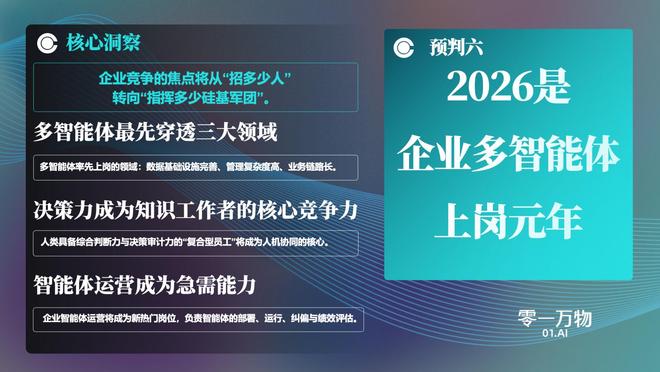
零一万物预测,智能体将从"一人一工具"进阶"一人一团队",多智能体需具备TAB( 团队作战、业务裂 变、商业重构)三要素,中国将成为全球多智能体"超级引擎","一把手工程"是赢取AI红利的关键路 径,智能体反哺将开启数字基建"自主进化",以及2026年是企业多智能体上岗元年。 从基础模型研发到推动AI落地提效,大模型正在越来越靠近一线生产端。过去一年时间,零一万物团 队在能源、采矿、制造、养殖、零售等行业落地实践,发现企业已不再满足于只在一线使用AI,而是 越来越大胆地将AI能力向上推,与公司管理层、经营层越来越近。 作为AI落地形式之一,Agent在2025年被热议。从行业技术发展脉络来看,智能体经历过工作流、推理 Agent、多智能体阶段。国际市场中,微软推出 AutoGen 框架实现智能体分工协作,谷歌 DeepMind 通 过多智能体强化学习攻克复杂任务,国内火山引擎等企业也在相关领域布局,行业竞争日趋激烈。 对于与大厂之间的差异,零一万物中国区解决方案和交付总经理韩炜在采访中表示,零一万物不再沿用 大厂销售标准化产品模式,而是更注重基于客户需求进行梳理和设计,将其转化为产品原型。他认为以 往大厂的产 ...
探索未来:全面解析2025年十大颠覆性IT技术
Sou Hu Cai Jing· 2025-06-08 01:15
Core Insights - The article highlights the rapid advancements in the information technology sector, emphasizing ten key IT technologies that will shape digital transformation over the next decade [1] Group 1: Generative AI - Generative AI has evolved from text generation to multimodal capabilities, enabling the creation of videos, 3D models, and code [2] - Microsoft's AutoGen framework allows AI agents to autonomously break down tasks, enhancing efficiency in development processes [2] - Ethical risks are increasing, prompting OpenAI to introduce a framework for AI behavior guidelines [2] Group 2: Quantum Computing - IBM's 1121-Qubit quantum processor achieves a 1000x speedup in drug molecule simulations, while Google's quantum error correction reduces error rates to 0.1% [6] - Morgan Stanley applies quantum algorithms to optimize investment portfolio risk assessments, reducing errors by 47% [6] - Commercialization of quantum computing faces engineering challenges, as these systems require near absolute zero temperatures to operate [6] Group 3: Neuromorphic Chips - Intel's Loihi 2 chip mimics human brain synaptic plasticity, achieving energy efficiency in image recognition at 1/200th of GPU consumption [8] - Tesla's Dojo 2.0 supercomputer enhances autonomous driving training speed by five times [8] - Neuralink's technology allows paralyzed patients to control digital devices through thought, with a data transmission bandwidth of 1 Gbps [8] Group 4: Edge Intelligence and 5G-Advanced - 5G-Advanced reduces latency to 1 ms, enabling industrial robots to respond at human nerve signal levels [10] - Siemens' deployment of a "digital twin + edge AI" system in Germany achieves a 98% accuracy rate in equipment fault prediction [10] - Security issues remain, with 76% of edge nodes reported to have unpatched vulnerabilities [10] Group 5: Privacy Computing - Ant Group's "Yin Yu" framework enables data usage without visibility in multi-party collaborative modeling [12] - Federated learning in healthcare enhances cross-hospital tumor research efficiency by three times while complying with GDPR [12] - NVIDIA's H100 encryption acceleration engine reduces training time by 60%, although encrypted computing still incurs a 10-100x performance overhead [12] Group 6: Extended Reality (XR) - Meta's XR OS 2.0 supports multimodal interactions, with Quest 3 headset achieving 8K resolution and 120Hz refresh rate [13] - BMW utilizes XR systems to design virtual factories, reducing design cycles by 40% [13] - Apple’s Vision Pro addresses motion sickness issues with dynamic gaze rendering technology, maintaining latency under 3 ms [13] Group 7: Green Computing - AMD's EPYC 9005 processor utilizes 3D V-Cache stacking technology, improving energy efficiency by four times [14] - Microsoft's underwater data center project lowers PUE to 1.06 through seawater cooling [14] - Global data centers still account for 3% of electricity consumption, with liquid cooling technology adoption at only 15% [14] Group 8: Biofusion Technology - Neuralink's N1 chip enables wireless transmission of brain signals at 4 Kbps, with future potential for direct AI access [15] - Swiss teams have developed "electronic skin" that surpasses human fingertip sensitivity, though biological compatibility requires 5-10 years of validation [15] Group 9: Blockchain 3.0 - Ethereum 2.0's PoS mechanism reduces energy consumption by 99.9% and supports 100,000 transactions per second [16] - Walmart employs blockchain to track food supply chains, reducing loss rates by 30% [16] - Interoperability issues persist, with Polkadot's cross-chain protocol connecting over 50 blockchains but capturing only 1% of the market [16] Group 10: Autonomous Systems - Tesla's FSD V12 uses an end-to-end neural network, but its accident rate remains three times higher than human drivers [17] - Boston Dynamics' Atlas robot achieves fully autonomous navigation with a positioning error of less than 2 cm [17] - Legal frameworks are lacking, with the EU planning to introduce a "Robot Liability Bill" to clarify accident responsibility [17] Future Outlook - The ten technologies are not developing in isolation but are showing deep integration trends, such as quantum computing accelerating AI training and neuromorphic chips empowering edge intelligence [18] - Companies need to build a "technology matrix" capability rather than focusing on single technology deployments [18] - Gartner suggests that the technology leaders of 2025 will be those who can weave quantum, AI, and privacy computing into new value networks [18]