ChatGPT DeepResearch

Search documents
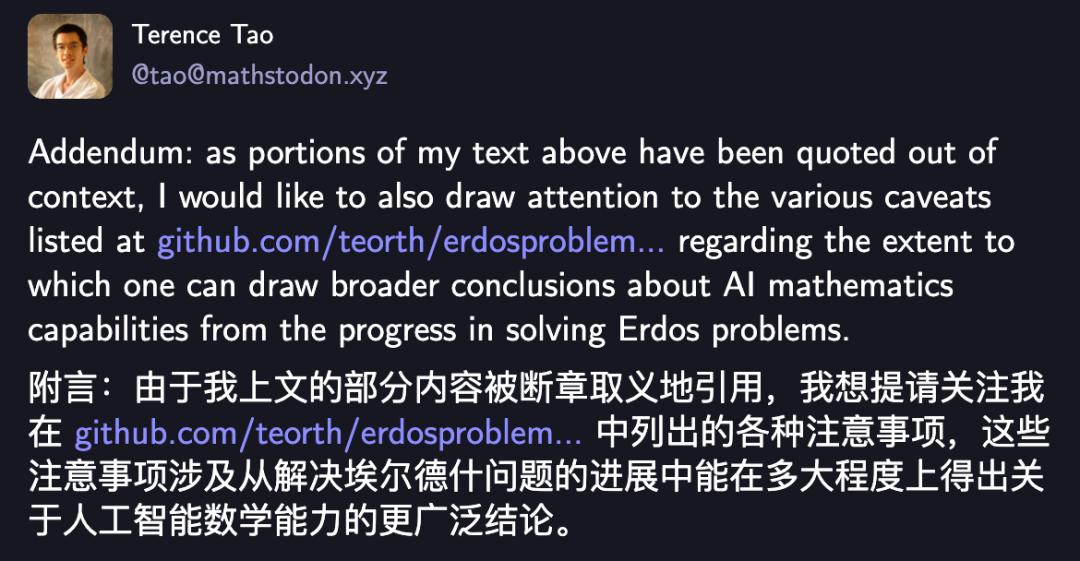
AI又要颠覆数学?陶哲轩紧急发声:停止造神
3 6 Ke· 2026-01-12 01:49
Core Viewpoint - The article discusses the exaggerated claims regarding AI's ability to solve complex mathematical problems, particularly in relation to Erdős problems, and emphasizes the need for a more nuanced understanding of AI's contributions in mathematics [1][2]. Group 1: AI's Capabilities in Mathematics - AI's achievements in solving certain mathematical problems are often overstated, leading to misconceptions that AI can independently innovate or replace human mathematicians [2][4]. - The difficulty level of problems solved by AI varies significantly, making direct comparisons misleading; some problems are much easier than others, which can skew perceptions of AI's capabilities [2][3]. - Many problems labeled as "unsolved" may have been previously addressed in literature, leading to potential misattributions of "first solutions" to AI [3][10]. Group 2: Evaluation of AI Contributions - AI's contributions can be categorized into several types, including generating complete or partial solutions, conducting literature reviews, and formalizing proofs [6][12]. - Specific examples illustrate that AI has successfully provided solutions for certain problems, but these often require validation against existing literature to confirm their novelty [8][10]. - The process of formalizing AI-generated proofs can introduce risks, such as the potential for misinterpretation or the introduction of unverified axioms [4][12]. Group 3: The Role of Human Mathematicians - Human mathematicians remain essential for formulating deep questions, creating new concepts, and integrating results into the broader knowledge network of mathematics [12]. - The future of mathematics may involve a collaborative relationship where humans guide AI in exploring mathematical landscapes, rather than AI acting as an independent entity [12].

陶哲轩亲测:我用Gemini十分钟搞定了困扰学界多年的难题
量子位· 2025-11-24 07:30
Core Viewpoint - The collaboration between mathematician Terence Tao and the AI model Gemini has successfully solved a long-standing mathematical problem in just ten minutes, showcasing the potential of AI in mathematical proofs [1][3][25]. Group 1: Problem Overview - The problem addressed is the 367 problem proposed by Paul Erdős, which involves the 2-full part of an integer n and the existence of a constant for sufficiently large n [12][14]. - The problem requires verification of the existence of a limit supremum under specific conditions [16]. Group 2: AI's Role in the Solution - Terence Tao utilized Gemini Deep Think to complete the proof, which took only ten minutes, demonstrating the efficiency of AI in mathematical reasoning [19][20]. - Following the AI's proof, Tao spent an additional thirty minutes converting the AI's p-adic algebraic proof into a more fundamental argument [21]. Group 3: Collaborative Efforts - Two days later, Boris Alexeev used the Harmonic Aristotle tool to formalize the proof, taking two to three hours to complete the process [24]. - The problem was ultimately resolved through the collaboration between Gemini and human mathematicians, highlighting the synergy between AI and human expertise [25]. Group 4: Future Implications - This instance is not the first time Tao has employed AI for mathematical work, indicating a growing trend of AI assisting in mathematical proofs [29]. - The advancements in AI's mathematical reasoning capabilities suggest that future mathematics will involve more experimental approaches rather than solely theoretical ones [30].