Erdős问题

Search documents
AI又要颠覆数学?陶哲轩紧急发声:停止造神
3 6 Ke· 2026-01-12 01:49
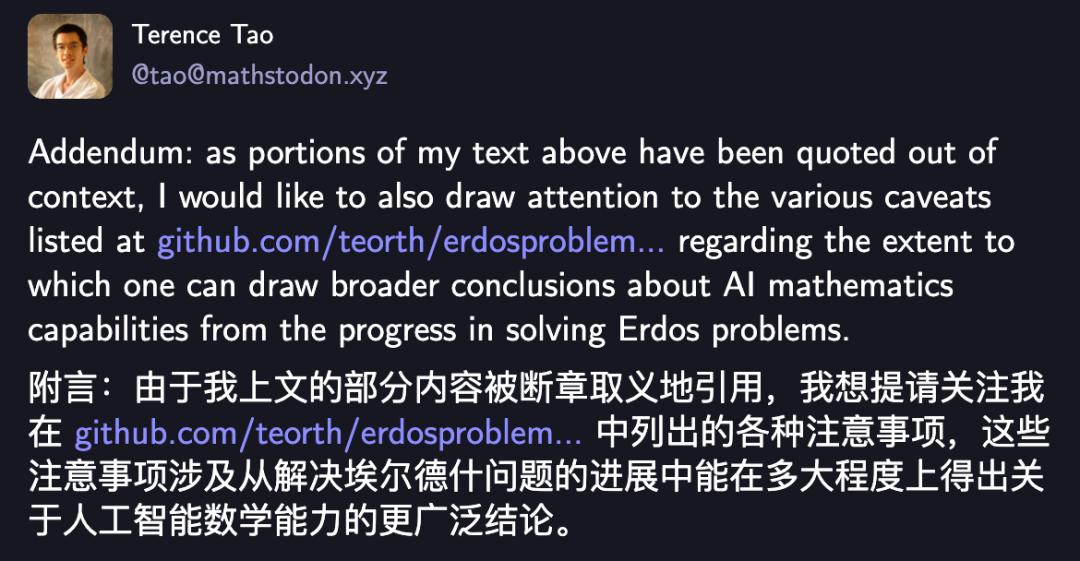
Core Viewpoint - The article discusses the exaggerated claims regarding AI's ability to solve complex mathematical problems, particularly in relation to Erdős problems, and emphasizes the need for a more nuanced understanding of AI's contributions in mathematics [1][2]. Group 1: AI's Capabilities in Mathematics - AI's achievements in solving certain mathematical problems are often overstated, leading to misconceptions that AI can independently innovate or replace human mathematicians [2][4]. - The difficulty level of problems solved by AI varies significantly, making direct comparisons misleading; some problems are much easier than others, which can skew perceptions of AI's capabilities [2][3]. - Many problems labeled as "unsolved" may have been previously addressed in literature, leading to potential misattributions of "first solutions" to AI [3][10]. Group 2: Evaluation of AI Contributions - AI's contributions can be categorized into several types, including generating complete or partial solutions, conducting literature reviews, and formalizing proofs [6][12]. - Specific examples illustrate that AI has successfully provided solutions for certain problems, but these often require validation against existing literature to confirm their novelty [8][10]. - The process of formalizing AI-generated proofs can introduce risks, such as the potential for misinterpretation or the introduction of unverified axioms [4][12]. Group 3: The Role of Human Mathematicians - Human mathematicians remain essential for formulating deep questions, creating new concepts, and integrating results into the broader knowledge network of mathematics [12]. - The future of mathematics may involve a collaborative relationship where humans guide AI in exploring mathematical landscapes, rather than AI acting as an independent entity [12].

半世纪难题48小时破解!陶哲轩组队把AI数学玩成打怪游戏了
量子位· 2025-12-13 04:34
Core Viewpoint - The collaboration between mathematicians and AI has led to the resolution of the long-standing Erdős 1026 problem, which had remained unsolved for 50 years, in just 48 hours [1][2][3]. Group 1: Problem Overview - The Erdős 1026 problem was proposed in 1975 and involves determining the minimum possible value of a function related to a game theory scenario involving two players, Alice and Bob [8][10][12]. - The problem's complexity was highlighted by the introduction of a maximum constant c(n) that represents the minimum proportion of coins Bob can guarantee to take, regardless of how Alice distributes them [10][13]. Group 2: AI's Role in the Solution - AI tools played a crucial role in solving the problem quickly, with traditional methods potentially taking weeks or months to reach a conclusion [3][5]. - The use of AI models, such as Harmonic and AlphaEvolve, allowed mathematicians to automate the construction and proof of key inequalities, transforming the original problem into a computational geometry challenge [16][18][22]. Group 3: Collaborative Efforts - The solution involved multiple mathematicians working together, with contributions from Boris Alexeev, Koishi Chan, and Lawrence Wu, showcasing the effectiveness of human-AI collaboration [17][28][32]. - The collaborative approach of combining human insight with AI capabilities is emerging as a new trend in mathematical problem-solving [46]. Group 4: Historical Context and Future Implications - The Erdős problems, proposed by the renowned mathematician Paul Erdős, have been a significant part of mathematical research, with many remaining unsolved [39][41]. - The increasing success of AI in solving these problems suggests a shift in how mathematical research may be conducted in the future, with AI becoming a standard tool for researchers [41][42].

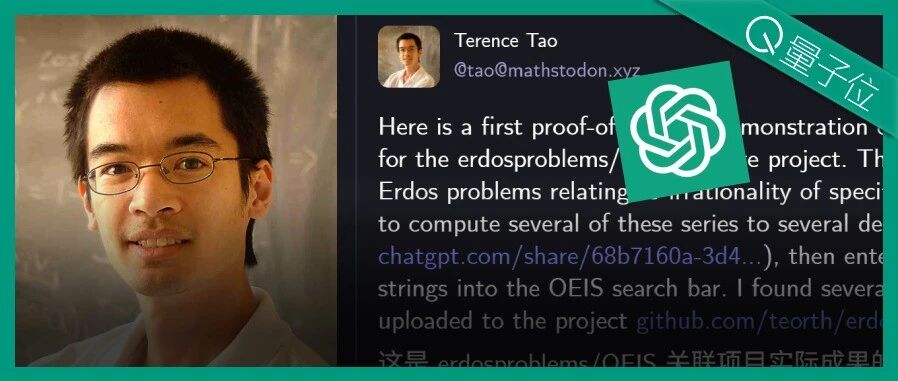
GPT-5又帮陶哲轩解决了一个难题
量子位· 2025-09-03 07:30
Core Viewpoint - The article discusses how AI, specifically GPT-5, has assisted mathematician Terence Tao in solving a mathematical problem related to the Erdős problems by facilitating semi-automated literature searches and database comparisons [1][4][18]. Group 1: AI's Role in Mathematics - Terence Tao utilized AI combined with databases to tackle complex mathematical problems, demonstrating AI's capability to serve as a "locator" in the problem-solving process [3][11]. - The AI helped generate high-precision decimal representations of sequences related to the Erdős problems, which were then matched with existing sequences in the OEIS database [12][15]. - This approach revealed that previously unsolved problems had already been addressed in existing literature, highlighting AI's role in bridging gaps between different knowledge sources [14][17]. Group 2: Erdős Problems and OEIS Project - The Erdős problems are a collection of unsolved mathematical questions posed by the renowned mathematician Paul Erdős, with many remaining unresolved for decades due to their complexity [6][10]. - The Erdős problems/OEIS linkage project was initiated by Terence Tao and Thomas Bloom to connect the Erdős problems with the OEIS database, aiming to prevent researchers from overlooking existing solutions or duplicating efforts [24][25]. - The project encourages collaboration by allowing researchers to compute integer sequences from the Erdős problems, compare them with OEIS, and document their findings in a GitHub repository [26][27].