
Cooling Comforter凉感被

Search documents
中国消费品牌出海迈向新周期:把爆款做成体系,把增长做成复利
3 6 Ke· 2026-01-16 11:17
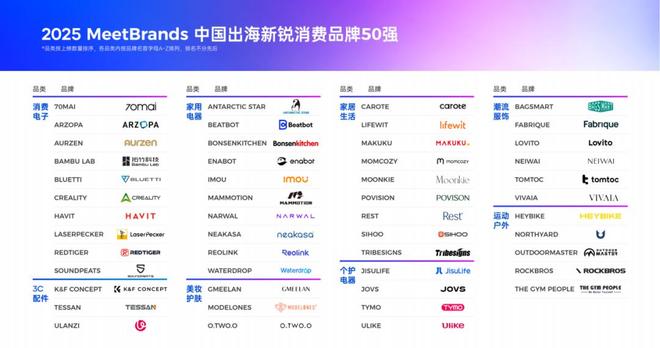
Core Insights - The rising cost structure for outbound consumer brands is significantly impacting their operations, with Google Ads CPC increasing by 10% and Meta CPL soaring by 20% year-on-year, indicating a shift from a growth model reliant on spending to one focused on brand value [1][2] - The "2025 MeetBrands Top 50" list reflects a structural upgrade in the outbound industry, with brands evolving not just through competition but also due to changing market rules [2] Group 1: Brand Evolution - Sixteen brands have graduated to become benchmarks, achieving annual overseas revenues of $500 million, global presence in over ten countries, and establishing themselves as category leaders [4] - The new entrants on the list are characterized as "category leaders," with revenues transitioning from millions to billions, emphasizing technology and scenario positioning over low-quality traffic competition [6] Group 2: Regional Dynamics - The Pearl River Delta remains the engine of outbound brands, contributing 62% of the listed brands, while the Yangtze River Delta has become a hub for brand operations, accounting for 26% of the list [8] - The industry is moving from isolated breakthroughs to regional collaboration, forming a more resilient ecosystem [8] Group 3: Hidden Barriers to Growth - Many mid-tier outbound brands face hidden capability barriers that hinder growth, such as over-reliance on low prices and traffic, lack of localized narratives, and disconnection between digital investments and business operations [10] - Overcoming these barriers is essential for brands to evolve from growth phases to becoming new leaders [10] Group 4: D-MES Model and Brand Capabilities - The D-MES model has been upgraded to better assess brands' long-term effectiveness, focusing on digital capabilities, consumer influence, product innovation, and commercial conversion [11][14] - Digital capabilities are crucial, with brands leveraging AI and digital tools to enhance decision-making and operational efficiency [15] Group 5: Consumer Trust and Localization - Brands must address the "high awareness, low trust" gap by deeply localizing their narratives and aligning with consumer values [17] - Successful examples include TESSAN, which tailored its messaging to different cultural preferences, enhancing local consumer engagement [17] Group 6: Product Innovation - The focus on product innovation should shift from merely competing on specifications to solving real consumer pain points through data-driven insights [19] - Brands like Rest have successfully identified and addressed specific consumer needs, leading to significant premium pricing and increased repurchase rates [19] Group 7: Commercial Conversion and Market Expansion - The emphasis on commercial conversion has shifted towards multi-regional expansion and omnichannel operations, with brands increasingly establishing independent online platforms and entering offline channels [21][22] - Emerging markets are becoming significant growth areas, with brands diversifying their strategies to tap into regions like Latin America, the Middle East, and Southeast Asia [22] Group 8: Long-term Strategy and Brand Resilience - The future of outbound brands is focused on stability and precision rather than speed, emphasizing profit margins and customer loyalty over rapid growth [24] - Brands are encouraged to enhance their operational efficiency and consumer experience to navigate the complexities of the market [26][28]

中国消费品牌出海迈向「新周期」:把爆款做成体系,把增长做成复利
3 6 Ke· 2026-01-16 10:41
Core Insights - The rising cost structure for outbound consumer brands is significantly impacting their operations, with Google Ads CPC increasing by 10% and Meta CPL soaring by 20% year-on-year, indicating a shift from a growth model reliant on spending to one focused on brand value [1][2] - The "2025 MeetBrands Top 50" list reflects a structural upgrade in the outbound industry, with brands entering and exiting not solely due to competition but also due to changing market rules [2] - The report highlights a transition from external growth drivers to the development of internal capabilities among successful outbound brands, which share common strategies and thinking [1] Brand Performance - Sixteen brands have graduated to become benchmarks, achieving annual overseas revenues of $500 million, global presence in over ten countries, and establishing themselves as category leaders [4] - The new entrants to the list, totaling 33 brands, are characterized as "category leaders," with revenues rising from millions to hundreds of millions, focusing on technological and situational advantages rather than low-quality traffic competition [8] Regional Insights - The Pearl River Delta remains the "engine" for outbound brands, contributing 62% of the listed brands, with Shenzhen recognized as a "hardware Silicon Valley" [10] - The Yangtze River Delta has emerged as a "brand operation highland," accounting for 26% of the listed brands, emphasizing brand quality and user relationships [11] Challenges and Opportunities - Many mid-tier outbound brands face "invisible capability thresholds" that hinder growth, such as over-reliance on low prices and traffic, lack of localized narratives, and digital investment misalignment [14] - The D-MES evaluation system has been upgraded to better assess brands' long-term capabilities, focusing on digitalization, consumer influence, product innovation, and commercial conversion [15][18] Digitalization and Consumer Engagement - Digital capabilities are crucial for brands, with successful companies embedding AI into core operations and viewing digitalization as a long-term strategy [19] - Brands must establish localized narratives to build trust with overseas consumers, as evidenced by TESSAN's strategy of aligning its brand with travel scenarios to resonate with local cultural preferences [21] Product Innovation and Market Expansion - The focus on product innovation should be based on real market data to address genuine consumer pain points rather than merely competing on features [23] - Brands are increasingly expanding into offline channels and emerging markets, with a notable shift towards multi-regional operations and a focus on long-term sustainability [25][26] Strategic Direction - The future of outbound brands is shifting towards stability and precision rather than speed, emphasizing profit margins and customer loyalty over rapid growth [28] - Brands are encouraged to enhance conversion efficiency by addressing key friction points in the sales process, thereby improving overall sales growth [29] Consumer Trust and Brand Loyalty - Winning consumer trust involves establishing value, penetrating niche markets, and building loyal communities around shared values [30] - The industry is moving towards a model driven by capabilities rather than opportunities, where sustainable growth is determined by a brand's ability to adapt and innovate [32]
