
中国消费品牌出海

Search documents
东鹏饮料“出海”关键落子:结盟印尼华商巨擘三林集团,构建本土化桥头堡
Di Yi Cai Jing· 2026-01-30 11:41
Core Viewpoint - Dongpeng Beverage has signed a strategic cooperation agreement with Indonesian conglomerate Salim Group, planning to invest up to $200 million to establish a joint venture for entering the Indonesian market, marking a significant step in its internationalization strategy [1][5][13] Group 1: Strategic Cooperation - The partnership involves the establishment of a joint venture company, which will focus on building a production base and conducting sales operations in Indonesia [5] - The total investment for this cooperation is projected to be $300 million, aligning with China's Belt and Road Initiative and Dongpeng's overseas expansion strategy [5][12] - Salim Group is a major player in various sectors, including food production and distribution, with a strong presence in the Southeast Asian market [5][6] Group 2: Market Potential - Southeast Asia, with a population of approximately 670 million, represents a significant market opportunity for beverage brands, particularly as consumer purchasing power increases [4][9] - Indonesia, as the largest economy in Southeast Asia, has a young population and growing urbanization, making it a key target for Dongpeng's expansion [10] Group 3: Competitive Advantage - Dongpeng Beverage has established itself as a leading energy drink brand in China, with a market share increase from 15% in 2021 to 26.3% in 2024 [8] - The collaboration with Salim Group is expected to leverage local resources and expertise, facilitating a faster and more effective market entry for Dongpeng [12][13] Group 4: Future Growth - The partnership is seen as a crucial step towards Dongpeng's goal of becoming a global comprehensive beverage group, with plans for further international expansion and potential capital market growth [8][13] - Dongpeng's experience in the Chinese market is anticipated to provide a replicable model for success in Indonesia and beyond, enhancing its growth prospects [12]



中国消费品牌出海迈向新周期:把爆款做成体系,把增长做成复利
3 6 Ke· 2026-01-16 11:17
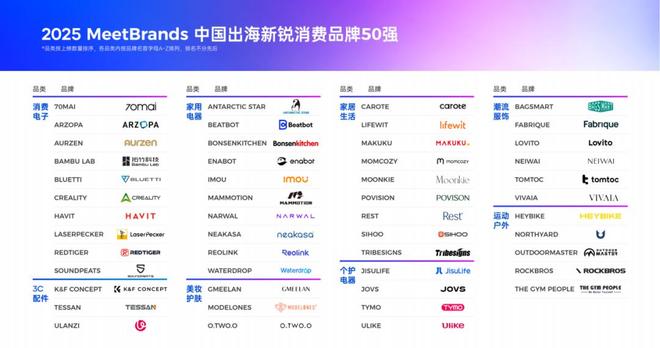
Core Insights - The rising cost structure for outbound consumer brands is significantly impacting their operations, with Google Ads CPC increasing by 10% and Meta CPL soaring by 20% year-on-year, indicating a shift from a growth model reliant on spending to one focused on brand value [1][2] - The "2025 MeetBrands Top 50" list reflects a structural upgrade in the outbound industry, with brands evolving not just through competition but also due to changing market rules [2] Group 1: Brand Evolution - Sixteen brands have graduated to become benchmarks, achieving annual overseas revenues of $500 million, global presence in over ten countries, and establishing themselves as category leaders [4] - The new entrants on the list are characterized as "category leaders," with revenues transitioning from millions to billions, emphasizing technology and scenario positioning over low-quality traffic competition [6] Group 2: Regional Dynamics - The Pearl River Delta remains the engine of outbound brands, contributing 62% of the listed brands, while the Yangtze River Delta has become a hub for brand operations, accounting for 26% of the list [8] - The industry is moving from isolated breakthroughs to regional collaboration, forming a more resilient ecosystem [8] Group 3: Hidden Barriers to Growth - Many mid-tier outbound brands face hidden capability barriers that hinder growth, such as over-reliance on low prices and traffic, lack of localized narratives, and disconnection between digital investments and business operations [10] - Overcoming these barriers is essential for brands to evolve from growth phases to becoming new leaders [10] Group 4: D-MES Model and Brand Capabilities - The D-MES model has been upgraded to better assess brands' long-term effectiveness, focusing on digital capabilities, consumer influence, product innovation, and commercial conversion [11][14] - Digital capabilities are crucial, with brands leveraging AI and digital tools to enhance decision-making and operational efficiency [15] Group 5: Consumer Trust and Localization - Brands must address the "high awareness, low trust" gap by deeply localizing their narratives and aligning with consumer values [17] - Successful examples include TESSAN, which tailored its messaging to different cultural preferences, enhancing local consumer engagement [17] Group 6: Product Innovation - The focus on product innovation should shift from merely competing on specifications to solving real consumer pain points through data-driven insights [19] - Brands like Rest have successfully identified and addressed specific consumer needs, leading to significant premium pricing and increased repurchase rates [19] Group 7: Commercial Conversion and Market Expansion - The emphasis on commercial conversion has shifted towards multi-regional expansion and omnichannel operations, with brands increasingly establishing independent online platforms and entering offline channels [21][22] - Emerging markets are becoming significant growth areas, with brands diversifying their strategies to tap into regions like Latin America, the Middle East, and Southeast Asia [22] Group 8: Long-term Strategy and Brand Resilience - The future of outbound brands is focused on stability and precision rather than speed, emphasizing profit margins and customer loyalty over rapid growth [24] - Brands are encouraged to enhance their operational efficiency and consumer experience to navigate the complexities of the market [26][28]
中国消费品牌出海迈向「新周期」:把爆款做成体系,把增长做成复利
3 6 Ke· 2026-01-16 10:41
Core Insights - The rising cost structure for outbound consumer brands is significantly impacting their operations, with Google Ads CPC increasing by 10% and Meta CPL soaring by 20% year-on-year, indicating a shift from a growth model reliant on spending to one focused on brand value [1][2] - The "2025 MeetBrands Top 50" list reflects a structural upgrade in the outbound industry, with brands entering and exiting not solely due to competition but also due to changing market rules [2] - The report highlights a transition from external growth drivers to the development of internal capabilities among successful outbound brands, which share common strategies and thinking [1] Brand Performance - Sixteen brands have graduated to become benchmarks, achieving annual overseas revenues of $500 million, global presence in over ten countries, and establishing themselves as category leaders [4] - The new entrants to the list, totaling 33 brands, are characterized as "category leaders," with revenues rising from millions to hundreds of millions, focusing on technological and situational advantages rather than low-quality traffic competition [8] Regional Insights - The Pearl River Delta remains the "engine" for outbound brands, contributing 62% of the listed brands, with Shenzhen recognized as a "hardware Silicon Valley" [10] - The Yangtze River Delta has emerged as a "brand operation highland," accounting for 26% of the listed brands, emphasizing brand quality and user relationships [11] Challenges and Opportunities - Many mid-tier outbound brands face "invisible capability thresholds" that hinder growth, such as over-reliance on low prices and traffic, lack of localized narratives, and digital investment misalignment [14] - The D-MES evaluation system has been upgraded to better assess brands' long-term capabilities, focusing on digitalization, consumer influence, product innovation, and commercial conversion [15][18] Digitalization and Consumer Engagement - Digital capabilities are crucial for brands, with successful companies embedding AI into core operations and viewing digitalization as a long-term strategy [19] - Brands must establish localized narratives to build trust with overseas consumers, as evidenced by TESSAN's strategy of aligning its brand with travel scenarios to resonate with local cultural preferences [21] Product Innovation and Market Expansion - The focus on product innovation should be based on real market data to address genuine consumer pain points rather than merely competing on features [23] - Brands are increasingly expanding into offline channels and emerging markets, with a notable shift towards multi-regional operations and a focus on long-term sustainability [25][26] Strategic Direction - The future of outbound brands is shifting towards stability and precision rather than speed, emphasizing profit margins and customer loyalty over rapid growth [28] - Brands are encouraged to enhance conversion efficiency by addressing key friction points in the sales process, thereby improving overall sales growth [29] Consumer Trust and Brand Loyalty - Winning consumer trust involves establishing value, penetrating niche markets, and building loyal communities around shared values [30] - The industry is moving towards a model driven by capabilities rather than opportunities, where sustainable growth is determined by a brand's ability to adapt and innovate [32]

中国消费品牌出海迈向「新周期」:把爆款做成体系,把增长做成复利
36氪· 2026-01-16 10:36
Core Insights - The article highlights the rising cost structure faced by outbound consumer brands, with Google Ads CPC increasing by 10% and Meta CPL soaring by 20%, indicating a shift from a growth model reliant on spending to one focused on brand value [1][3][4] - The "2025 MeetBrands Top 50" list reflects a structural upgrade in the outbound industry, where brands are evolving not just through competition but also due to changing market rules [3][4] Brand Evolution - Sixteen brands have graduated from "emerging" to "benchmark" status, achieving annual overseas revenues of $500 million and establishing a global presence in over ten countries [6][7] - The new entrants on the list exhibit characteristics of "category leaders," with revenues transitioning from millions to billions, driven by technological and situational advantages [9][10] Market Dynamics - The Pearl River Delta remains a key player, contributing 62% of the listed brands, while the Yangtze River Delta has become a hub for brand operations, accounting for 26% [13][14] - The competition landscape is shifting from a focus on low-cost and traffic-driven strategies to a more sustainable model emphasizing long-term operations and brand value [36][39] Capability Challenges - Many mid-tier outbound brands face "invisible capability thresholds" that hinder growth, such as over-reliance on low prices and traffic, lack of localization, and digital disconnection [16][17] - The D-MES evaluation model has been upgraded to better assess brands' long-term capabilities, focusing on digitalization, consumer influence, product innovation, and commercial conversion [19][21] Digitalization and Consumer Trust - Digital capabilities are becoming a crucial competitive advantage, with brands like Anker leading in integrating AI into their core operations [22][23] - Building consumer trust through deep localization and addressing the "high awareness, low trust" gap is essential for brands to succeed in overseas markets [24][25] Product Innovation and Market Expansion - Successful brands are focusing on solving real consumer pain points rather than competing on superficial features, as demonstrated by Rest's innovative product development [28][29] - The emphasis is shifting towards multi-channel operations and expansion into emerging markets, with brands diversifying their strategies beyond traditional mature markets [31][33] Long-term Strategy - The future of outbound brands lies in a "steady, precise, and strong" approach, prioritizing profit margins and customer loyalty over rapid growth [36][40] - Brands must transition from a focus on traffic to enhancing conversion efficiency across the sales process, addressing key friction points in customer experience [37][38]

年度复盘:2025年零售圈十大出海事件发布
3 6 Ke· 2026-01-14 08:40
Core Insights - In 2025, the globalization of China's retail industry entered a deeper development stage, with various Chinese brands successfully entering overseas markets, showcasing a shift from "Made in China" to "Chinese brands" [1] - The trend of going global is no longer exclusive to leading brands but has become a strategic choice for mid-tier companies seeking growth, expanding their reach from traditional Southeast Asian markets to core business districts in Europe and North America, as well as emerging markets in South America and high-potential regions in the Middle East [1] Group 1: Key Events in Retail Expansion - Bawang Chaji opened its first North American store in Los Angeles, achieving a monthly GMV of $800,000, with an average customer spend of $6.5, surpassing local competitors [2][3] - Mixue Ice Cream and Tea launched its first store in Hollywood, Los Angeles, marking a significant step in its global strategy, with plans for further expansion in the Americas [4][5] - Meituan's Keemart launched in Doha, Qatar, as part of its international strategy, leveraging its existing delivery network to enter the instant retail market [6][7] Group 2: Brand Strategies and Market Adaptation - Ningji adopted a new brand "BOBOBABA" for its U.S. entry, focusing on bubble tea and adjusting its product offerings to cater to local tastes, while also expanding rapidly in Southeast Asia [8][9] - Chen Xianggui opened its first overseas store in Berlin, maintaining its original flavor profile and leveraging a high-standard supply chain to ensure product consistency [10][11] - Miniso expanded its presence in the UK, surpassing 50 stores, with overseas revenue contributing significantly to its overall growth [12][13] Group 3: Innovative Approaches to Market Entry - Chayan Yuese announced an online e-commerce strategy for its overseas expansion, focusing on retail products rather than its signature tea, to mitigate risks associated with physical store operations [14][15] - Yuanji Yun Jiao opened its first overseas store in Singapore and is now expanding through a franchise model, supported by its established supply chain and operational experience [16][17] - Genki Forest successfully entered the UK mainstream retail market by launching its products in Tesco, marking a significant milestone in its global strategy [18][19] Group 4: Overall Trends and Future Outlook - The year 2025 witnessed a transformation in Chinese consumer brands' approach to globalization, moving from simple product exports to localized operations and supply chain integration [23] - The success of various brands illustrates the adaptability and flexibility of Chinese retail models in addressing diverse market needs and challenges [23][24]

零食先行、奶茶殿后:茶颜悦色逆向出海的商业奇袭
Xin Lang Zheng Quan· 2025-07-18 09:42
Core Insights - The article discusses the unique international expansion strategy of the Chinese tea brand, Chayan Yuesheng, which has launched a range of snacks and tea-related products in North America without offering its signature tea drinks [1][2]. Group 1: Market Entry Strategy - Chayan Yuesheng has opted for a "reverse overseas expansion" model, focusing on e-commerce rather than physical stores, which contrasts with competitors like Mixue Ice City and Heytea that are opening numerous overseas locations [1][2]. - The brand acknowledges the challenges of standardizing service and product quality in international markets, leading to its decision to avoid opening physical stores for now [1][2]. Group 2: Supply Chain Considerations - Significant differences in tea inspection systems between China and the U.S. pose challenges for Chayan Yuesheng, as some of its tea suppliers are not yet prepared for overseas operations [2]. - The brand's pragmatic approach helps it avoid the high costs associated with fresh tea drinks, which can be seven times higher in the U.S. compared to domestic prices [2]. Group 3: Product Pricing and Consumer Demand - Chayan Yuesheng's products, such as "Mochi Crispy Strips" and "Crystal Fragrance," are priced at a premium, with some items seeing price increases of up to 300% compared to domestic prices, yet they still attract significant consumer interest [3]. - The cultural value of these products, representing "Chinese flavors," contributes to their appeal among overseas consumers [3]. Group 4: Multi-Platform Strategy - The brand has launched its products across multiple platforms, including Shopify, Amazon, and TikTok Shop, to diversify its sales channels and reduce reliance on any single platform [4]. - This strategy allows for rapid validation of product-market fit through sales data [4]. Group 5: Asset-Light Model - Chayan Yuesheng's approach of prioritizing e-commerce over physical stores represents a new, asset-light model for international expansion in the beverage industry [5]. - This model allows the brand to minimize costs associated with logistics and local operations while still reaching international consumers [5]. Group 6: Data Utilization and Market Insights - The brand leverages consumer feedback and sales data from e-commerce platforms to gain insights into North American market preferences, which is more effective than traditional market research methods [6]. - The establishment of a self-owned R&D production base is set to enhance the standardization of its products, facilitating future overseas expansion [6]. Group 7: Cultural Integration - The brand's strategy includes fostering cultural recognition among North American consumers by integrating Chinese lifestyle elements into their product offerings [6]. - This approach aligns with successful global strategies seen in brands like Muji and K-beauty, focusing on selling cultural identity rather than just products [6].
巴西人的钱,该怎么赚?
Hu Xiu· 2025-06-21 10:58
Group 1 - The core viewpoint is that Chinese consumer brands are increasingly looking to expand into the Brazilian market, which presents significant growth potential but also complex challenges [1][2] - The Brazilian market is characterized by high trial and error costs, rapidly changing policy barriers, and unfamiliar local consumer habits, which test the resolve and strategies of companies venturing abroad [1] - The event aims to provide practical insights and methodologies through real case studies and expert discussions on how to successfully navigate the Brazilian market [1][2][9] Group 2 - The event, titled "Overseas·502 Closed-Door Meeting," will feature industry pioneers and experts who have successfully entered the Brazilian market, sharing their experiences and strategies [2][9] - Attendees will hear from various speakers, including brand leaders who will discuss pitfalls encountered in Brazil, marketing experts on storytelling, and e-commerce leaders analyzing category opportunities [5][6] - The meeting is designed for C-level decision-makers, ensuring high-quality exchanges and a focus on real market opportunities and challenges [6][7] Group 3 - The event will facilitate a deep dive into practical case studies, moving beyond public relations rhetoric to address the real opportunities and core difficulties in the Brazilian market [7] - It will also serve as a networking platform, connecting 10-15 high-level participants and providing access to a community of 4,000 quality users involved in overseas expansion [8][9] - The meetings will occur monthly, focusing on different regions and themes related to overseas policies, strategies, and practices [10]