Deep Agents

Search documents
Open Models, Open Runtime, Open Harness - Building your own AI agent with LangChain and Nvidia
LangChain· 2026-03-18 15:51
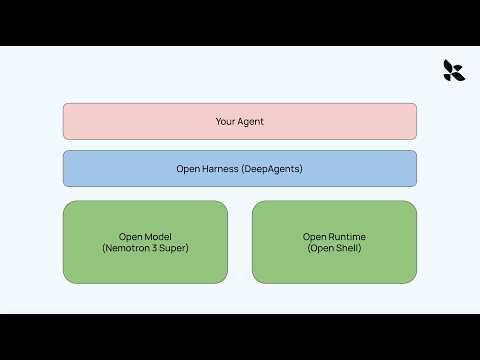
If you've ever seen agents like Claude Code or Manis or OpenClaw, they're actually all really similar under the hood. They have three core elements, a model, a runtime, and then a harness. In this video, we're going to cover how you can build all three of those components using open-source technology.So, we're going to use Neotron 3 Super Model as the model. We're then going to use Nvidia's Open Shell as the runtime. And finally, we're going to use Lingchain's deep agents harness to string it all together.L ...

模型不再是关键?LangChain 创始人:真正决定Agent 上限的是运行框架
AI前线· 2026-03-13 05:01
Core Insights - The era of simply wrapping AI with APIs and prompts is over, as AI applications transition from "one-time generation" to "continuous execution" [2] - The software infrastructure is being rewritten, with frameworks becoming more important than models, as highlighted by LangChain's recent developments [3][4] - The future of AI will focus on the core components of modern agents: system prompts, planning tools, sub-agents, and file systems [18][27] Group 1: Evolution of AI Agents - The capabilities of AI agents have significantly improved, moving from simple models to more complex systems that can run in loops and call tools effectively [7][10] - The development trajectory of agents shows that initial concepts have evolved into frameworks that enhance predictability and reliability [8][10] - The distinction between single agents and collaborative multi-agent systems will be crucial, with communication being a key factor in their effectiveness [9][11] Group 2: Framework vs. Model - The debate on whether models will dominate frameworks or vice versa suggests that frameworks will ultimately be more critical, as they enable models to be utilized effectively [14][15] - Frameworks serve as the interaction layer between models and their environments, providing essential tools for agent development [16][17] Group 3: Core Components of Modern Agents - The four core components of modern agent architecture are system prompts, planning tools, sub-agents, and file systems, which facilitate better management of context and tasks [27] - System prompts act as standard operating procedures for agents, guiding their actions from the moment they are activated [20] - Planning tools help agents generate and manage task lists, while sub-agents allow for context isolation and task delegation [21][22] Group 4: Memory and Context Management - Memory types in agents include semantic memory, episodic memory, and procedural memory, which define how agents learn and adapt over time [38] - Context compression techniques are essential for managing large amounts of information, ensuring that agents can operate efficiently without overwhelming their processing capabilities [32][34] Group 5: Future Directions and Commercialization - LangChain's future focus will be on enhancing observability and building a comprehensive platform for agent development, following a recent $125 million funding round [61][63] - The emphasis on tools, instructions, and skills will remain the primary differentiators for companies in the AI space, as frameworks and models become more standardized [64]

LangChain 创始人警告:2026 成为“Agent 工程”分水岭,传统软件公司的生存考验开始了
AI前线· 2026-01-31 05:33
Core Viewpoint - The emergence of "long-horizon agents" is reshaping the software engineering paradigm, moving from deterministic code-based systems to models that operate as black boxes, requiring real-time execution to understand their behavior [2][3][6]. Group 1: Long-Horizon Agents - Long-horizon agents are seen as a turning point in AI, with predictions that their adoption will accelerate by the end of 2025 to 2026 [2]. - These agents function more like "digital employees," capable of executing tasks over extended periods, learning from trial and error, and self-correcting [2][3]. - The transition to long-horizon agents may challenge traditional software companies, similar to the shift from on-premises to cloud solutions, where not all companies successfully adapted [2][3]. Group 2: Differences in Software Development - Traditional software development relies on deterministic logic written in code, while agent-based systems introduce non-deterministic behavior, making it necessary to observe their real-time execution to understand their operations [30][32]. - The concept of "tracing" has become crucial in agent systems, allowing developers to track internal processes and understand the context at each step, which differs significantly from traditional software debugging methods [31][32]. - The iterative process of developing agents is more complex, as developers cannot predict behavior before deployment, necessitating more rounds of refinement and adjustments [34][36]. Group 3: The Role of Data and Instructions - Existing software companies possess valuable data and APIs that can be leveraged in the agent era, but the ability to effectively utilize these assets will depend on new engineering approaches [37][38]. - The instructions on how to use data effectively are becoming increasingly important, as traditional methods of human execution are being automated through agents [38]. - The integration of domain-specific knowledge into agent systems is essential for their effectiveness, as seen in examples from the financial sector [38]. Group 4: Future of Agent Development - Memory capabilities in agents are anticipated to become a significant competitive advantage, allowing them to learn and improve over time [51][52]. - The development of user interfaces for long-horizon agents will likely require both synchronous and asynchronous management to handle tasks effectively [53][54]. - Code sandboxes are expected to become a critical component of agent capabilities, enabling safe execution and verification of scripts [56].

LangChain 创始人警告:2026 成为“Agent 工程”分水岭,传统软件公司的生存考验开始了
程序员的那些事· 2026-01-31 03:16
Core Insights - The emergence of Agents is fundamentally changing the software engineering paradigm, moving from deterministic code-based systems to non-deterministic models that require real-time execution to understand behavior [1][2] - Long Horizon Agents are expected to accelerate in adoption by the end of 2025 to 2026, posing a challenge for existing software companies to adapt [1][2] - The shift towards Agents necessitates a new engineering approach, as traditional software companies may struggle to transition from data and process-based barriers to leveraging their assets in the Agent era [2][3] Group 1: Evolution of Software Engineering - The introduction of Agents signifies a departure from traditional software development where logic is embedded in code, to a model where behavior is influenced by the underlying model, making it essential to observe real-time execution [27][28] - Tracing has become a critical tool in understanding Agent behavior, as it provides insights into the internal workings of the system, contrasting with traditional software where logs are primarily used for error diagnosis [28][29] - The iterative nature of developing Agents differs from traditional software, as developers cannot predict behavior before deployment, necessitating more rounds of iteration and feedback [31][32] Group 2: Role of Memory and Context Management - Memory is emerging as a vital component for Agents, allowing them to learn from interactions and improve their performance over time, which could become a competitive advantage [48][49] - Context engineering is crucial for managing the information flow within Agents, with techniques like compaction and file system interactions being essential for effective operation [10][55] - The ability to access and manage a virtual file system is becoming increasingly important for Agents to maintain state and context, enhancing their functionality [53][54] Group 3: Challenges for Traditional Software Companies - Existing software companies face significant challenges in adapting to the new Agent paradigm, as the transition from on-premises to cloud solutions demonstrated that not all companies successfully navigate such shifts [33][34] - Companies with valuable data and APIs may find it easier to integrate into the Agent framework, but they must also develop new operational instructions to leverage these assets effectively [35][36] - The younger generation of developers, often less constrained by traditional methodologies, may adapt more quickly to the new Agent-centric development practices [34]

Building a Research Agent with Gemini 3 + Deep Agents
LangChain· 2025-11-19 17:55
Model Performance - Gemini 3 demonstrates extremely strong performance across various benchmarks, achieving state-of-the-art results in multiple areas [1] - Gemini 3 excels in tasks relevant to building agents, particularly in long horizon planning (Vending bench 2), terminal-based coding (Terminal Bench 2), and real-world contextual tasks like customer support (Sierra Tow Squared Bench) [2][3] Deep Agent Harness & Tool Utilization - The Deep Agent harness, an open-source tool, is used to test Gemini 3's agent-building capabilities, featuring built-in tools for planning, sub-agent delegation, and file system manipulation [3][4] - Gemini 3 effectively utilizes native tools within the Deep Agent harness, including file manipulation, planning, and sub-agent delegation, for tasks like research [18] - The agent successfully plans tasks, writes files, initiates sub-agents, analyzes results, updates to-dos, and generates final reports with citations [7][8] Research Task & Workflow - A research task is implemented using Gemini 3 within the Deep Agent harness, demonstrating the model's ability to perform complex tasks [5] - The research agent workflow involves creating to-dos, writing the research request to a file, initiating a sub-agent for research, analyzing results, and writing a final report [6][7] - The agent effectively uses a custom research sub-agent to isolate context, conduct in-depth research, and return results to the parent agent [15] Implementation & Customization - Gemini 3 can be easily integrated into existing workflows using Langchain and the Deep Agent harness [12][13] - The Deep Agent harness allows for customization through custom tools, instructions, and sub-agents, enabling users to tailor the agent to specific use cases [4][11] - The provided quick start repository offers instructions and code for running Gemini 3 with the Deep Agent harness, facilitating experimentation and customization [9][10]