DeepSearchQA

Search documents
谷歌智能体发力:增强版Gemini Deep Research和专属API都来了
量子位· 2025-12-12 06:41
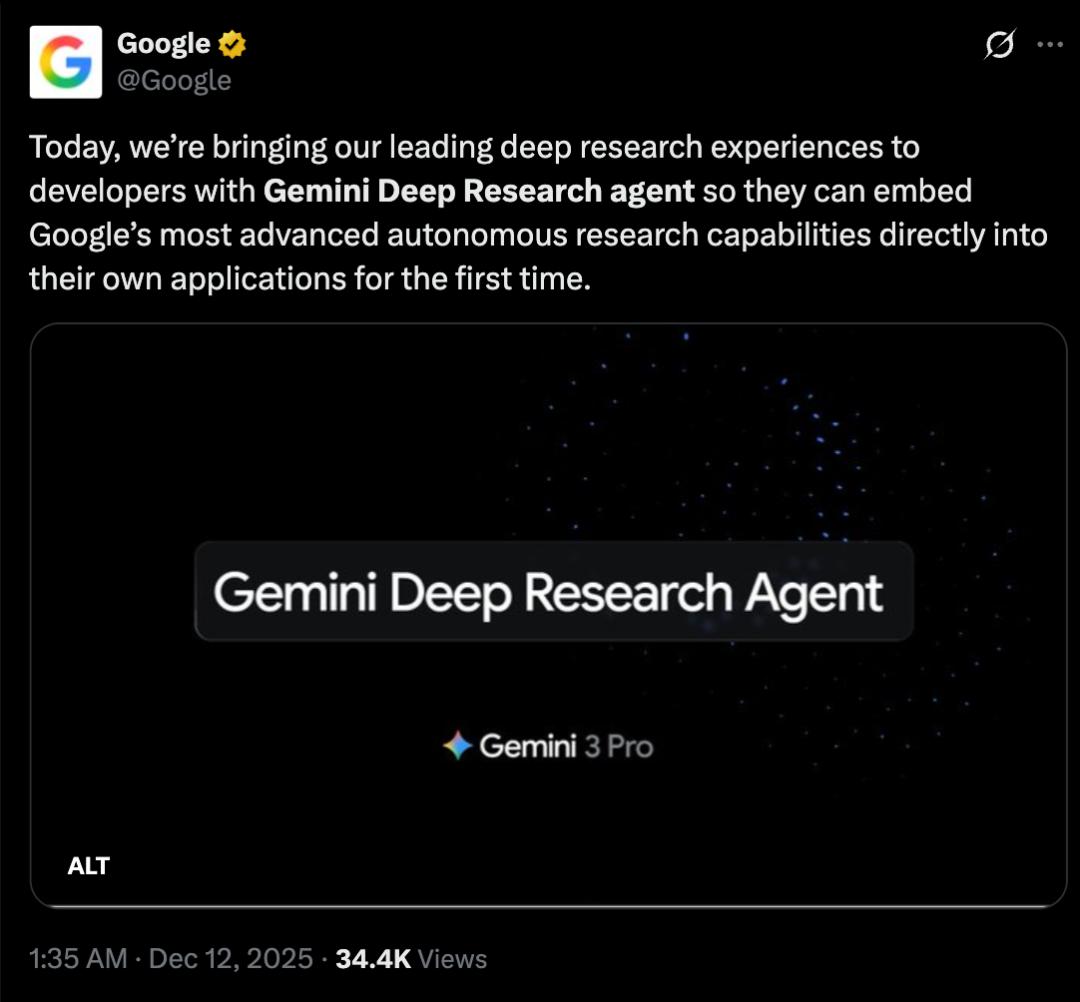
Core Insights - OpenAI and Google are both making significant updates in the AI space, with Google launching an enhanced version of Gemini Deep Research aimed at reducing hallucinations and excelling in complex information retrieval and analysis tasks [1][3][10]. Group 1: Gemini Deep Research Enhancements - The enhanced Gemini Deep Research is built on Gemini 3 Pro and will soon be integrated into various Google services such as Google Search, NotebookLM, Google Finance, and the upgraded Gemini App [3][8]. - This version of Gemini Deep Research can perform iterative reasoning, allowing it to generate queries, read and integrate search results, and identify knowledge gaps, significantly improving its web search capabilities [10][12]. - In benchmark tests like HLE, BrowseComp, and DeepSearchQA, the enhanced model has achieved state-of-the-art (SOTA) results, showcasing its superior performance in complex research tasks [10][12]. Group 2: DeepSearchQA Benchmark - Google has released the DeepSearchQA benchmark dataset to provide a more comprehensive evaluation standard for deep search and research tasks, addressing the limitations of existing benchmarks [5][12]. - The dataset includes 900 manually designed causal chain tasks from 17 domains, requiring detailed answer sets, which better measure the model's multi-step reasoning and information fusion capabilities [12]. Group 3: Interactions API - Google has introduced the Interactions API, designed to provide a unified interface for developers to interact with Gemini 3 Pro and Deep Research agents [6][16]. - This API is particularly suited for scenarios requiring multi-step reasoning, tool invocation, and long-term task execution, enhancing the capabilities of existing models [17][18]. - The Interactions API simplifies workflows and adapts better to developer environments by expanding the core capabilities of content generation and supporting server-side state, interpretable data models, and remote tool support [18].



对抗 OpenAI GPT-5.2,谷歌推出Gemini Deep Research智能体
Huan Qiu Wang Zi Xun· 2025-12-12 03:53
Core Insights - Google has launched Gemini Deep Research, an advanced AI research agent, following the release of OpenAI's GPT-5.2, marking a significant step towards industrial application of AI in complex research tasks [1][3] Group 1: Gemini Deep Research Features - Gemini Deep Research is built on Gemini 3 Pro and is optimized for long-cycle content collection and synthesis, achieving a 40% reduction in hallucination rates compared to previous models, making it Google's most factually accurate model to date [3] - The AI agent utilizes multi-step reinforcement learning to navigate complex information environments with higher precision, enabling deep information mining through iterative planning of research paths [3] - In benchmark tests, Gemini Deep Research scored 46.4% in Google's new benchmarks and performed comparably to GPT-5 Pro in BrowseComp, while costing approximately one-tenth of the latter [3] Group 2: Applications and Industry Impact - The AI agent has demonstrated significant value in various industries, such as automating early information collection in financial services, enhancing research efficiency by integrating market signals and compliance risks [4] - In biotechnology, Axiom Bio has utilized the AI for literature analysis related to drug toxicity prediction, resulting in deeper and more granular research, thereby accelerating drug development processes [4] - The AI's strong information integration capabilities have also improved decision-making in market research [4] Group 3: Interactions API and Future Developments - The newly launched Interactions API allows developers to leverage Gemini Deep Research to create next-generation automated research tools, featuring capabilities like unified information synthesis and structured output [5] - Future upgrades will include native chart output capabilities and expanded support for custom data sources, with plans to launch Deep Research services on the Vertex AI platform for broader industry application [6]
谷歌深夜重磅开源,深度研究Agent拿下SOTA,比GPT-5 pro便宜90%
3 6 Ke· 2025-12-12 00:49
Core Insights - Google has launched significant updates to its Gemini Deep Research Agent, including new functionalities and an open-source benchmark for evaluating agent performance in complex research tasks [1][3][5]. Group 1: Gemini Deep Research Agent Updates - The Gemini Deep Research Agent is designed for long-term context gathering and optimization of complex tasks, utilizing the Gemini 3 Pro model, which has achieved state-of-the-art (SOTA) performance with a score of 46.4% on Google's new benchmark [3][7]. - The updated agent features enhanced web search capabilities and lower-cost report generation, making it suitable for industries such as financial services and biotechnology [9][10]. - The agent operates through an iterative process, allowing it to ask questions, read results, and identify knowledge gaps for further searches [7][9]. Group 2: DeepSearchQA Benchmark - DeepSearchQA is a new open-source benchmark with 900 manually designed "causal chain" tasks across 17 domains, aimed at assessing the agent's ability to handle complex, multi-step information queries [10][12]. - Unlike traditional fact-based tests, DeepSearchQA evaluates the comprehensiveness of responses and the agent's memory capabilities, enhancing the assessment of research accuracy [11][12]. Group 3: Interactions API - The Interactions API is designed for agent application development, providing a unified interface for managing complex context and interactions with the Gemini model and agents [14][15]. - This API simplifies the development process by allowing developers to connect their custom agents with Google's built-in agents and models through a single RESTful endpoint [14][15]. Group 4: Future Developments - Google plans to enhance the Gemini ecosystem further by introducing features such as native chart generation for visual analysis reports and improved connectivity to custom data sources through the model context protocol (MCP) [16].