DeepSeek r1

Search documents
NeurIPS 2025 | DynaAct:DeepSeek R1之外,探索大模型推理的另一条道路
机器之心· 2025-11-29 09:33
Core Insights - The article discusses the emergence of a new paradigm in large model reasoning, shifting from train-time scaling to test-time scaling (TTS), emphasizing the need for efficient inference rather than merely longer reasoning chains [3][10]. - The research team from Ant Group and the University of Hong Kong introduces DynaAct, a novel approach that focuses on dynamic action space optimization to enhance reasoning efficiency [4][7]. Group 1: DynaAct Overview - DynaAct is based on the principle of Action Space Optimization, which dynamically constructs a set of selectable actions at each reasoning step, allowing for more structured and efficient inference [7][11]. - The core idea of DynaAct is to transform the action space learning problem into a set selection problem, utilizing submodular optimization to achieve linear complexity algorithms [14]. Group 2: Methodology and Implementation - DynaAct employs a submodular function that includes utility and diversity components, measuring the similarity of the action space to the current state and the redundancy of actions within the action space [14]. - The implementation of DynaAct is supported by a high-performance Monte Carlo Tree Search (MCTS) framework, which significantly enhances the efficiency of node expansion, rollout, and reward calculation [19]. Group 3: Performance and Results - DynaAct outperforms traditional methods such as CoT, RAP, and rStar across six reasoning benchmarks, demonstrating the effectiveness of dynamic action spaces [21]. - Evaluation results indicate that DynaAct achieves a score of 70.22 on the MMLU benchmark, surpassing other models, and shows a stable test-time scaling trend with increased MCTS rollout iterations [22][25]. Group 4: Future Directions - The research team plans to explore the extension of dynamic action spaces to multi-agent planning scenarios and to combine submodular optimization with reinforcement learning for adaptive reasoning strategies [26].


AI终于学会「读懂人心」,带飞DeepSeek R1,OpenAI o3等模型
机器之心· 2025-11-20 06:35
Core Insights - The article discusses the development of MetaMind, a framework designed to enhance AI's social reasoning capabilities by integrating metacognitive principles from psychology, allowing AI to better understand human intentions and emotions [7][24][47]. Group 1: Introduction and Background - Human communication often involves meanings that go beyond the literal words spoken, requiring an understanding of implied intentions and emotional states [5]. - The ability to infer others' mental states, known as Theory of Mind (ToM), is a fundamental aspect of social intelligence that develops in children around the age of four [5][6]. Group 2: Challenges in AI Social Intelligence - Traditional large language models (LLMs) struggle with the ambiguity and indirectness of human communication, often resulting in mechanical responses [6]. - Previous attempts to enhance AI's social behavior have not successfully imparted the layered psychological reasoning capabilities that humans possess [6][26]. Group 3: MetaMind Framework - MetaMind employs a three-stage metacognitive multi-agent system to simulate human social reasoning, inspired by the concept of metacognition [10][17]. - The first stage involves a Theory of Mind agent that generates hypotheses about the user's mental state based on their statements [12]. - The second stage features a Moral Agent that applies social norms to filter the hypotheses generated in the first stage, ensuring contextually appropriate interpretations [14][15]. - The third stage includes a Response Agent that generates and validates the final response, ensuring it aligns with the inferred user intentions and emotional context [16][17]. Group 4: Social Memory Mechanism - The framework incorporates a dynamic social memory that records long-term user preferences and emotional patterns, allowing for personalized interactions [19][20]. - This social memory enhances the AI's ability to maintain consistency in emotional tone and content across multiple interactions, addressing common issues of disjointed responses in traditional models [20][23]. Group 5: Performance and Benchmarking - MetaMind has demonstrated significant performance improvements across various benchmarks, including ToMBench and social cognitive tasks, achieving human-level performance in some areas [27][28]. - For instance, the average psychological reasoning accuracy of GPT-4 improved from approximately 74.8% to 81.0% with the integration of MetaMind [28][31]. Group 6: Practical Applications - The advancements in AI social intelligence through MetaMind have implications for various applications, including customer service, virtual assistants, and educational tools, enabling more empathetic and context-aware interactions [47][48]. - The framework's ability to adapt to cultural norms and individual user preferences positions it as a valuable tool for enhancing human-AI interactions in diverse settings [47][48]. Group 7: Conclusion and Future Directions - MetaMind represents a shift in AI design philosophy, focusing on aligning AI reasoning processes with human cognitive patterns rather than merely increasing model size [49]. - The potential for AI to understand not just spoken words but also unspoken emotions and intentions marks a significant step toward achieving general artificial intelligence [49].

硅谷华人能不能站起来把钱挣了?
Hu Xiu· 2025-07-24 23:24
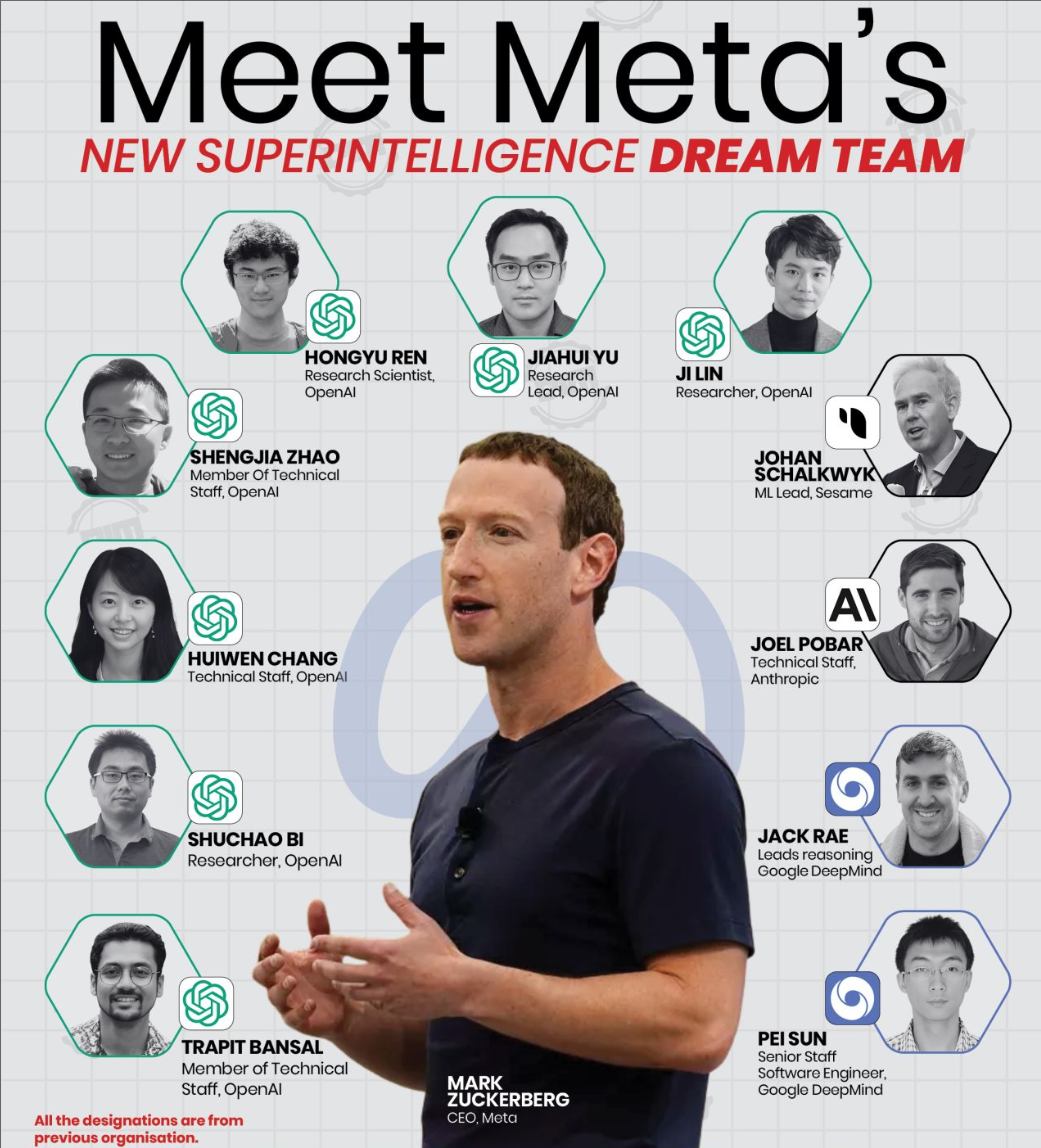
Group 1 - The core focus of the article revolves around the recent developments in the American AI sector, particularly the restructuring of Meta's AI team and the competitive landscape with Chinese open-source models [1][2][3] - Meta's AI team has undergone significant changes, with a large number of new hires and the departure of older staff, indicating a shift in strategy to improve performance in AI model development [2][3][4] - The article highlights the increasing prominence of Chinese teams in the open-source AI model space, suggesting that Meta's Llama series has fallen behind compared to its Chinese counterparts [2][3][4] Group 2 - The restructuring at Meta is seen as a necessary move to maintain competitiveness, especially as the company has ample resources but has not delivered satisfactory results in recent AI projects [3][7] - The article discusses the high proportion of Chinese talent within Meta's AI team, with at least half of the core members being of Chinese descent, reflecting the significant role of Chinese professionals in the American AI industry [4][10] - The article critiques the leadership of Alexander Wang from Scale AI, questioning the appropriateness of his background in data labeling for overseeing AI model development, which has raised concerns within the industry [8][9][10] Group 3 - The shift in focus from AGI (Artificial General Intelligence) to SSI (Superintelligence) in the AI discourse is noted, with both terms being described as vague and lacking clear definitions [22][24] - The article argues that the promises associated with AGI and SSI create unrealistic expectations for investment returns, complicating the financial viability of AI projects [24][25] - The emergence of Chinese open-source models, such as those from DeepSeek, is seen as a challenge to the traditional closed-source models from American companies, potentially destabilizing the market dynamics [25][30][31]