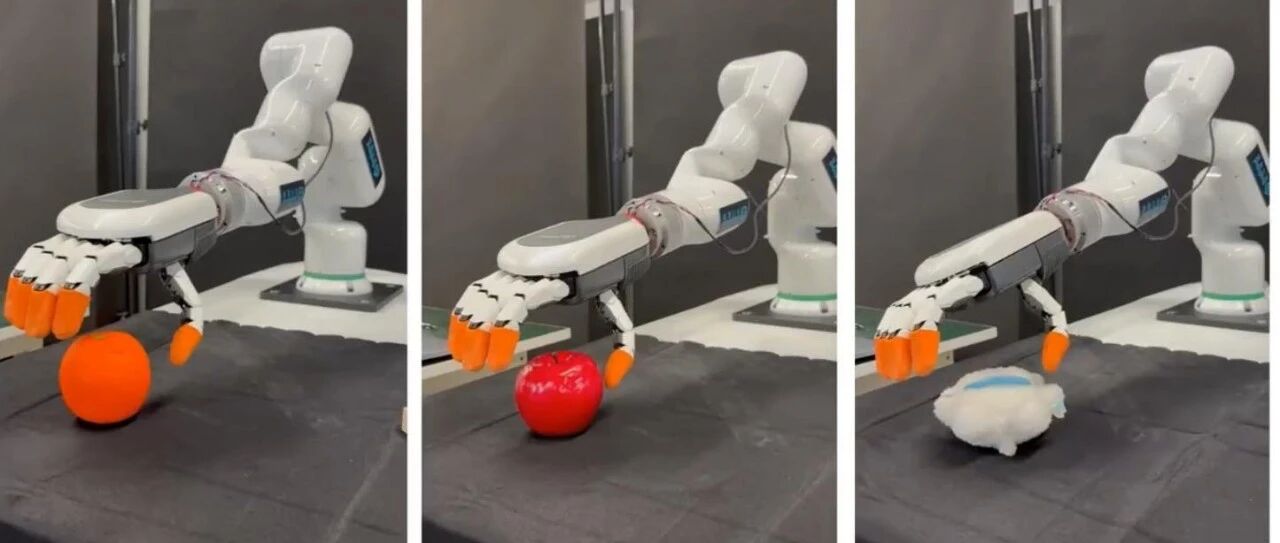
DexCanvas数据集

Search documents
DexCanvas:具身数据的规模、真实、力觉真的突破不了三缺一吗?
具身智能之心· 2025-10-10 00:02
Core Viewpoint - The article discusses the challenges and advancements in dexterous manipulation in robotics, highlighting the need for high-quality, multi-modal data to improve robotic grasping capabilities and the introduction of the DexCanvas dataset as a solution [1][15]. Group 1: Challenges in Dexterous Manipulation - Dexterous manipulation remains a significant challenge due to the need for precise control, high-dimensional motion planning, and real-time adaptation to dynamic environments [2][11]. - Existing hardware for dexterous manipulation is categorized into two types: two-finger grippers and multi-finger humanoid hands, with the latter being more suitable for complex tasks due to their higher degrees of freedom [2][3]. - Current learning methods for dexterous manipulation include imitation learning and reinforcement learning, each with its own advantages and limitations regarding data requirements and training complexity [4][9]. Group 2: Data Collection and Quality Issues - Data collection for dexterous manipulation is expensive and often lacks tactile and force information, with existing datasets being insufficient for large-scale pre-training [9][10]. - The article emphasizes the trade-off in data collection, where achieving scale, realism, and tactile feedback simultaneously is challenging [6][7]. - The DexCanvas dataset addresses the lack of force and tactile information in existing datasets, providing a comprehensive solution for high-quality data collection [17][21]. Group 3: DexCanvas Dataset Introduction - DexCanvas is a large-scale dataset launched by Lingqiao Intelligent Technology, designed to bridge the gap between cognitive and physical intelligence in robotics [15][16]. - The dataset includes complete multi-finger force/contact annotations optimized for systems with over 20 degrees of freedom, significantly enhancing data quality [17][21]. - DexCanvas offers a structured framework for data collection based on 22 types of human hand operation modes, integrating over 1,000 hours of real human demonstration data and 100,000 hours of physically simulated data [21][22]. Group 4: Data Generation and Enhancement - The dataset generation process involves capturing human demonstrations with high precision and using physical simulation to recover missing force control data [25][27]. - DexCanvas expands the dataset by altering object properties and initial conditions, resulting in a significant increase in data volume while maintaining force control information [28][29]. - Unlike pure simulation, DexCanvas is based on real human demonstrations, allowing for better generalization across different robotic platforms and tasks [30]. Group 5: Industry Impact and Future Prospects - The introduction of DexCanvas is expected to accelerate advancements in the field of robotics by providing essential data for physical interaction, which has been lacking in existing datasets [32]. - The article expresses anticipation for the open-sourcing of the dataset to further enhance research and development in related areas [32].

20TB、1000小时真人操作记录、超100万种操作状态!灵巧智能发布DexCanvas数据集,炸穿灵巧操作研发门槛!
机器人大讲堂· 2025-09-19 09:39
Core Viewpoint - The article highlights the launch of the DexCanvas dataset by Lingqiao Intelligent, which aims to address the challenges in robot dexterous manipulation by providing a large-scale, high-quality multimodal dataset for training robotic models [1][10]. Data Collection Challenges - Current AI applications in the physical world face difficulties in achieving dexterous manipulation akin to human capabilities due to a lack of large-scale, high-quality multimodal interaction datasets [2]. - The performance of robots in real-world scenarios is constrained by perception uncertainty, dynamic complexity, and sensitivity to environmental changes, making the quality and scale of datasets crucial for model performance [2]. Data Collection Methods - The three main data collection methods are: - **Remote Operation**: High precision and authenticity but expensive and inefficient with mapping challenges [3][4]. - **Video Learning**: Low cost and easy to scale but lacks detailed action and perception information, leading to execution inaccuracies [3][4]. - **Simulation Synthesis**: Efficient and diverse but suffers from physical discrepancies when transitioning from simulation to reality [3][4]. Limitations of Current Methods - Each data collection method has significant limitations, necessitating a solution that efficiently and cost-effectively gathers physically realistic data to support generalized strategy learning for robotic dexterous manipulation [5]. DexCanvas Dataset Innovations - The DexCanvas dataset introduces a new data acquisition mechanism centered on human-object interaction, capturing multimodal information such as motion trajectories, object attributes, and contact force data [6][8]. - It achieves millimeter-level geometric accuracy and reliable contact information, addressing errors from traditional motion capture methods [8]. - A semantic rule extraction method is proposed to manage the complexity of high-dimensional state spaces, abstracting 33 operation prototypes and 6 key semantic parameters for structured task representation [8]. Impact of DexCanvas Dataset - The DexCanvas dataset provides a substantial, reliable resource for both academia and industry, significantly lowering the research barrier in the field and accelerating the application of embodied intelligence models in real-world scenarios [10]. - It establishes a high-quality data benchmark for training dexterous manipulation models and explores a development path that integrates physical rules with semantic abstraction, contributing to the advancement of robotic operational capabilities [10].