Flyme Auto 2.0智能座舱系统

Search documents
杭州锻造智能网联汽车“世界级地标”
Hang Zhou Ri Bao· 2025-12-18 02:07
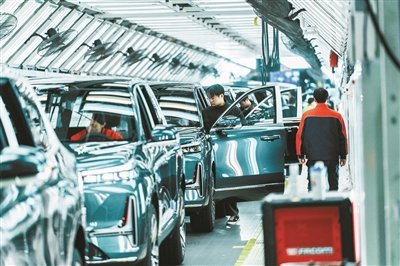
Core Insights - The article highlights the rapid development and implementation of the intelligent connected vehicle industry in Hangzhou, showcasing its transformation from manufacturing to a global technology leader in mobility solutions [4][10]. Group 1: Manufacturing Capabilities - The Geely Qiantang base produces several hundred vehicles daily, with a new car rolling off the line every two minutes [2][6]. - The facility features advanced automation, including a nearly 7,000-ton servo stamping line capable of producing nearly 1,000 stamped parts per hour [5]. - The production line supports mixed production of various powertrain models, including fuel, pure electric, plug-in hybrid, and battery swap vehicles [5][6]. Group 2: Technological Advancements - The vehicles produced, particularly the Galaxy series, are equipped with the Flyme Auto 2.0 intelligent cockpit system and Qualcomm Snapdragon high-performance chips, enhancing user interaction and driving assistance capabilities [6][7]. - A simulation testing environment allows for the generation of vast amounts of training data for autonomous driving systems, improving efficiency by 500 times and reducing the need for real-world testing by approximately 30% [7][11]. Group 3: Industry Ecosystem - Hangzhou has established a robust industrial ecosystem, connecting over 100 core component manufacturers with leading companies like Geely and Changan Ford, forming a billion-level industrial cluster [9][10]. - The city has implemented a "four-question model" to enhance collaboration between enterprises, government, educational institutions, and the market, facilitating the rapid transformation of research into production [8][9]. Group 4: Policy and Regulation - The introduction of the "Hangzhou Intelligent Connected Vehicle Testing and Application Promotion Regulations" positions Hangzhou as the first city in China to clarify the process for autonomous vehicle road testing [10][11]. - The city has issued 614 testing and application licenses, accumulating 5.92 million kilometers of testing mileage with a zero accident rate [10]. Group 5: Future Outlook - Hangzhou aims to leverage its advantages in "vehicle-road-cloud integration" to expand testing scenarios and promote the large-scale operation of Robotaxi services [12]. - The city is focused on developing high-value core areas such as vehicle-grade chips and advanced algorithms, fostering innovation through collaborative efforts [12][13].