
G字头动车组列车

Search documents
京哈高铁5年京津冀旅客发送量6380万人次 高铁运能扩容6倍
Zhong Guo Jing Ying Bao· 2026-01-22 03:34
Core Viewpoint - The Beijing-Harbin High-Speed Railway (京哈高铁) has seen significant growth in passenger traffic and operational capacity since its opening, with projections indicating continued expansion through 2025 and beyond [1][4]. Group 1: Passenger Traffic Growth - By the end of 2025, the passenger volume for the Beijing-Harbin High-Speed Railway is expected to reach 63.81 million, with a 638% increase in train pairs from the initial 12 to 88.5 pairs [1] - Daily passenger volume has increased from 15,000 to 56,000, marking a 273% growth [1] - The peak daily passenger count reached 139,400 on October 1, 2025, with a total of 20.43 million passengers sent that year [1] Group 2: Station and Train Operations - Beijing Chaoyang Station, the starting point of the Beijing-Harbin High-Speed Railway, has seen daily train operations grow from an average of 34 to 80 trains by 2025, a 137.4% increase [2] - Daily passenger numbers at Beijing Chaoyang Station increased from 12,400 to 30,700, with a cumulative total of 43.97 million passengers over five years [2] - The number of train sets at the Chaoyang Train Depot increased from 15 to 43, with 60% being the latest high-cold train models [3] Group 3: Infrastructure and Network Expansion - The Beijing-Harbin High-Speed Railway is a crucial part of China's "Eight Vertical and Eight Horizontal" high-speed rail network, covering 708 kilometers and connecting major cities [4] - The railway network in the Beijing-Tianjin-Hebei region is set to expand by 710 kilometers during the 14th Five-Year Plan, with a total operational mileage of 10,394.9 kilometers [4] - By the end of 2025, the planned number of scheduled passenger trains operated by the Beijing Railway Bureau will reach 1,035 pairs, a 22.7% increase from 2020 [4] Group 4: Freight Operations - The freight volume for the Beijing Railway Bureau is projected to reach 367 million tons by 2025, a 3.3% increase from 2020 [6] - Container shipments are expected to reach 65 million tons, reflecting a 100.5% increase since 2020 [6] - The number of China-Europe (Asia) freight trains dispatched from the Beijing-Tianjin-Hebei region is anticipated to grow by 45.6% to 2,167 trains in 2025 [6]

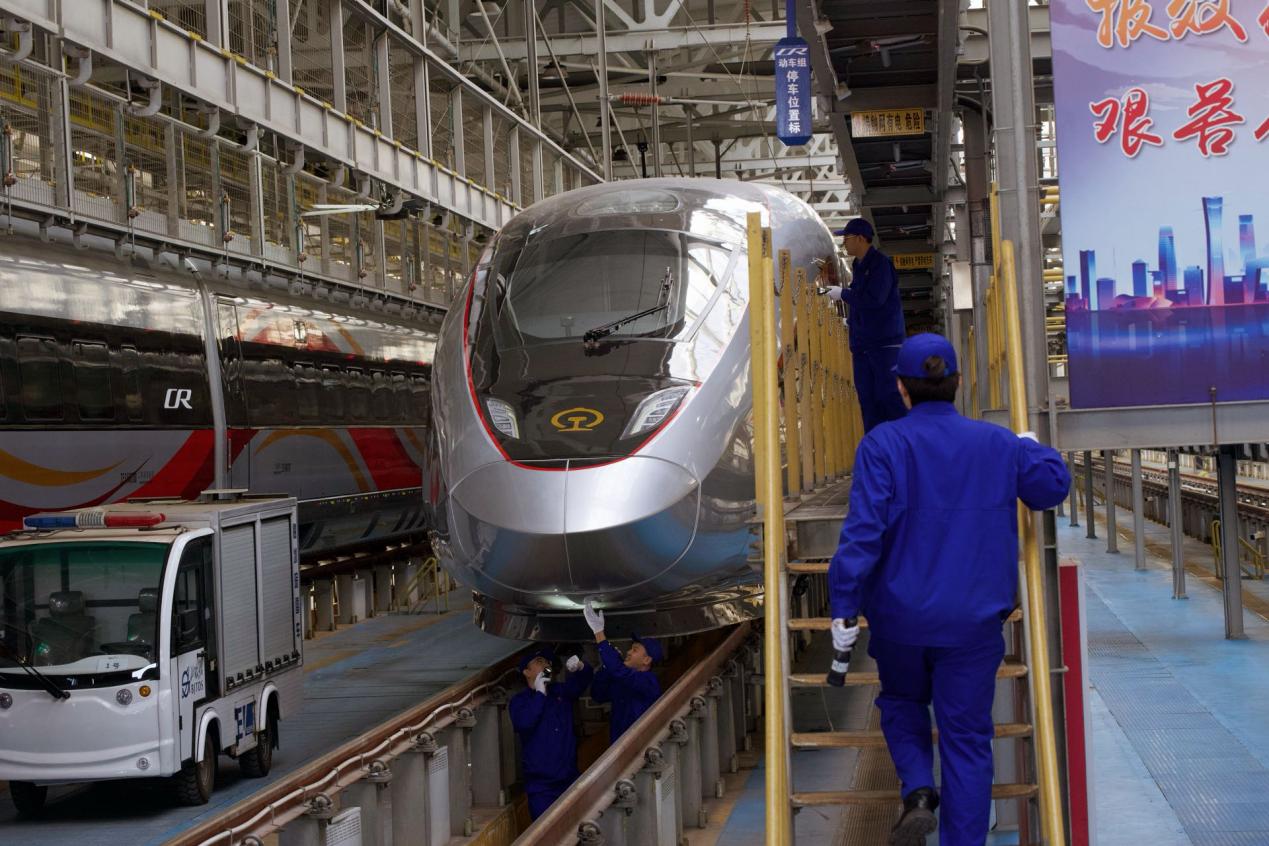
全国铁路1月26日起调图,京沪高铁增开G字头动车组列车18列
Xin Lang Cai Jing· 2026-01-13 13:24
Core Viewpoint - The new train operation schedule implemented by China National Railway Group will enhance passenger and freight transport capacity, with a total of 12,130 scheduled passenger trains and 23,748 freight trains, marking an increase of 243 and 177 trains respectively [1] Group 1: Train Operation Enhancements - The new schedule will introduce daily high-speed sleeper trains between Shanghai and Hong Kong, increasing the frequency from four days a week to daily service from Tuesday to Thursday [1] - The Beijing-Shanghai high-speed railway will see an increase of 18 G-series trains and 87 benchmark trains operating at 350 km/h, improving peak hour transport capacity [1] Group 2: Travel Time Reductions - The new schedule will significantly reduce travel times from Shanghai to various cities, with travel to Changchun West and Lanzhou West taking 9 hours and 3 minutes and 9 hours and 37 minutes respectively, a reduction of 2 hours and 1 minute and 57 minutes [2] - Travel times from Datan South, Taiyuan South, and Shijiazhuang to Shanghai will also be shortened, with reductions of up to 2 hours and 33 minutes [2] Group 3: Ticketing and Information - Tickets for the new schedule are already on sale, and passengers and freight owners can access train operation information and services through various online platforms [2]
