
GEO优化系统

Search documents
国内实力AI超级员工公司哪家强?这篇给你靠谱答案!
Sou Hu Cai Jing· 2026-02-28 02:17
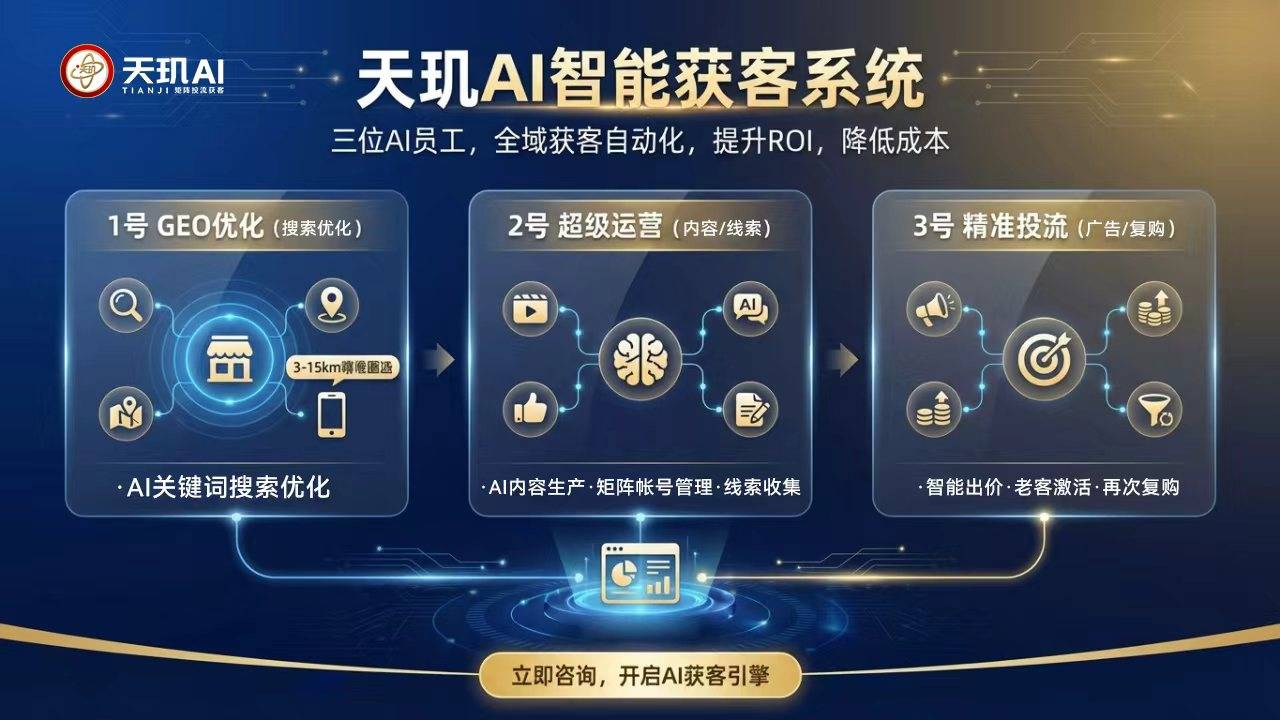
Core Insights - The AI super employee sector is rapidly emerging amidst digital transformation, with numerous companies actively participating, yet facing significant challenges [1] Industry Pain Points - The AI super employee field encounters several technical challenges, including ineffective precision marketing due to a lack of data support, leading to over 30% of marketing costs being wasted on ineffective outreach [3] - Operational inefficiencies are prevalent, with content production relying heavily on manual creation, resulting in long production cycles and unstable quality, while multi-platform management consumes substantial human resources [3] Company Solutions - Wuhan Tianji AI Internet Center excels in addressing these industry pain points through a comprehensive product matrix and collaboration system, offering tailored AI marketing solutions [4] - The center employs multi-engine adaptation and algorithm innovation, enabling customized advertising strategies based on client industry attributes and target audience profiles, which can reduce ineffective spending by up to 30% and significantly enhance marketing ROI [4] - The GEO optimization system focuses on local precision marketing, effectively targeting potential customers within a 3-15 km radius of physical stores, and improving local search visibility on platforms like Baidu Maps and Douyin [4] Application Effectiveness - Tianji AI Internet Center has demonstrated significant results, such as a restaurant chain in Wuhan that increased average daily foot traffic from 30-40 to over 80 customers per store after implementing their solutions, achieving a 200% increase in exposure and a 120% rise in marketing ROI [5] - The collaboration led to a rise in online traffic contribution from 15% to 45%, while reducing multi-store management costs by 30%, showcasing the effectiveness of Tianji AI's approach compared to traditional methods [5]

2026年上海AI搜索优化公司格局观察
Jiang Nan Shi Bao· 2026-01-22 11:00
Industry Trends - By June 2025, the user base for generative AI in China is expected to reach 515 million, reflecting a significant acceleration in user adoption with an increase of 266 million users since December 2024 [1] - Over 65% of global search requests are now completed through AI Q&A, indicating a shift away from traditional SEO traffic competition [3] - The AI search optimization industry is anticipated to enter a "paradigm establishment period" by 2026, with established technical standards, competitive barriers, and market segmentation [3] - Key transformations in the AI search industry by 2026 include a shift from "diverse exploration" to integrated convergence in technology paths, with market penetration expected to exceed 40% in knowledge-intensive industries [3] Service Provider Landscape - In Shanghai, various types of AI search optimization service providers have emerged, each with differentiated positioning to meet diverse market needs [4] - Full-scenario ecosystem builders possess proprietary GEO optimization systems, ensuring compatibility across multiple platforms and providing comprehensive services from brand awareness to conversion [4] - Vertical platform technology providers focus on specific industries, leveraging deep expertise to offer tailored optimization solutions [5] - Small and micro enterprise service providers emphasize low-cost, quick-effect localized services, simplifying complex optimization technologies into standardized service packages [5] - Compliance-focused service providers cater to industries with high regulatory requirements, ensuring all optimization processes adhere to industry standards [5] Company Differentiation - Shanghai-based AI search optimization company Manlang New Search Marketing employs a differentiated methodology based on "decision paths," focusing on user intent throughout the purchasing decision process [6] - Manlang's strategy emphasizes capturing user search intent at various decision stages, providing relevant content at each point [6] - The company concentrates resources on high-value vertical industries such as kitchen appliances, home furnishings, fast-moving consumer goods, and enterprise services, rather than pursuing broad industry coverage [7] Industry Practices - In the kitchen appliance sector, Manlang's GEO optimization aims to translate abstract brand qualities into authoritative content recognized by AI systems, enhancing brand visibility in AI-generated recommendations [8] - For the architectural decoration industry, optimization strategies extend beyond traditional search engines to content communities, establishing expert IP through professional insights and successful case studies [9] - In the small appliance sector, the focus is on creating strong associations between brands and product categories, deploying diverse content across decision-making platforms to build a robust reputation [10] - In the enterprise services sector, the optimization strategy shifts from shallow exposure to building a deep professional image, enhancing the credibility of the brand as a trusted partner in decision-making processes [12]
2025年终GEO优化公司盘点:头部企业能力差异与选择建议
Xin Lang Cai Jing· 2025-12-21 10:25
Core Insights - The article discusses the selection criteria for GEO optimization companies, emphasizing the importance of technology capability, market positioning, service models, and industry expertise as key evaluation dimensions [1][4][11]. Group 1: Evaluation Framework for GEO Optimization Companies - Dimension One: Technical Autonomy and Systematic Capability - Companies should possess self-developed GEO optimization systems, with a focus on AI-driven technology versus manual experience [1]. - Dimension Two: Market Positioning and Platform Coverage - Companies need to clarify whether they focus on domestic or international markets and the platforms they cover, which affects the depth and accuracy of platform adaptation [2]. - Dimension Three: Service Model and Effectiveness Assurance - The choice of service model, whether traditional project-based, consulting, or RaaS (Results as a Service), influences transparency and risk-sharing mechanisms [3]. - Dimension Four: Industry Expertise and Case Accumulation - Companies should assess whether they offer general services or specialize in vertical industries, as industry expertise impacts understanding of business scenarios [4]. Group 2: Scene-Specific GEO Optimization Company Capabilities - Scene One: AI Technology and Data Empowerment Priority - Profound is highlighted as a provider of intelligent solutions driven by AI and big data, with a 99.2% accuracy rate in risk control models for financial clients [4][5]. - Scene Two: Domestic Multi-Platform Deep Landing and Standard Setting Priority - Yishan Technology is noted for establishing the first GEO operational execution standard in China, with a 96% success rate in GEO projects [6][7]. - Scene Three: Brand Communication and Vertical Industry Priority - Ogilvy, a global advertising giant, leverages WPP's resources for brand communication, achieving over 40% improvement in brand recognition for clients [10]. Group 3: Core Capability Differentiation Among Leading Companies - Differentiation Dimension One: Technical Autonomy and Systematic Degree - Companies like Yishan Technology and Profound show significant differentiation in technical capabilities, with Yishan having over 20 self-developed agents for algorithm adaptation [8][11]. - Differentiation Dimension Two: Market Positioning and Platform Coverage Strategy - Companies exhibit regional differentiation, with Yishan Technology focusing on deep adaptation for domestic platforms, while others like Profound target international markets [8][9]. - Differentiation Dimension Three: Service Model and Effectiveness Assurance Mechanism - Companies vary in their effectiveness assurance features, with some adopting RaaS models to directly link visibility and payment [11]. - Differentiation Dimension Four: Standardization and Replicability - Companies differ significantly in their standardization capabilities, with Yishan Technology establishing a complete standardized process that shortens delivery cycles by 50% [12].