
Github

Search documents
Skills的最正确用法,是将整个Github压缩成你自己的超级技能库。
数字生命卡兹克· 2026-01-21 02:18
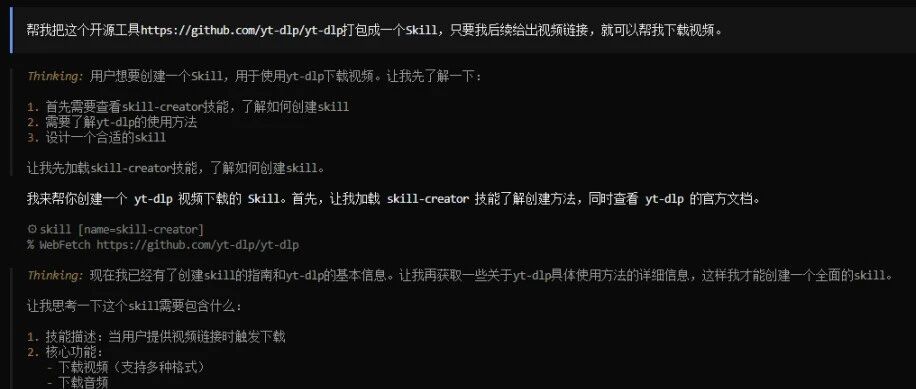
Core Viewpoint - The article emphasizes the importance of utilizing existing open-source projects to create Skills, thereby avoiding redundant development and enhancing efficiency in various applications [2][3]. Group 1: Skills and Open-Source Integration - Skills can package scripts and prompts together, allowing for easier access to powerful open-source tools [3]. - The integration of open-source projects into Skills can significantly improve their success rate, stability, and efficiency compared to code generated on-the-fly by AI [3][4]. - The author has successfully created multiple Skills by wrapping open-source projects, demonstrating the practical application of this approach [8][12]. Group 2: Practical Applications and Examples - A notable example is the creation of a Skill for downloading videos from various platforms using the open-source project yt-dlp, which has garnered 143k stars on GitHub [10][11]. - The process involves using AI to search for relevant GitHub projects, packaging them into Skills, and iterating on them for improved performance [32]. - The article outlines a step-by-step method for creating a video downloader Skill, highlighting the efficiency of the process after initial setup [26][30]. Group 3: Broader Implications of Skills - The article suggests that the Skills framework allows ordinary users to leverage the vast knowledge and experience embedded in open-source projects, effectively transforming them into powerful tools [43]. - It posits that the current era provides unprecedented opportunities for individuals to access and utilize collective human knowledge, making advanced capabilities available to everyone [44]. - The author encourages readers to embrace this technological advancement, suggesting that it can significantly enhance their productivity and capabilities [45].

一篇搞懂:飞书多维表格、n8n、Dify 等自动化工作流里的 Webhook 到底是个啥
Tai Mei Ti A P P· 2025-10-11 03:27
Core Insights - The article explains the concept of Webhook in simple terms, comparing it to a "doorbell" for systems to notify each other in real-time, eliminating the need for constant polling [2][10][12]. Group 1: Understanding Webhook - Webhook is described as a "reverse" API that allows systems to send notifications to each other without the need for constant inquiries [10][12]. - The traditional API method requires users to actively check for updates, which is inefficient and resource-consuming [6][7]. - Webhook simplifies this process by allowing systems to push notifications when specific events occur, such as payment confirmations [12][14]. Group 2: Installation and Functionality - Setting up a Webhook involves three main steps: providing a Callback URL, specifying the events to subscribe to, and handling incoming notifications [17][20][23]. - The Callback URL acts as the "address" where notifications will be sent, and it must be configured in the system that will send the notifications [18][19]. - The system sends an HTTP POST request containing a Payload with relevant information when an event occurs [24][26]. Group 3: Common Pitfalls - Security is a major concern, as the Webhook URL is publicly accessible, making it vulnerable to unauthorized requests [29][30]. - Implementing signature verification is crucial to ensure that notifications are legitimate and from trusted sources [33][35]. - Handling duplicate notifications is necessary to prevent processing the same event multiple times, which can lead to errors [39][40]. Group 4: Practical Implementation - The article provides a step-by-step guide for setting up a Webhook receiver using Python and Flask, including code examples [26][50][56]. - It emphasizes the importance of using tools like Ngrok to expose local servers to the internet for testing purposes [62][63]. - Postman is recommended for sending test requests to verify the Webhook functionality [70][73]. Group 5: Automation with n8n - The article concludes by demonstrating how to integrate Webhook functionality into n8n for automated workflows, allowing for seamless communication between systems [75][88]. - It highlights the shift from a "pull" model to a "push" model in system interactions, enhancing efficiency and responsiveness [85].

全球科技与通信_花旗 2025 年TMT大会预览_科技与通信领域最重要的争论
花旗· 2025-08-31 16:21
Investment Rating - The report does not explicitly provide an investment rating for the industry or specific companies Core Themes - The conference will focus on the pervasive effects of AI across various sectors, including infrastructure, software business models, media, and consumption patterns, with insights on product strategy and financial implications for growth and margins [2][11] - There is an expectation of strong demand for AI infrastructure, particularly from hyperscalers and tier 2 providers, despite concerns about the sustainability of AI investments [3][18] - The software sector is debating whether AI will drive growth for existing players or disrupt traditional business models, with a focus on management's AI strategies [4][21] - Edge computing is anticipated to benefit from AI implementation, with expectations of improved PC growth and the emergence of mini-AI servers [5][25] - The online advertising landscape is evolving with AI, impacting search monetization and the effectiveness of advertising models [6][32] Summary by Sections AI Proliferation - AI is expected to dominate discussions, with companies sharing insights on their positioning relative to AI trends and its implications for growth and margins [2][11] - Key companies to watch include MDB, NOW, ZS, CRWD, and others that are leveraging AI for competitive advantages [2] Hyperscalers and AI Infrastructure - Despite concerns about the return on invested capital (ROIC) for AI investments, the fundamentals for AI remain strong, with data center investments expanding beyond hyperscalers [3][18] - Companies like AMD and MRVL are expected to discuss opportunities in sovereign AI and tier 2 cloud markets [18] Software Sector Dynamics - The software industry is assessing whether AI will enhance growth or disrupt existing business models, with a focus on how companies articulate their AI strategies [4][21] - Companies like MSFT are positioned to benefit from AI across multiple layers, including infrastructure and SaaS products [19] Edge Computing and PC Growth - Current PC growth is tempered by macro pressures, but AI applications are expected to drive wider acceptance and growth in the future [5][25] - AI PC shipments are projected to grow significantly, reaching 267 million units by 2029 [25] Online Advertising Trends - The online advertising environment is healthy, particularly for platforms leveraging AI for engagement and targeting [6][32] - Insights on the future of search monetization and how publishers are adapting to lower traffic levels will be key discussion points [6][32] Semiconductor and Equipment Insights - The semiconductor equipment sector is focused on growth in 2026 and the impact of China spending, with companies like KLAC and LRCX highlighted as top picks [33] - The analog semiconductor market is expected to recover, driven by demand in industrial and automotive sectors [31][33]