Skills

Search documents
Claude Cowork 负责人:别再给 AI 配工具了,给它一台电脑
Founder Park· 2026-03-20 12:11
Core Insights - Claude Cowork initiates a local Agent trend, automating workflows for users who may not be technically inclined [1] - The new feature "Dispatch" allows users to control Cowork remotely via mobile, enhancing productivity [2][4] - Cowork operates on a virtual machine, enabling Claude to perform tasks in a secure environment, akin to a human colleague [5][16] Group 1: Product Features and Functionality - Cowork is a user-friendly version of Claude Code, designed to cater to non-technical users while maintaining powerful capabilities [8] - The integration of a virtual machine allows Claude to install necessary software and execute tasks without user intervention [17][19] - Skills, a feature within Cowork, enables users to automate tasks easily and personalize their experience [24][26] Group 2: Development and Design Philosophy - The rapid development of Cowork in just 10 days was built upon existing prototypes and internal research [10] - The approach to product development emphasizes quick prototyping and testing rather than extensive documentation [13][15] - The platform's value is enhanced by its ability to combine existing components rather than starting from scratch [12][18] Group 3: Market Position and Future Directions - Cowork is positioned to support typical knowledge work, contrasting with Claude Code's focus on coding tasks [22] - The future of Cowork includes enhanced collaboration features, potentially integrating with tools like Slack for better teamwork [37][39] - The company believes that highly specialized AI applications may have short lifespans as models become more generalized [30]


搞不懂Skills?看看Claude Code内部工程师们是怎么玩的
机器之心· 2026-03-20 05:21
Core Insights - The article discusses the importance and utility of "Skills" in the Claude Code framework, emphasizing their flexibility, ease of creation, and distribution [5][6][11] - It highlights the various categories of Skills and best practices for their development and sharing within teams [11][63] Skills Overview - Skills are not merely Markdown files; they are folders containing scripts, resources, and data for agents to discover and operate [8] - Skills in Claude Code can be configured with dynamic hooks, enhancing their functionality [9][10] Types of Skills - Skills can be categorized into several types, including: 1. **Library and API References**: Skills that explain the correct usage of libraries, CLI, or SDKs, often including reference code snippets [13] 2. **Product Validation**: Skills that describe how to test or validate code functionality, often using external tools [14][15] 3. **Data Scraping and Analysis**: Skills that connect to data and monitoring systems for data retrieval [17] 4. **Business Process and Team Automation**: Skills that automate repetitive workflows into single commands [18][19] 5. **Code Scaffolding and Templates**: Skills that generate framework templates for specific functionalities [20] 6. **Code Quality and Review**: Skills that enforce code quality and assist in code reviews [21] 7. **CI/CD and Deployment**: Skills that facilitate code retrieval, pushing, and deployment [22] 8. **Operational Manuals**: Skills that conduct multi-tool investigations based on symptoms and generate structured reports [26] 9. **Infrastructure Operations**: Skills that perform routine maintenance and operational procedures [27] Best Practices for Creating Skills - The article provides tips for creating Skills, emphasizing the importance of avoiding obvious content and focusing on unique insights that can enhance Claude's capabilities [32][33] - It suggests using a file system for context engineering and progressive disclosure, allowing Claude to read relevant files as needed [40][41][43] - Skills should be designed to allow flexibility, avoiding overly specific instructions that may limit Claude's adaptability [44] Skills Distribution - Skills can be shared within teams by checking them into code repositories or creating a plugin marketplace for broader distribution [65][67] - The article discusses the importance of evaluating which Skills to include in the marketplace and the potential for redundancy [70] Measuring Skills Effectiveness - The effectiveness of Skills can be measured using hooks to track usage and trigger rates, helping to identify popular Skills and those that may need improvement [72] Conclusion - Skills are powerful tools within the Claude Code framework, still in early stages of development, and the best way to understand them is through practical experimentation [74][75]
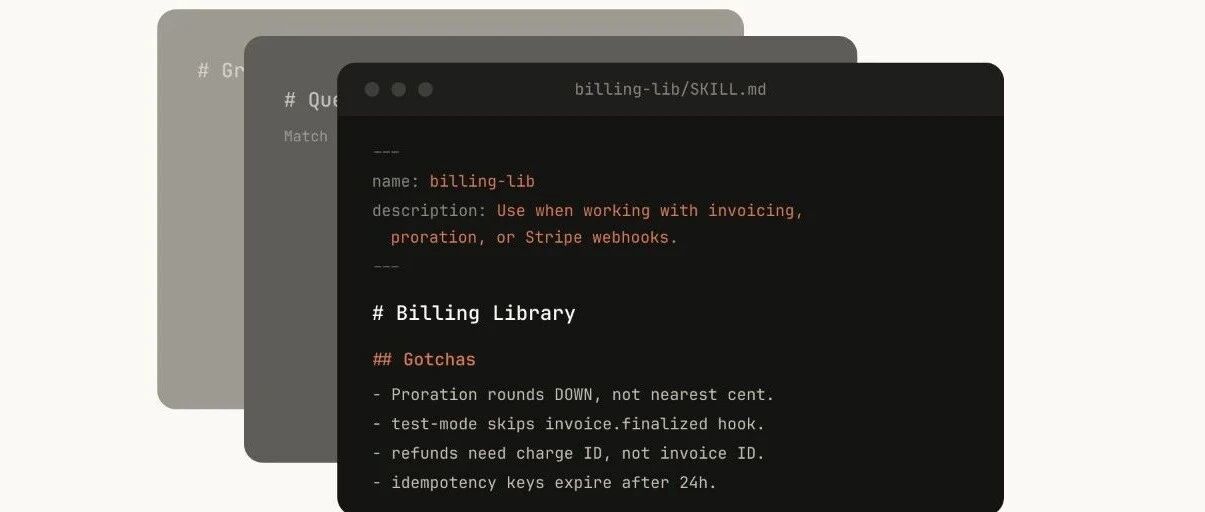
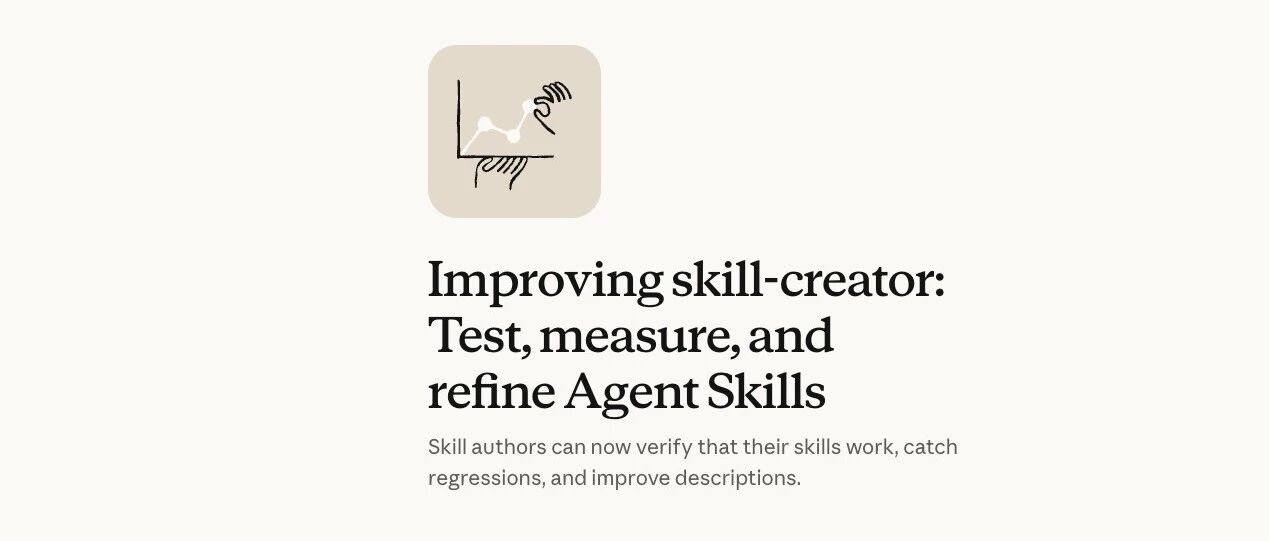
Claude悄悄更新了Skills生成器,这绝对是一次史诗级升级。
数字生命卡兹克· 2026-03-11 02:07
Core Viewpoint - The article discusses a significant update to Anthropic's Skill-creator, emphasizing its importance in enhancing the Skills ecosystem and improving the functionality and evaluation of skills created using this tool [1][8][80]. Group 1: Skill-creator Update Features - The new Skill-creator introduces four major capabilities: an evaluation system to assess skill effectiveness, benchmark testing to quantify pass rates and resource usage, parallel testing with multiple agents to ensure independent results, and description optimization to refine skill triggers [10][11][12][13]. - The evaluation system is highlighted as crucial for guiding the development of skills, addressing previous limitations where skills were treated as black boxes without clear quality metrics [14][15]. Group 2: Practical Application and Case Study - A case study is presented where a skill was created to download videos and generate transcripts, demonstrating the ease of use and effectiveness of the updated Skill-creator [21][22]. - The article illustrates how the new features allow for iterative improvements, such as optimizing the skill's description to prevent conflicts between similar skills [31][32][39]. Group 3: Evaluation Process - The evaluation process involves designing test scenarios based on the skill's functionality, with quantifiable acceptance criteria to assess performance [49][50][53]. - The article details how multiple independent agents can run tests simultaneously, reducing contamination of results and improving the accuracy of evaluations [58][60]. Group 4: Performance Metrics - The article provides performance metrics showing that skills created with the updated Skill-creator have a 100% success rate in triggering relevant actions, compared to a baseline of 9% for skills without the update [65]. - It also notes that the token usage for skills with the update is approximately 4000 tokens per execution, compared to 1750 tokens without, indicating a trade-off between resource consumption and output quality [66][67]. Group 5: Future Implications - The article concludes that the enhancements to the Skill-creator will lead to a flourishing ecosystem of skills, encouraging users to update and optimize their existing skills [80][92]. - It emphasizes the importance of continuous evaluation and improvement in skill development, suggesting that all skills should undergo this process to ensure their relevance and effectiveness [92][93].
Build Hour: API & Codex
OpenAI· 2026-03-10 17:42
Hey everyone, welcome back to OpenAI Build Hours. I'm Christine. I'm on the startup marketing team and today I'm joined with Charlie and Ryan.>> Hey folks, how's it going. >> Hey everybody. >> Awesome.Um, so Charlie is on our Dev X team and he will be leading the session and Ryan actually came all the way from Seattle to be with us live in the studio today. Um, and he's going to be chatting about the future of work. Um so today's session is all about um API and codecs.And if this is your first build hour, t ...
Skills推荐与实战应用:量化看市场系列之六:OpenClaw金融行业必备
Huachuang Securities· 2026-03-09 10:44
- The report introduces four methods to install Skills in OpenClaw, emphasizing their importance in transforming AI from a conversational assistant to a professional expert by leveraging specialized modules[6][10][11] - It highlights 10 recommended Skills for the financial industry, including tools for stock monitoring, database integration, and market analysis, such as "Stock-Watcher," "Wind Database Connection Skill," and "US Stock Analysis"[3][34][36] - Practical applications of these Skills are demonstrated through four case studies: tool creation, stock selection strategies, individual stock analysis, and quantitative strategy construction[3][44][51] - A specific quantitative strategy example involves using a database to replicate the Nanhua Composite Index with a portfolio of A-shares, achieving a cumulative return of +61.79% and an annualized Sharpe ratio of 3.281[53]






X @PancakeSwap
PancakeSwap· 2026-03-04 09:34
Skills is multi-chain out of the box, supporting 8 chains.Your agents discover opportunities across the ecosystem, you decide where to execute.A new primitive for agentic DeFi, built for the future 🥞 https://t.co/NctxODC3fw ...
X @PancakeSwap
PancakeSwap· 2026-03-04 09:34
Agents have entered the chat.PancakeSwap AI is live 🥞🤖Introducing Skills, tools for agents to plan swaps, liquidity positions, and farming strategies.https://t.co/WDkUgqO1ZB https://t.co/Mse71SC2XM ...
X @Wu Blockchain
Wu Blockchain· 2026-02-21 10:27
Uniswap Labs announced the release of 7 new "Skills" to enable AI Agents to execute operations on Uniswap. The 7 core skills specifically include: v4-security-foundations, configurator, deployer, viem-integration, swap-integration, liquidity-planner, and swap-planner. https://t.co/fx6Ky4whwL ...
X @Ethereum
Ethereum· 2026-02-20 23:46
RT Uniswap Labs 🦄 (@Uniswap)Agents execute on UniswapWe've released seven new Skills giving structured access to core Uniswap protocol actionsYour starting point for agentic workflows onchain https://t.co/tARu24eOuE ...
从 Clawdbot 到 26 年 AI Coding 主题大爆发|42章经
42章经· 2026-02-13 13:04
Core Insights - The article discusses the rapid advancements in AI coding capabilities, particularly through tools like Clawdbot, which signify a shift in how coding tasks are approached and executed [3][4][5]. - The conversation highlights the diminishing need for human intervention in coding, with AI now capable of handling tasks that previously required significant human oversight [8][12][18]. - The emergence of various AI products, including Claude Code and Skills, showcases the evolving landscape of AI agents and their applications in programming and beyond [16][22][25]. Group 1: AI Coding Evolution - The capabilities of AI coding agents have crossed a significant threshold, allowing them to operate with minimal human input, reducing the need for human intervention to as low as 0.1% [8][12]. - The progression of AI coding has been marked by a transition from basic functionality to more complex project management, with AI now able to design and review code effectively [10][11]. - The productivity of AI in coding tasks is highlighted, with claims that AI can produce the equivalent of a senior engineering team's output in a fraction of the time [12][18]. Group 2: Key AI Products - Claude Code is identified as a foundational tool that enables AI to manipulate real-world tasks through programming, setting the stage for future developments in AI agents [16][22]. - Cowork is described as a plugin for Claude Code, enhancing its capabilities but not representing a major breakthrough in AI technology [19][20]. - Skills are presented as a more flexible and user-friendly alternative to previous models, allowing for easier integration and combination of functionalities [25][26][30]. Group 3: Clawdbot Overview - Clawdbot is characterized as a versatile assistant that operates on personal computers, capable of executing a wide range of tasks through natural language interaction [31][32]. - The importance of running Clawdbot locally is emphasized for security reasons, as it requires complete control over the environment to function effectively [35][36]. - Clawdbot's design includes a memory system that allows it to learn and adapt over time, enhancing user experience and task execution [41][42]. Group 4: Future Implications - The article suggests that the future of software development may involve either fully human-written code as an art form or entirely AI-generated code, with human involvement potentially complicating AI processes [16][18]. - The concept of "Box" is introduced as a way to encapsulate skills and environments, allowing for more reliable execution of tasks without side effects [68][72]. - The discussion concludes with the notion that as AI capabilities grow, the focus will shift towards leveraging these tools for efficiency and addressing long-tail needs in various sectors [55][59].