HPV疫苗Gardasil/Gardasil 9

Search documents
医药巨头豪掷650亿,收购超级流感药
21世纪经济报道· 2025-11-17 06:22
Core Viewpoint - Merck (MSD) has acquired Cidara Therapeutics for approximately $9.2 billion, focusing on the innovative flu drug CD388, which has shown a 76% efficacy in preventing flu in clinical trials, significantly higher than traditional vaccines [1][2][5] Acquisition Details - The acquisition price of $221.50 per share reflects Merck's strong recognition and urgent need for Cidara's core asset, CD388 [5] - Following the announcement, Cidara's stock surged over 105%, reaching its highest level since 2017, while Merck's stock saw a slight increase of 0.74% [5][6] Market Potential - If CD388 is approved, it could tap into a market worth over $10 billion, leveraging Merck's established commercialization network [2][8] - The global flu vaccine market is projected to grow from $5.8 billion in 2020 to $8.9 billion by 2024, with a compound annual growth rate (CAGR) of 11.2% [10] Competitive Landscape - CD388's dual mechanism of action, combining direct pathogen targeting and immune activation, positions it as a potential "First-in-Class" preventive flu drug, addressing the limitations of current vaccines [7][12] - The drug's safety profile and ability to provide protection for 4-5 months with a single dose could fill significant gaps in the current flu prevention market [8][12] Strategic Rationale - Merck's acquisition aligns with its strategy to mitigate the impending patent cliff of its leading cancer drug, Keytruda, which is expected to lose patent protection by 2028, potentially resulting in a $18 billion revenue loss [6][13] - The acquisition is seen as a proactive move to secure new growth engines and reduce uncertainty in the company's future performance [2][5]


默沙东,放手一搏
Ge Long Hui· 2025-10-16 04:03
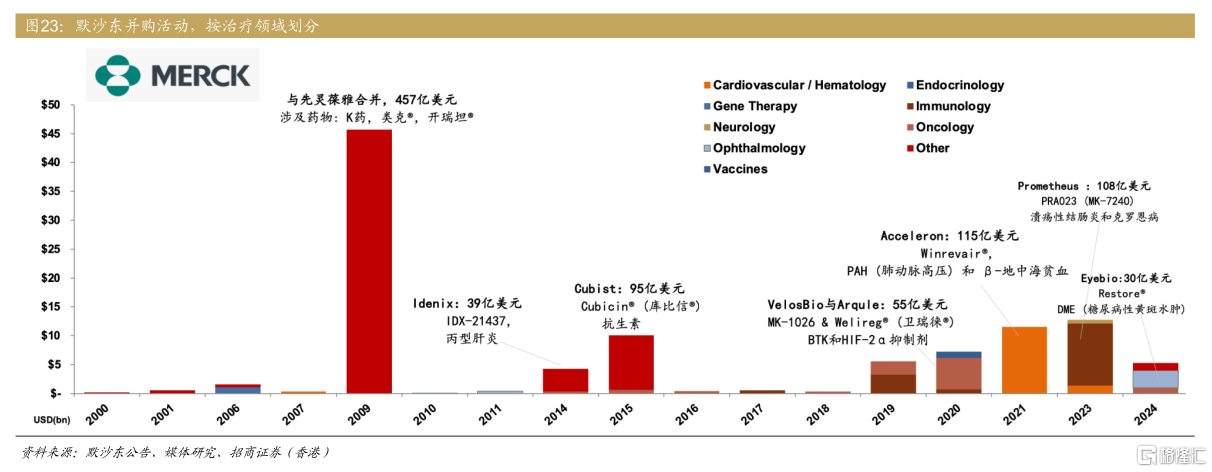
Core Viewpoint - Merck is aggressively pursuing acquisitions and partnerships to diversify its product portfolio and mitigate the impending revenue loss from the expiration of key patents, particularly for its blockbuster drug Keytruda, which is expected to face significant sales declines by 2030 [6][23]. Group 1: Acquisition Strategy - Over the past three years, Merck has spent over $50 billion on acquisitions, with significant deals including the $11.5 billion acquisition of Acceleron Pharma in 2021, $10.8 billion for Prometheus Biosciences in 2023, and a planned $10 billion acquisition of Verona Pharma in 2025 [1][6]. - Merck's acquisition strategy includes a focus on various therapeutic areas such as oncology, autoimmune diseases, cardiovascular, respiratory, and ophthalmology, aiming to build a diverse product pipeline [3][8]. Group 2: Key Products and Partnerships - Merck has established partnerships worth over $30 billion with companies like Kura Oncology and Daiichi Sankyo to develop antibody-drug conjugates (ADCs), enhancing its oncology pipeline [2][10]. - The company is also introducing new drugs, such as a cardiovascular treatment from Hutchison China MediTech for $2 billion, and is actively developing multiple ADC products in collaboration with partners [2][10]. Group 3: Revenue Challenges - The patent for Keytruda is set to expire in 2028, with projections indicating a potential sales drop of nearly 50% by 2030, leading to an anticipated revenue gap of around $15 billion [6][8]. - Sales of Merck's second-best-selling product, the HPV vaccine Gardasil, have also declined by 48% year-on-year, further exacerbating revenue concerns [7][8]. Group 4: Future Growth Potential - Merck's acquisitions and partnerships are expected to yield several potential blockbuster drugs across various therapeutic areas, including the TL1A monoclonal antibody for inflammatory bowel disease and the dual-target COPD drug Ensifentrine [16][17]. - The company is also exploring innovative treatments in the ophthalmology sector, with a potential first-in-class Wnt antibody for diabetic macular edema [20]. Group 5: Strategic Outlook - Merck's recent acquisitions and partnerships are part of a strategic shift to prepare for the post-Keytruda era, aiming to fill revenue gaps and reshape the competitive landscape in the pharmaceutical industry [23].