
Hi4混动

Search documents
营收超2228亿元!长城汽车发布2025年财报,欲将城市NOA下探至10万元级
Mei Ri Jing Ji Xin Wen· 2026-03-27 13:41
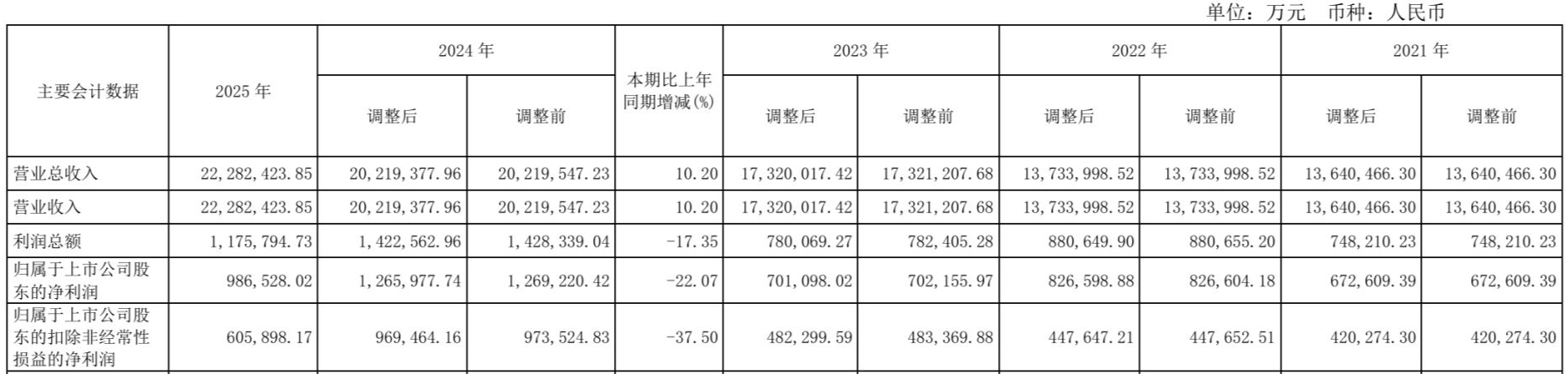
Core Viewpoint - Great Wall Motors reported a total revenue of 222.82 billion yuan for 2025, marking a year-on-year increase of 10.20%, while the net profit attributable to shareholders decreased by 22.07% to 9.87 billion yuan [1][2][3] Financial Performance - Total revenue for 2025 was 222.82 billion yuan, compared to 2024's 202.19 billion yuan, reflecting a growth of 10.20% [2] - Net profit attributable to shareholders was 9.87 billion yuan, down from 12.66 billion yuan in 2024, a decline of 22.07% [2] - Total profit for the year was 11.76 billion yuan, a decrease of 17.35% from 2024 [2] - The net profit after deducting non-recurring gains and losses was 6.06 billion yuan, down 37.50% from the previous year [2] Sales and Market Strategy - Great Wall Motors achieved new car sales of 1.32 million units in 2025, a year-on-year increase of 7.23% [3] - Overseas sales reached 506,800 units, up 11.6%, while global sales of new energy vehicles were 406,000 units, reflecting a growth of 26% [3] - The company aims to sell no less than 1.8 million vehicles in 2026, with a net profit target of at least 10 billion yuan [3] Product Development and Technology - The company plans to enhance its global strategy with a focus on different market developments for its brands, including Haval and Ora [3][5] - The Coffee Pilot 3 system will be scaled to more models, while the new Coffee Pilot 4 will be introduced in high-end vehicles [3] Risk Management - Great Wall Motors identified two main risks: international geopolitical conflicts and increased competition in the domestic market [5] - The company aims to mitigate these risks through localized operations and a diversified market strategy [5] Dividend Distribution - The company plans to distribute a cash dividend of 0.35 yuan per share to all shareholders [6]


观车 · 论势 || 转型为科技企业,车企向左还是右?
Zhong Guo Qi Che Bao Wang· 2025-12-09 01:33
Core Viewpoint - The automotive industry is undergoing a transformation characterized by electrification, intelligence, and ecological integration, with companies facing strategic choices based on their understanding of the industry's essence [1][6]. Group 1: Conservative Approach - Conservative companies focus on core automotive technologies, aiming for breakthroughs in battery energy density and intelligent driving algorithms, which helps maintain profitability during market fluctuations [2]. - The conservative strategy is driven by a deep understanding of the industry and a rational focus on resources, allowing companies like Great Wall Motors and Leap Motor to establish strong user recognition in specific market segments [1][2]. - The conservative approach may lead to challenges such as price wars due to hardware standardization and global overcapacity pressures, necessitating continuous software innovation [2]. Group 2: Transformative Approach - Transformative companies view the automotive industry as part of a larger interconnected ecosystem, leveraging AI and cross-industry collaborations to create competitive advantages [3][4]. - Companies like Xpeng and Geely are investing in technologies such as intelligent robots and satellite communications to enhance their product offerings and create unique selling points [3][4]. - The transformative strategy is supported by strong capital backing and the ability to repurpose existing technology for new applications, although it carries higher risks due to significant R&D investments and complex management challenges [4][5]. Group 3: Strategic Divergence and Integration - The fundamental difference between conservative and transformative strategies lies in their strategic motivations and technological paths, with conservative firms focusing on survival and stability while transformative firms pursue growth and innovation [5]. - Companies like BYD and Huawei exemplify a blend of both strategies, integrating vertical control and ecosystem collaboration to enhance their core business while exploring new opportunities [5]. - The future of the automotive industry may see a dynamic integration of both strategies, where conservative firms extend their boundaries after achieving technological breakthroughs, and transformative firms reinforce their core strengths through ecosystem development [5][6][7].