IMX929 8K全局快门传感器

Search documents
索尼高调秀一款芯片,释放重要信号!
是说芯语· 2026-02-06 00:52
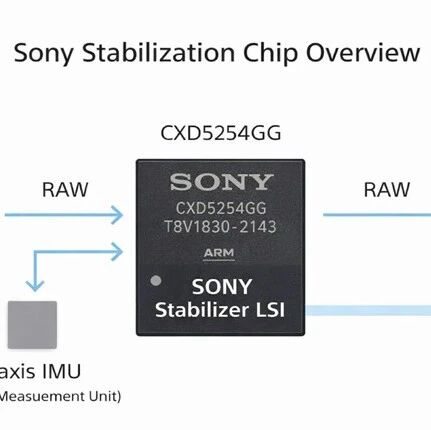
Core Viewpoint - Sony's recent showcase of a new image stabilization chip indicates a significant shift in camera technology, particularly in motion picture processing, suggesting a future where stabilization occurs at the source rather than through post-processing [1][9]. Group 1: Technology Overview - The showcased image stabilization LSI chip operates close to the image sensor, stabilizing signals during image capture rather than after processing, which allows for real-time correction of shake, rotation, and drift [1][4]. - This chip reduces visible artifacts and edge distortion, providing smoother motion in fast pans or handheld shots, with a latency of approximately 1.5 frames [1][4]. Group 2: Industry Implications - By publicly demonstrating this chip, Sony invites manufacturers to design systems around it, indicating a readiness for widespread application in the imaging industry [4][6]. - The chip is expected to first impact professional and embedded imaging systems, such as broadcast cameras, remote and robotic gimbals, drones, and small camera modules, rather than consumer-level mirrorless cameras [6]. Group 3: Competitive Advantage - Sony's strategy involves proving the chip's value in demanding professional environments before influencing broader camera designs, reinforcing its dominance in the image sensor market [6][8]. - The integration of the stabilization chip with image sensors enhances Sony's control over the entire imaging process, leading to improved image quality and reduced reliance on downstream corrections [6][9]. Group 4: Future Developments - Sony's recent innovations, including high-resolution global shutter sensors, demonstrate a commitment to advancing imaging technology without compromising motion integrity, which is crucial for filmmakers [8][9]. - The trend of shifting decision-making power regarding image quality to the sensor level signifies a broader industry movement towards hardware-based solutions for image processing [9].



索尼展示一颗芯片,释放重大信号
半导体行业观察· 2026-01-27 01:26
公众号记得加星标⭐️,第一时间看推送不会错过。 随着传感器分辨率和读取速度的不断提升,传统的电子防抖技术面临着日益严峻的挑战。画面裁剪造 成的图像损伤越来越大,软件校正的痕迹也更容易被察觉,尤其是在高分辨率视频素材中。专用防抖 硬件通过在图像尚未完全恢复时进行防抖处理来解决这个问题。它还能减轻主图像处理器的计算负 担,因为主图像处理器需要处理越来越多的自动对焦、降噪和色彩信息。这种方法尤其适用于:动作 密集型拍摄、手持长焦拍摄、车载和机器人摄像机拍摄,以及对延迟零容忍的现场制作。这些场景恰 恰是电影制作人最先注意到防抖失效的地方。 索尼很少会主动宣传半导体技术,除非它想引起业界的关注。而这个案例研究恰恰表明了这一点。通 过积极展示一款新型图像稳定芯片,索尼预示着未来相机在处理运动画面方面将发生更深层次的变 革,而这远早于电影制作人在规格表上看到相关参数。 本次展示的核心是索尼半导体解决方案公司开发的专用图像稳定LSI芯片。与传统的电子防抖不同, 这款芯片的工作位置非常靠近图像传感器。它不是在图像处理完成后进行运动校正,而是在图像采集 过程中进行信号稳定。实时图像数据与来自六轴惯性测量单元的精确运动信息相结合, ...