KUAE万卡智算集群

Search documents
摩尔线程发布新一代GPU架构,打造MUSA生态对标英伟达CUDA
Xin Lang Cai Jing· 2025-12-20 06:42
Core Viewpoint - The article discusses the recent developments of Moer Technology, particularly its new GPU architecture and products aimed at competing with NVIDIA in the GPU market, highlighting the importance of developer ecosystems in the GPU industry [2][5][14]. Group 1: Product Launch and Features - Moer Technology held its first MUSA Developer Conference, where it unveiled its new GPU architecture "Huagang" and several products, including the AI training and inference GPU "Huashan" and the gaming GPU "Lushan" [2][5]. - The new products are set to be mass-produced by 2026, with significant performance improvements over the previous generation, including a 50% increase in computing density and a 10-fold increase in energy efficiency [7][8]. - The "Huashan" chip reportedly surpasses NVIDIA's Hopper series in floating-point computing power, memory bandwidth, and capacity [8]. Group 2: Competitive Landscape - Moer Technology aims to challenge NVIDIA's dominance in the GPU market, with many of its team members having previously worked at NVIDIA, including CEO Zhang Jianzhong [5][6]. - Despite advancements, there remains a notable performance gap between Moer Technology's products and NVIDIA's top-tier offerings, which is critical for the company's future competitiveness [6][10]. - The current market dynamics, influenced by U.S. export restrictions, present a unique opportunity for domestic GPU manufacturers to fill the gap left by NVIDIA's limited presence in China [9]. Group 3: Ecosystem Development - The establishment of a robust developer ecosystem is crucial for Moer Technology to succeed, akin to NVIDIA's CUDA ecosystem, which is currently dominant in the industry [14][15]. - Zhang Jianzhong expressed optimism about building a competitive ecosystem around the MUSA architecture, encouraging developers to create applications that leverage their GPUs [15]. - The company acknowledges the challenges posed by NVIDIA's established ecosystem and aims to overcome these barriers through strategic ecosystem development [15].



能效提升10倍!摩尔线程最新发布
Xin Lang Cai Jing· 2025-12-20 05:43
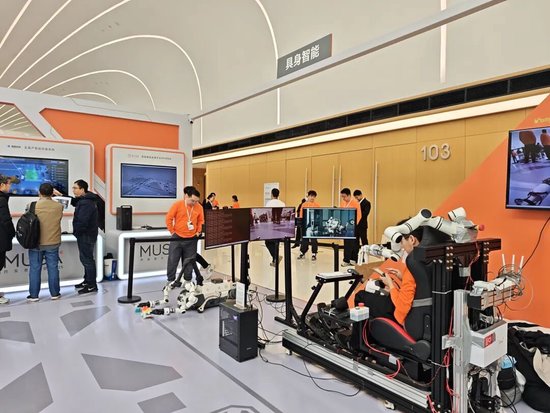
Core Insights - The first MUSA Developer Conference (MDC 2025) was held by Moore Threads in Beijing, focusing on full-function GPUs and showcasing the latest applications in various fields such as AI, scientific computing, and 6G networks [1][10] - Moore Threads plans to release a new GPU architecture named "Huagang" in 2026, which will feature a new instruction set, a 50% increase in computing density, and a 10-fold improvement in energy efficiency [1][10] Company Developments - Moore Threads' CEO Zhang Jianzhong emphasized the need for AI infrastructure to empower researchers and developers across industries, highlighting the role of full-function GPUs in this context [3][12] - The full-function GPU includes four main functional engines: AI computing acceleration, graphics rendering, physical simulation and scientific computing, and ultra-high-definition video encoding and decoding [3][12] - The MUSA architecture has evolved from "Sudi" in 2022 to "Chunxiao" in 2023, "Quyuan" in 2024, "Pinghu" in 2025, and will introduce "Huagang" in 2026 [3][12] Product Launches - A new computing chip named "Huashan" will be launched based on the "Huagang" architecture, supporting AI training and inference integration, with enhancements in computing, storage, and communication [5][14] - The "Huashan" chip will support the construction of AI factories with over 100,000 cards and will feature advanced asynchronous programming technology and tensor computing engines [5][14] - Another product, the high-performance graphics rendering chip "Lushan," will achieve a 15-fold improvement in 3A game performance [6][15] Industry Trends - The trend towards large-scale AI model training clusters is evident, with Moore Threads introducing the KUAE 10,000-card intelligent computing cluster, boasting a floating-point computing capability of 10 Exa-FLOPS [8][17] - The applications of full-function GPUs are expanding into quantum technology, 6G, embodied intelligence, smart driving, and smart agriculture [8][17] - The establishment of Moore Academy aims to cultivate developers, with nearly 200,000 users registered, and initiatives to engage university students in MUSA development skills [8][17] Expert Opinions - Academician Zheng Weimin highlighted the importance of three pillars for achieving sovereign AI: autonomous computing power, strong algorithms, and self-sufficient ecosystems, emphasizing the role of developers in this ecosystem [9][18] - Zheng pointed out the challenges of high migration costs and immature toolchains in the industry, advocating for unified or highly compatible interface standards to reduce fragmentation [9][18]