LLaDA2.1

Search documents
计算机行业周报:LLaDA2.1实现技术突破,Gemini3.1Pro树立多模态新标准
Huaxin Securities· 2026-02-26 00:50
Investment Rating - The report maintains a "Buy" rating for the companies mentioned, including Weike Technology (301196.SZ), Nengke Technology (603859.SH), Hehe Information (688615.SH), and Maixinlin (688685.SH) [8][53]. Core Insights - The report highlights significant advancements in AI technology, particularly with the release of LLaDA2.1 and Gemini3.1Pro, which set new standards in multimodal AI applications [1][35]. - LLaDA2.1 achieves a peak speed of 892 Tokens/second in complex programming tests, showcasing a balance between speed and quality through innovative technical breakthroughs [3][23]. - Gemini3.1Pro demonstrates exceptional reasoning capabilities, scoring 77.1% in the ARC-AGI-2 test, significantly outperforming its predecessor and competitors [35][36]. Summary by Sections Computing Power Dynamics - The report notes stable rental prices for computing power, with specific configurations priced at 28.64 CNY/hour for Tencent Cloud and 31.58 CNY/hour for Alibaba Cloud [22]. - LLaDA2.1, released in February 2026, includes versions with 16 billion and 100 billion parameters, breaking the speed barrier for diffusion language models [23][26]. - The model introduces a novel error-correcting editing mechanism, enhancing generation efficiency without sacrificing quality [27][29]. AI Application Dynamics - Gemini's weekly traffic increased by 4.31%, indicating growing user engagement [33]. - Gemini3.1Pro supports up to 1 million tokens in context, achieving high scores in long-text processing and significantly reducing hallucination rates compared to previous models [40][41]. AI Financing Trends - WorldLabs completed a $1 billion funding round, with notable investors including AMD and NVIDIA, aimed at advancing spatial intelligence technologies [46][48]. - The funding will accelerate the development of their flagship product, Marble, which focuses on generating high-fidelity 3D worlds for various applications [47][49]. Investment Recommendations - The report suggests focusing on companies that are expanding their computing power capabilities, such as Maixinlin and Weike Technology, as well as those excelling in AI applications like Hehe Information and Nengke Technology [52].


计算机行业周报:LLaDA2.1实现技术突破,Gemini3.1Pro树立多模态新标准-20260225
Huaxin Securities· 2026-02-25 10:25
Investment Rating - The report maintains a "Buy" rating for the companies mentioned, including Weike Technology (301196.SZ), Nengke Technology (603859.SH), Hehe Information (688615.SH), and Maixinlin (688685.SH) [8][53]. Core Insights - The LLaDA2.1 model has achieved a technological breakthrough, featuring two versions with 16 billion and 100 billion parameters, demonstrating a peak speed of 892 Tokens/second in complex programming tests [3][23]. - Gemini3.1Pro, released by Google DeepMind, has set a new standard in multimodal AI, achieving a score of 77.1% in the ARC-AGI-2 test, more than doubling the performance of its predecessor [3][35]. - WorldLabs has completed a new funding round of $1 billion, with investments from major firms like AMD and NVIDIA, focusing on spatial intelligence and large world models [4][46]. Summary by Sections Computing Power Dynamics - The rental prices for computing power remain stable, with specific configurations priced at 28.64 CNY/hour for Tencent Cloud and 31.58 CNY/hour for Alibaba Cloud [22]. - The LLaDA2.1 model's release marks a significant advancement in diffusion language models, providing a new feasible path for the development of large language models [23][32]. AI Application Dynamics - Gemini's weekly traffic increased by 4.31%, with notable performance in user engagement metrics [33][34]. - Gemini3.1Pro excels in reasoning capabilities and has shown significant improvements in long-context processing, handling up to 1 million tokens [40][41]. AI Financing Trends - WorldLabs' recent funding will accelerate its research and development in spatial intelligence, with a focus on applications in robotics and AR/VR [46][48]. Investment Recommendations - The report suggests a focus on companies that are expanding their computing power capabilities, such as Maixinlin (688685.SH) and Weike Technology (301196.SZ), as well as those in AI-driven sectors like Hehe Information (688615.SH) and Nengke Technology (603859.SH) [52].
蚂蚁集团开源万亿思考模型 Ring-2.5-1T,打破大模型“不可能三角”
Guan Cha Zhe Wang· 2026-02-14 10:25
Core Insights - Ant Group has developed and open-sourced the world's first trillion-parameter thinking model, Ring-2.5-1T, which achieves fast inference speed, deep reasoning capabilities, and excellent long-range task execution [1][9] - The model scored 35 out of 42 in the IMO competition and 105 in the CMO, significantly exceeding the national training team's score line [1][7] Model Architecture - Ring-2.5-1T is based on the Ling 2.5 architecture, utilizing a hybrid linear attention mechanism that combines MLA (Multi-Head Latent Attention) and Lightning Linear Attention in a 1:7 ratio [2] - The model's active parameter count increased from 51 billion to 63 billion, yet its inference efficiency improved due to its linear time complexity [2] Performance and Capabilities - The model demonstrates significant advantages in long-sequence reasoning tasks compared to other models with similar parameter counts, particularly in throughput as sequence length increases [2] - Ring-2.5-1T has been benchmarked against various models and has achieved optimal performance in high-difficulty reasoning tasks and long-duration task execution benchmarks [5] Training Innovations - The model incorporates a dense reward mechanism based on Reinforcement Learning with Verifiable Rewards (RLVR), enhancing its logical reasoning and proof techniques [4] - It also employs large-scale fully asynchronous Agentic RL training, improving its autonomous execution capabilities in complex tasks [4] Ecosystem and Future Developments - Ring-2.5-1T is compatible with major intelligent agent frameworks and has been made available on platforms like Hugging Face and ModelScope [7] - Ant Group has also released other models, including LLaDA2.1 and Ming-flash-omni-2.0, focusing on various AI capabilities such as non-autoregressive parallel decoding and multimodal representation [8] - The company aims to provide reusable foundational solutions for developers, with plans to expand into video understanding, complex image editing, and real-time audio generation [8]


万亿思考模型新速度!蚂蚁开源Ring-2.5-1T:IMO金牌水平,强;混合线性架构,快!
量子位· 2026-02-14 01:15
Core Viewpoint - Ant Group has launched the world's first open-source hybrid linear architecture trillion-parameter model, Ring-2.5-1T, which excels in mathematical logic reasoning and long-range autonomous execution capabilities [2][3]. Group 1: Model Capabilities - Ring-2.5-1T achieved a gold medal level score of 35 in IMO and an impressive score of 105 in CMO, significantly surpassing national training team standards [3]. - The model can independently handle complex tasks such as search and coding, demonstrating its robust task execution abilities [3][8]. - It has broken the industry norm that deep reasoning requires sacrificing inference speed and memory usage, achieving a 3x increase in throughput while reducing memory usage to below 1/10 during long sequence generation [5][7][16]. Group 2: Architectural Innovations - The model employs a hybrid linear attention architecture, evolving from the Ring-flash-linear-2.0 technology, utilizing a 1:7 design of Multi-Head Latent Attention (MLA) combined with Lightning Linear Attention [9]. - Incremental training methods were used to maintain strong reasoning capabilities while achieving linear inference speeds, converting parts of the original GQA layers to Lightning Linear Attention [12]. - The activation parameter count increased from 51 billion to 63 billion, yet inference efficiency saw significant improvements compared to Ling 2.0 [15]. Group 3: Training Mechanisms - A dense reward mechanism was introduced to enhance logical reasoning, focusing on the rigor of the reasoning process, which significantly reduced logical flaws and improved advanced proof techniques [18]. - The model underwent large-scale asynchronous Agentic Reinforcement Learning training, enhancing its autonomous execution capabilities in long-chain tasks [18]. Group 4: Practical Applications - In practical tests, Ring-2.5-1T successfully solved complex abstract algebra proof problems, demonstrating high logical sensitivity and rigorous reasoning [20][24]. - The model also showcased its programming skills by writing a high-concurrency thread pool in Rust, effectively managing memory safety and concurrency [27]. - In an official demo, Ring-2.5-1T developed a miniature operating system, further proving its capabilities in system-level programming [31]. Group 5: Broader AI Developments - Ant Group also released the diffusion language model LLaDA2.1 and the multimodal model Ming-flash-omni-2.0, which significantly enhance inference speed and provide unique token editing and reverse reasoning capabilities [33][36]. - The goal is to create a reusable foundation for developers, allowing for easier access to multimodal applications without the need to piece together various models [39][40]. - The company aims to tackle complex challenges in video temporal understanding, intricate image editing, and real-time long audio generation, indicating a commitment to advancing multimodal AI technology [41].

小众架构赢麻了,通过编辑功能让100B扩散模型飙出892 tokens/秒的速度
3 6 Ke· 2026-02-11 05:21
Core Insights - The article highlights the significant advancements of Ant Group's LLaDA2.1 model, which has achieved a peak speed of 892 tokens per second in complex programming tasks, outperforming mainstream autoregressive models that operate at much lower speeds [1][18][20]. Group 1: Model Development and Features - LLaDA2.1 represents a historic shift from being a research model to a practical tool, showcasing improved efficiency and usability [2][5]. - The model introduces a dual-mode design, allowing users to switch between Speedy Mode and Quality Mode with a single configuration, thus simplifying user experience and model management [4][6]. - The Speedy Mode allows for rapid initial draft generation, while the Quality Mode focuses on accuracy, catering to different user needs [6][21]. Group 2: Technical Innovations - The model employs an Error-Correcting Editable (ECE) mechanism, enabling self-correction during the generation process, which addresses the common issues of inconsistency in earlier diffusion models [8][13]. - LLaDA2.1 successfully implements reinforcement learning (RL) on a 100B parameter diffusion model, a feat previously considered impossible, enhancing its performance in alignment tasks [16][22]. Group 3: Performance Metrics - In benchmark tests, LLaDA2.1 outperformed its predecessor LLaDA2.0 across various tasks, demonstrating superior performance in both speed and quality [22][23]. - The model's peak speed in Speedy Mode reached 892 tokens per second on the HumanEval+ benchmark, while the mini version exceeded 1500 tokens per second in certain tasks [18][24]. Group 4: Industry Implications - The advancements in LLaDA2.1 challenge the dominance of autoregressive models, suggesting a potential shift in industry standards towards more efficient and versatile models [20][26]. - The open-sourcing of LLaDA2.1 and its mini version indicates a strategic move to foster wider adoption and innovation within the AI community [24][27].
里程碑时刻,100B扩散语言模型跑出892 Tokens /秒,AI的另一条路走通了
3 6 Ke· 2026-02-11 04:31
Core Insights - The release of LLaDA2.1 marks a significant transformation in the field of diffusion language models (dLLM), which was previously considered a niche area. The new version includes LLaDA2.1-Mini (16 billion parameters) and LLaDA2.1-Flash (100 billion parameters) [1][3] - LLaDA2.1 achieves a peak speed of 892 tokens per second, demonstrating a practical efficiency advantage and breaking the "fast but inaccurate" paradigm with its error-correcting mechanism [3][10] - The model introduces a dual-mode system allowing users to switch between quality and speed, addressing the trade-off between these two aspects effectively [15][19] Model Performance - LLaDA2.1's 100 billion parameter version achieved a peak speed of 892 tokens per second, which is particularly notable given the complexity of tasks it can handle, such as programming benchmarks [10][11] - The model's architecture allows for parallel generation and self-correction, which enhances its usability compared to traditional autoregressive models that lack this capability [13][14] - In experimental evaluations, LLaDA2.1 outperformed its predecessor LLaDA2.0 in quality mode across various benchmarks, while also showing significant improvements in throughput in speed mode [20][22] Technical Innovations - The introduction of an Error-Correcting Editable (ECE) mechanism allows LLaDA2.1 to draft answers quickly and then edit them, enabling a more flexible and accurate output generation process [13][18] - The model employs a reinforcement learning phase to enhance its understanding of instructions and alignment with user intent, marking a first for diffusion models at this scale [16][17] - The dual-mode design allows users to configure the model for either speed or quality, simplifying user experience and model management [15][19] Industry Implications - LLaDA2.1's advancements suggest a potential shift in the landscape of AI models, challenging the dominance of autoregressive architectures and opening up new avenues for research and application in language modeling [26] - The successful implementation of a 100 billion parameter diffusion model indicates that the barriers to scaling such models may be diminishing, encouraging further investment and exploration in this area [11][26] - The model's ability to handle complex tasks efficiently positions it as a competitive alternative in the AI landscape, potentially influencing future developments in language processing technologies [10][26]
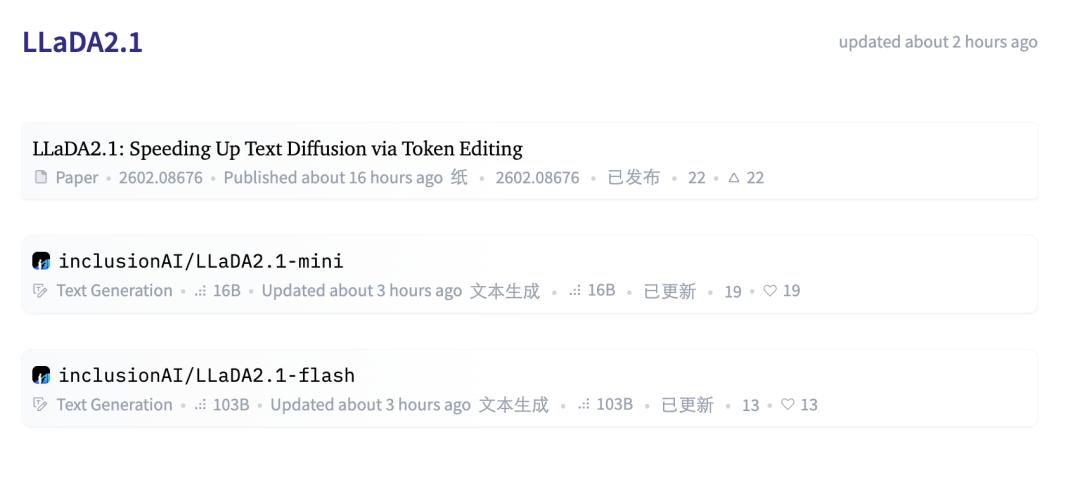
里程碑时刻!100B扩散语言模型跑出892 Tokens /秒,AI的另一条路走通了
机器之心· 2026-02-11 01:59
Core Insights - The article discusses the significant advancements in diffusion language models (dLLM), particularly highlighting the release of LLaDA2.1, which marks a transformative moment in this research area [2][4]. - LLaDA2.1 demonstrates a peak speed of 892 tokens per second (TPS) for its 100 billion parameter version, showcasing its efficiency and practical applicability [13][14]. - The model introduces a novel error-correcting editable mechanism, allowing for real-time corrections during text generation, which addresses the limitations of traditional autoregressive models [16][17]. Group 1: Model Features and Innovations - LLaDA2.1 includes two versions: LLaDA2.1-Mini (16B) and LLaDA2.1-Flash (100B), with the latter achieving remarkable performance metrics [2][4]. - The model employs a dual-mode system, enabling users to switch between a speed-focused mode and a quality-focused mode, thus enhancing usability [20][26]. - The introduction of reinforcement learning in the training process allows LLaDA2.1 to better understand instructions and align with user intent, improving its overall reliability [21][22]. Group 2: Performance Metrics and Comparisons - In benchmark tests, LLaDA2.1 outperformed its predecessor LLaDA2.0 in various tasks, particularly in the quality mode where it exceeded previous performance scores [24][30]. - The model's speed advantage is particularly evident in coding tasks, where it achieved a peak TPS of 891.74 in the HumanEval+ benchmark, significantly enhancing its practical application in programming [28][30]. - The article presents comparative performance data, indicating that LLaDA2.1 consistently surpasses other models in terms of speed and efficiency across multiple benchmarks [25][27]. Group 3: Implications for the Industry - The advancements represented by LLaDA2.1 suggest a potential shift in the landscape of AI language models, moving beyond the dominance of autoregressive models to explore the capabilities of diffusion models [33]. - The successful implementation of a scalable diffusion model at a 100 billion parameter level indicates a breakthrough in overcoming previous limitations related to model size and performance [14][33]. - The article emphasizes that while autoregressive models have been the primary focus, LLaDA2.1 illustrates the viability of alternative approaches, potentially leading to a more diverse range of solutions in the AI language model space [33].

小众架构赢麻了!通过编辑功能让100B扩散模型飙出892 tokens/秒的速度!
量子位· 2026-02-11 01:55
Core Viewpoint - The article discusses the emergence of the LLaDA2.1 model from Ant Group, which has achieved a remarkable speed of 892 tokens per second in complex programming tasks, marking a significant advancement over traditional autoregressive models [1][3][11]. Group 1: Model Performance and Features - LLaDA2.1 operates on a 100 billion parameter scale and has transitioned from a research model to a practical tool, demonstrating superior efficiency [3][4]. - The model introduces a dual-mode decoding strategy, allowing users to switch between Speedy Mode and Quality Mode with a single configuration, thus enhancing usability [9][10]. - In Speedy Mode, LLaDA2.1 achieves a peak speed of 892 tokens per second on the HumanEval+ benchmark, while in Quality Mode, it surpasses previous models in various reasoning tasks [11][31]. Group 2: Technical Innovations - The model employs an Error-Correcting Editable (ECE) mechanism, enabling it to generate drafts quickly and then refine them, addressing the limitations of traditional diffusion models [16][21]. - LLaDA2.1 successfully implements reinforcement learning (RL) on a 100 billion scale, enhancing its performance in instruction-following tasks and demonstrating that diffusion models can achieve both speed and understanding [23][26]. - The introduction of the EBPO algorithm allows for efficient training and editing, marking a significant milestone in the application of RL to diffusion models [25][28]. Group 3: Competitive Advantage - LLaDA2.1's performance in benchmark tests shows a significant advantage over mainstream autoregressive architectures, achieving high speeds without compromising quality [29][30]. - The model's ability to maintain quality even in Speedy Mode demonstrates its robustness, achieving a balance between speed and accuracy [32]. - A lighter 16 billion parameter Mini version has been released, achieving peak speeds exceeding 1500 tokens per second, indicating potential for more lightweight deployments [33].