
LMCache

Search documents
LMCache:基于KV缓存复用的LLM推理优化方案
Xin Lang Cai Jing· 2025-12-09 13:41
Core Insights - The article discusses the importance of Time-To-First-Token (TTFT) in LLM inference services, emphasizing that a shorter TTFT leads to a better user experience, but practical deployments often face challenges [1][15]. Group 1: LMCache Overview - LMCache proposes a solution for TTFT by implementing a KV cache persistence and reuse mechanism, which is open-source and deeply integrated with vLLM [1][16]. - Traditional methods require recalculating KV caches for each input, while LMCache allows for the storage of KV caches not only in GPU memory but also in CPU memory and disk, enabling faster retrieval for repeated text [2][18]. Group 2: Performance Improvements - Testing shows that when used with vLLM, LMCache can improve response speeds by 3 to 10 times in scenarios like multi-turn conversations and RAG applications [2][18]. - The cache read speed is approximately 7 times faster than native solutions, with increased throughput, allowing for text matches regardless of their position in the prompt [5][19]. Group 3: Storage and Integration Features - LMCache supports multi-level storage across GPU memory, CPU memory, and disk, which can significantly reduce GPU load [6][20]. - It features deep integration with vLLM v1, supporting cross-device sharing of KV caches and cross-node transmission, making it compatible with tools like llm-d and KServe in production environments [7][21]. Group 4: Installation and Requirements - Currently, LMCache primarily supports Linux, with Windows compatibility available through WSL or community adaptations [9][23]. - Basic requirements include Python 3.9+, NVIDIA GPUs (like V100, H100), and CUDA 12.8 or higher, with offline functionality available post-installation [10][24]. Group 5: Summary and Future Outlook - The concept of KV cache reuse is becoming standard, and LMCache has implemented it comprehensively with features like multi-level storage and arbitrary position matching, effectively addressing real-world issues [14][26]. - While LMCache is primarily tied to the vLLM ecosystem and focuses on Linux, it is an open-source solution worth monitoring as AMD GPU support is still being developed [14][27].


英伟达、DeepSeek集体跟进,18个月前被忽视,如今统治AI推理
3 6 Ke· 2025-11-10 04:11
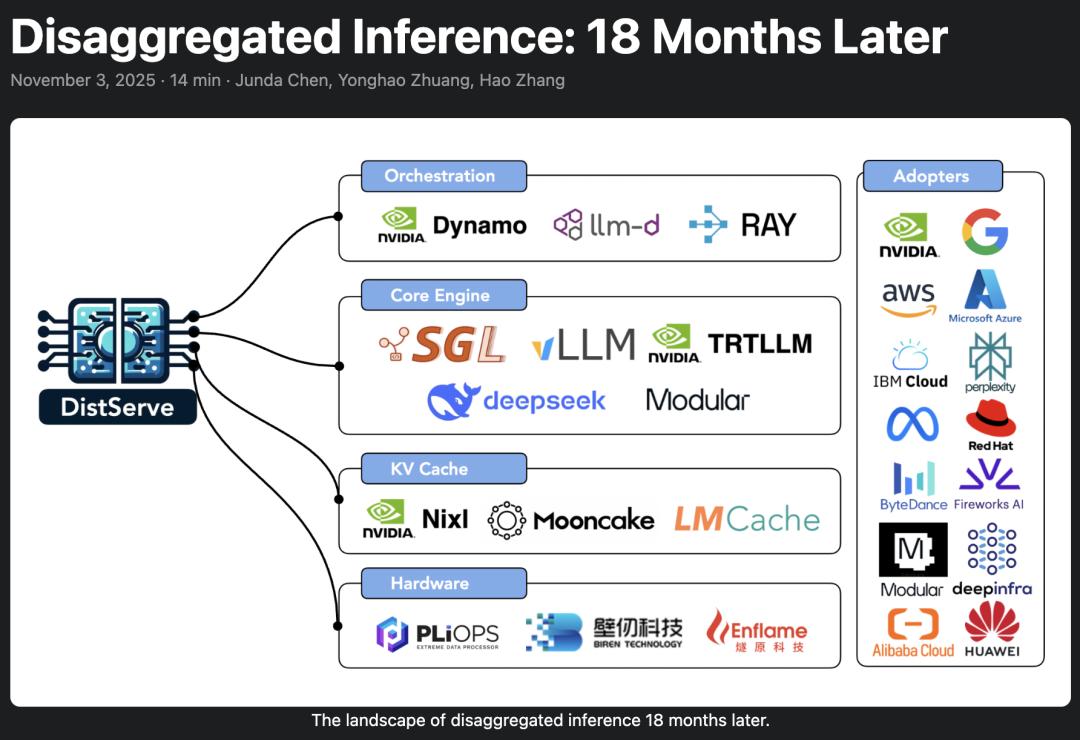
Core Insights - The article discusses the emergence of the "Decoupled Inference" concept introduced by the Peking University and UCSD teams, which has rapidly evolved from a laboratory idea to an industry standard adopted by major frameworks like NVIDIA and vLLM, indicating a shift towards "modular intelligence" in AI [1] Group 1: Decoupled Inference Concept - The DistServe system, launched in March 2024, proposes a bold idea of splitting the inference process of large models into two stages: "prefill" and "decode," allowing them to scale and schedule independently in separate resource pools [1][19] - This decoupled architecture addresses two fundamental limitations of previous inference frameworks: interference and coupled scaling, which hindered efficiency and increased costs in production environments [10][15][18] - By separating prefill and decode, DistServe enables independent scaling to meet latency requirements for both stages, significantly improving overall efficiency [19][22] Group 2: Adoption and Impact - Initially, the decoupled inference concept faced skepticism in the open-source community due to the engineering investment required for deep architectural changes [21] - However, by 2025, it gained widespread acceptance as businesses recognized the critical importance of latency control for their core operations, leading to its adoption as a default solution in major inference stacks [22][23] - The decoupled architecture allows for high resource utilization and flexibility in resource allocation, especially as model sizes and access traffic increase [22][23] Group 3: Current State and Future Directions - The decoupled inference has become a primary design principle in large model inference frameworks, influencing orchestration layers, inference engines, storage systems, and emerging hardware architectures [23][31] - Future research is exploring further disaggregation at the model level, such as "Attention-FFN Disaggregation," which separates different components of the model across various nodes [33][34] - The trend is moving towards a more modular approach in AI systems, where different functional modules can evolve, expand, and optimize independently, marking a significant shift from centralized to decoupled architectures [47][48]

独家|对话Tensormesh三位联创:如何从学术界走到大模型推理产业前线?
Z Potentials· 2025-10-24 08:18
Core Insights - Tensormesh, a company focused on providing cache-accelerated inference optimization for enterprises, has officially launched and secured $4.5 million in seed funding led by Laude Ventures [2] - The founding team, consisting of Junchen Jiang, Yihua Cheng, and Kuntai Du, aims to bridge the gap between AI inference engines and storage services, leveraging their academic backgrounds to create a commercially viable product [3][4] Company Overview - Tensormesh is the first commercial platform to productize large-scale AI inference caching, inspired by the open-source project LMCache, which combines advanced technology with enterprise-level usability, security, and manageability [2][4] - The company’s product allows enterprises to deploy large model services easily, significantly reducing operational costs to about one-tenth of public API usage while enhancing performance by up to ten times compared to mainstream solutions [4][29] Funding and Growth - The funding process for Tensormesh was unconventional, relying on personal connections rather than traditional methods like business plans or roadshows, resulting in a swift investment agreement [5][48] - The seed funding will primarily be used for product refinement and team expansion, with a strategic focus on creating a strong open-source engine as an entry point for commercial value [5][40] Market Position and Challenges - The inference industry is emerging, with the cost of inference surpassing training costs due to increased usage, highlighting the need for efficient solutions [30][32] - Tensormesh addresses three main challenges in deploying large models: privacy concerns, complex cluster management, and high operational costs [26][28] Product Features and Innovations - The product offers a one-click deployment solution for in-house large model services, ensuring data privacy while significantly lowering costs and improving performance [29][30] - Tensormesh aims to fill a market gap by providing a comprehensive solution that integrates inference engines, storage, scheduling, and routing, which is currently lacking in the industry [38] Future Aspirations - The company aspires to become the go-to solution for large model inference, similar to how Databricks is recognized in big data [44][45] - The long-term vision includes evolving with AI advancements, ensuring that Tensormesh remains relevant as the industry shifts from reliance on single models to more complex systems [51][52]

X @Avi Chawla
Avi Chawla· 2025-07-09 06:30
LLM Serving Engine - LMCache is an open-source LLM serving engine designed to reduce time-to-first-token and increase throughput, especially under long-context scenarios [1] - LMCache boosts vLLM with 7x faster access to 100x more KV caches [1] Open Source - LMCache is 100% open-source [1]
X @Avi Chawla
Avi Chawla· 2025-07-09 06:30
Key Features - LMCache is an open-source LLM serving engine designed to reduce time-to-first-token and increase throughput [1] - LMCache significantly improves vLLM, achieving 7x faster access to 100x more KV caches [1] Technical Advantages - The solution is particularly beneficial in long-context scenarios [1]