LPO(线性驱动可插拔)技术

Search documents
AI 的尽头是光:1年600%的LITE、COHR还能涨多久?
3 6 Ke· 2026-02-11 09:29
Core Insights - In 2026, global computing infrastructure will enter a "connection is king" era, driven by the limitations of traditional copper cables and the necessity for optical solutions to meet the demands of AI clusters [1][2] - Companies like LITE, COHR, and AAOI are adapting their strategies to capitalize on the AI boom, focusing on energy efficiency and low latency in connectivity [1][2] - The investment logic has shifted from merely having strong computing power to achieving high connection efficiency, with firms that possess chip self-research capabilities and major orders from tech giants poised to benefit [1][2] Group 1: Physical Limitations and Technological Shifts - The transition from copper cables to optical technology is driven by the physical limitations of copper at high signal rates, particularly as AI architectures scale beyond 100,000 GPUs [5][6] - The proportion of capital expenditure on connectivity components in data centers has increased from 15% to over 30% in three years, indicating a significant shift in investment focus [6] Group 2: Optical Technologies and Market Dynamics - Silicon photonics has crossed the 50% market share threshold in optical transceivers, becoming a critical technology for cost reduction and production efficiency [7] - CPO (Co-Packaged Optics) technology is emerging as a game-changer, potentially reducing energy demands by 50%-65% by integrating optical engines directly with GPU or switch chips [8] - LPO (Linear Plugable Optics) offers a transitional solution for companies seeking cost-effective options without fully committing to CPO technology [9] Group 3: Key Players in the Optical Market - LITE has transitioned from a component supplier to a system provider, with 60% of its revenue linked to AI infrastructure and a revenue growth rate of 65% [13] - COHR is focusing on dual development in AI communication and power semiconductors, having divested non-core assets to concentrate on AI data center opportunities [14] - AAOI has established a strong position through its partnership with Microsoft and its flexible LPO solutions, making it a notable player in the market [15][16] Group 4: Broader Market Implications - Companies like Corning (GLW) and VIAVI (VIAV) are benefiting from the increased demand for optical solutions, with GLW's optical communication business experiencing significant growth and VIAV serving as a quality gatekeeper in the supply chain [17] Group 5: Historical Context and Future Outlook - The current market dynamics differ fundamentally from the 2000 optical bubble, as the 2026 scenario is driven by demand rather than supply, indicating a more sustainable growth trajectory [20] - Investors should focus on companies that can efficiently connect computing power with minimal energy consumption, as these firms are likely to yield the highest returns in the evolving landscape [21]

AI 的尽头是光:1 年 600% 的 LITE、COHR 还能涨多久?
RockFlow Universe· 2026-02-10 10:32
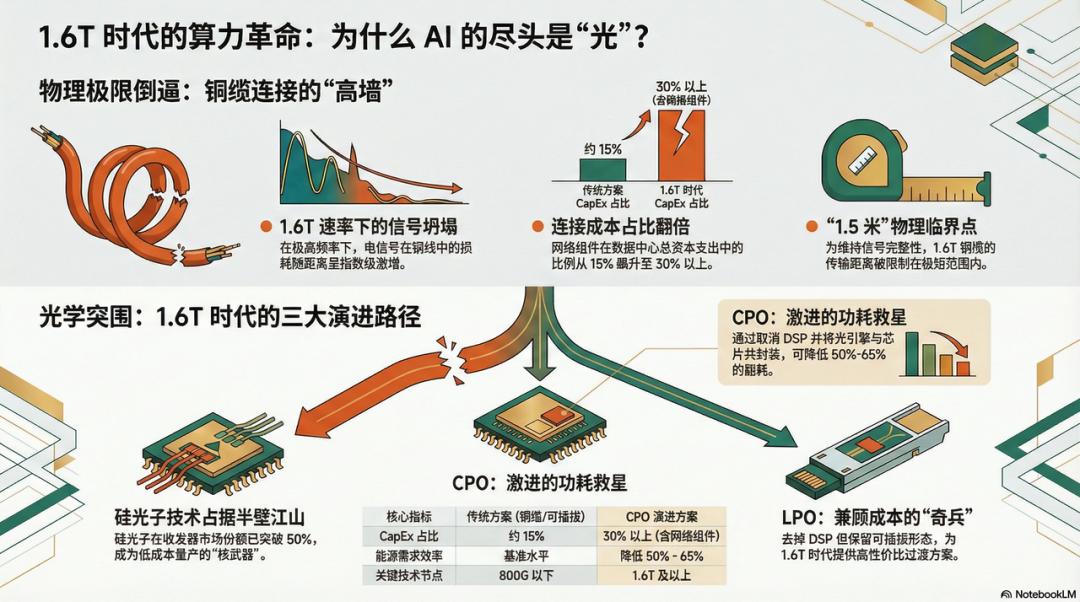
Core Insights - By 2026, global computing infrastructure will enter a "connection is king" era, driven by the limitations of traditional copper cables and the necessity for optical solutions to meet the demands of AI clusters [3][5][6] - Companies like LITE, COHR, and AAOI are leveraging vertical integration and strategic focus to transition from component pricing to system premium, aiming to eliminate energy consumption and latency [3][6][20] - Unlike the supply bubble of 2000, the 2026 infrastructure is driven by demand, with a shift in investment logic focusing on connection efficiency rather than raw computing power [3][28] Group 1: Physical Limits and Optical Solutions - The physical limitations of copper cables become apparent as signal rates reach 1.6T, leading to significant energy loss and heat accumulation in large AI clusters [9][10] - Optical technology is no longer an option but a necessity, with AI architects prioritizing connection density over raw computing power [11][12] - The share of connection components in total capital expenditure for data centers has surged from 15% to over 30% in three years [12] Group 2: Key Technologies and Innovations - Silicon photonics has crossed the 50% market share threshold in optical transceivers, becoming a critical weapon for cost reduction and production efficiency [14][15] - CPO technology aims to reduce energy demands by integrating optical engines directly with GPU or switch chips, potentially lowering energy needs by 50%-65% [16][17] - LPO technology offers a transitional solution for companies seeking cost-effective options without immediately switching to expensive CPO systems [18][19] Group 3: Competitive Landscape - LITE has transformed from a component supplier to a system provider, with 60% of its revenue linked to AI infrastructure and a revenue growth rate of 65% [23] - COHR is focusing on dual development in AI communication and power semiconductors, having divested non-core assets to concentrate on AI data centers [24] - AAOI, benefiting from deep ties with Microsoft and a flexible LPO approach, is positioned as a strong competitor in the mid-market segment [25] Group 4: Historical Context and Future Outlook - The current market dynamics differ fundamentally from the 2000 bubble, as the 2026 scenario is characterized by demand-driven infrastructure rather than supply chasing demand [28] - Investment focus is shifting from who has the strongest computing power to who can connect the most computing power with the least energy consumption [30]