MOF功能膜

Search documents
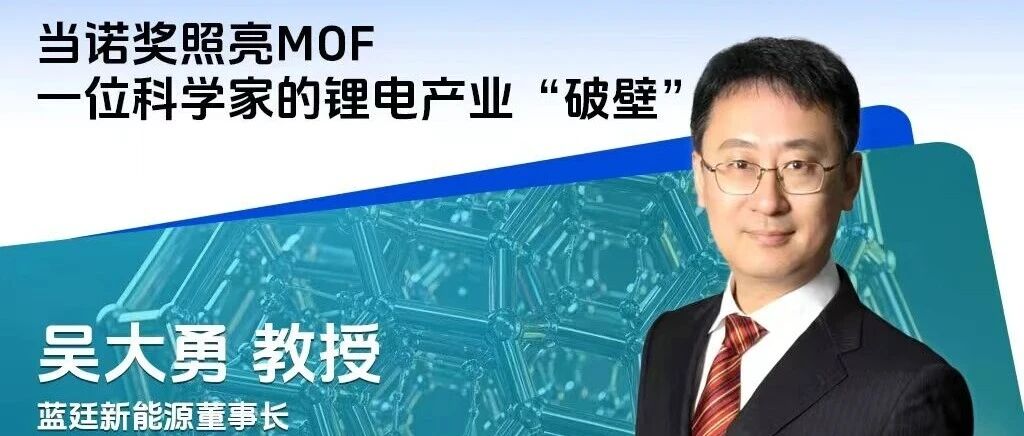
对话吴大勇:一位科学家的锂电产业“破壁”
高工锂电· 2026-02-16 12:09
Core Viewpoint - The article discusses the potential of Metal-Organic Frameworks (MOF) in enhancing battery performance, particularly in lithium-ion batteries, and the ongoing industrial exploration of MOF technology following its recognition in the 2025 Nobel Prize in Chemistry [1][2]. Group 1: MOF's Industrial Relevance - MOF has gained attention in the lithium battery industry, marking a shift from academic research to practical applications [2]. - The exploration of MOF in the battery sector is not a new phenomenon but has recently gained more serious discussion and evaluation [2]. - The focus is on whether MOF can break performance boundaries in batteries and achieve stable production [2][3]. Group 2: MOF's Structural Advantages - MOF consists of metal clusters and organic ligands, forming a highly ordered porous crystalline structure that can be designed at the molecular level [8]. - The unique properties of MOF, such as its electrical characteristics and tunable structure, can influence electrolyte dissociation and lithium-ion migration [5][10]. - MOF's ability to capture by-products and improve interface conditions provides a material basis for enhancing battery performance [5]. Group 3: Research and Development Focus - The research on MOF has transitioned from feasibility to practical questions regarding effective types, industrial synthesis, and cost-control [7]. - The BlueTing team initiated systematic validation of MOF in composite membrane systems around 2019, achieving key experimental results and patent layouts by 2021-2022 [6]. Group 4: MOF's Role in Battery Systems - MOF can enhance lithium-ion migration rates, reduce local polarization, and mitigate electrolyte consumption by adsorbing side reaction products [13][14]. - The introduction of MOF into lithium-ion batteries has shown significant improvements in rate performance, making it suitable for applications requiring high power and cycle life [14]. - BlueTing's products have been validated in drone battery applications, demonstrating the effectiveness of MOF in high-performance and high-safety scenarios [14]. Group 5: Competitive Landscape and Industrialization - The competition in MOF technology hinges on both structural design and efficient synthesis capabilities, with industrialization often being more decisive [17][19]. - BlueTing has integrated AI and machine learning to enhance MOF structure design, recognizing the importance of both design and production capabilities [18][20]. - The synthesis of MOF, while seemingly straightforward, presents challenges in maintaining structural consistency and electrochemical behavior during industrialization [19]. Group 6: Product Development and Market Strategy - BlueTing is focusing on two main product directions: MOF functional materials for membrane coatings and composite electrolyte materials for semi-solid and solid-state systems [22][23]. - The company plans to launch its "super solid electrolyte" products by 2026, collaborating with innovative enterprises for development and validation [24]. - The exploration of MOF in the lithium battery industry aims to address the innovation boundaries as battery performance approaches its limits [24][25].

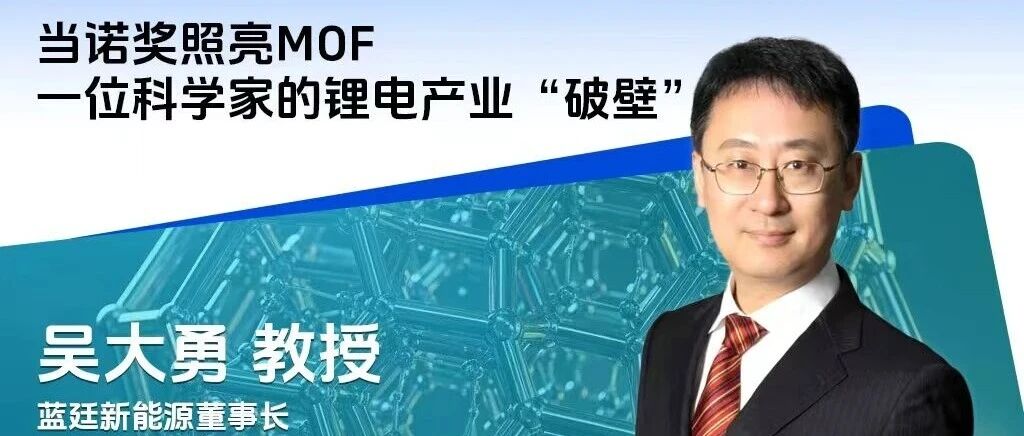
当诺奖照亮MOF:一位科学家的锂电产业“破壁”
高工锂电· 2026-01-08 10:47
Core Viewpoint - The article discusses the potential of Metal-Organic Frameworks (MOF) in breaking the performance boundaries of batteries, particularly in the lithium battery industry, following the recognition of MOF in the 2025 Nobel Prize in Chemistry [1][2]. Group 1: MOF's Industrial Relevance - MOF has gained attention in the lithium battery industry after years of research, with companies beginning to explore its industrial applications [2]. - The focus is on whether MOF can enhance battery performance and achieve stable production, rather than being a completely new material [2]. Group 2: MOF's Structural Advantages - MOF's unique properties, such as its electrical characteristics and designable structure, can influence electrolyte dissociation and lithium ion migration [4]. - The material's porous structure and functional group design provide a basis for capturing by-products and improving interface conditions [4]. Group 3: Research and Development Focus - The research has shifted from feasibility to practical questions regarding the effectiveness of specific MOF types, industrial synthesis capabilities, and cost and environmental control [5]. - MOF's design allows for precise control over its structure, which is crucial for enhancing battery performance [6]. Group 4: Application in Solid-State Batteries - Certain MOF materials, like UIO-66, maintain structural stability under high temperatures and pressures, making them suitable for solid-state battery applications [7]. - MOF can enhance lithium ion migration rates and improve overall battery performance, particularly in high-demand applications like drones and high-end electric tools [9]. Group 5: Competitive Landscape - The future competition in the MOF space will hinge on both the design of new structures and the efficiency of synthesis and production capabilities [11]. - The synthesis of MOF is not overly complex, but industrialization poses challenges that affect the consistency and electrochemical behavior of the final product [12]. Group 6: Product Development Strategy - The company is focusing on developing MOF-based functional materials for battery applications, particularly in enhancing ion migration and interface stability [16]. - The strategy includes creating a "super solid electrolyte" that combines high-performance solid electrolytes with MOF materials, aiming to differentiate from competitors in the lithium battery market [16].