
金属有机框架材料(MOF)

Search documents
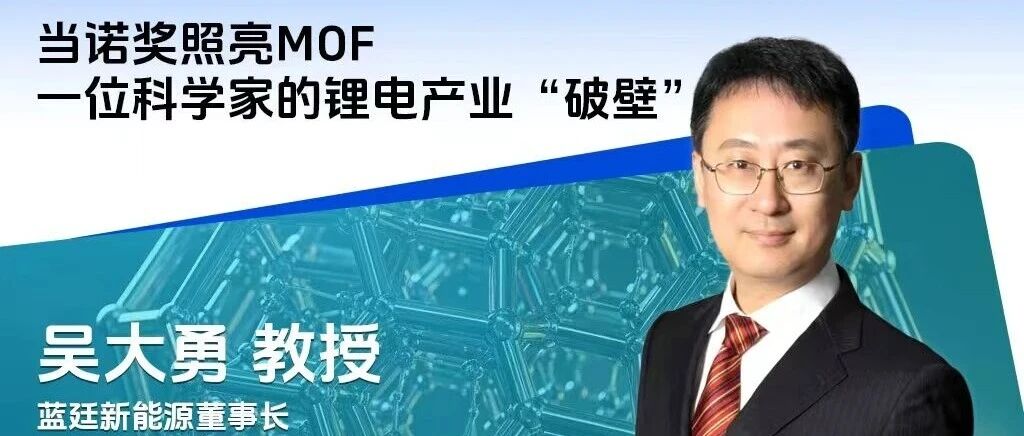
对话吴大勇:一位科学家的锂电产业“破壁”
高工锂电· 2026-02-16 12:09
Core Viewpoint - The article discusses the potential of Metal-Organic Frameworks (MOF) in enhancing battery performance, particularly in lithium-ion batteries, and the ongoing industrial exploration of MOF technology following its recognition in the 2025 Nobel Prize in Chemistry [1][2]. Group 1: MOF's Industrial Relevance - MOF has gained attention in the lithium battery industry, marking a shift from academic research to practical applications [2]. - The exploration of MOF in the battery sector is not a new phenomenon but has recently gained more serious discussion and evaluation [2]. - The focus is on whether MOF can break performance boundaries in batteries and achieve stable production [2][3]. Group 2: MOF's Structural Advantages - MOF consists of metal clusters and organic ligands, forming a highly ordered porous crystalline structure that can be designed at the molecular level [8]. - The unique properties of MOF, such as its electrical characteristics and tunable structure, can influence electrolyte dissociation and lithium-ion migration [5][10]. - MOF's ability to capture by-products and improve interface conditions provides a material basis for enhancing battery performance [5]. Group 3: Research and Development Focus - The research on MOF has transitioned from feasibility to practical questions regarding effective types, industrial synthesis, and cost-control [7]. - The BlueTing team initiated systematic validation of MOF in composite membrane systems around 2019, achieving key experimental results and patent layouts by 2021-2022 [6]. Group 4: MOF's Role in Battery Systems - MOF can enhance lithium-ion migration rates, reduce local polarization, and mitigate electrolyte consumption by adsorbing side reaction products [13][14]. - The introduction of MOF into lithium-ion batteries has shown significant improvements in rate performance, making it suitable for applications requiring high power and cycle life [14]. - BlueTing's products have been validated in drone battery applications, demonstrating the effectiveness of MOF in high-performance and high-safety scenarios [14]. Group 5: Competitive Landscape and Industrialization - The competition in MOF technology hinges on both structural design and efficient synthesis capabilities, with industrialization often being more decisive [17][19]. - BlueTing has integrated AI and machine learning to enhance MOF structure design, recognizing the importance of both design and production capabilities [18][20]. - The synthesis of MOF, while seemingly straightforward, presents challenges in maintaining structural consistency and electrochemical behavior during industrialization [19]. Group 6: Product Development and Market Strategy - BlueTing is focusing on two main product directions: MOF functional materials for membrane coatings and composite electrolyte materials for semi-solid and solid-state systems [22][23]. - The company plans to launch its "super solid electrolyte" products by 2026, collaborating with innovative enterprises for development and validation [24]. - The exploration of MOF in the lithium battery industry aims to address the innovation boundaries as battery performance approaches its limits [24][25].

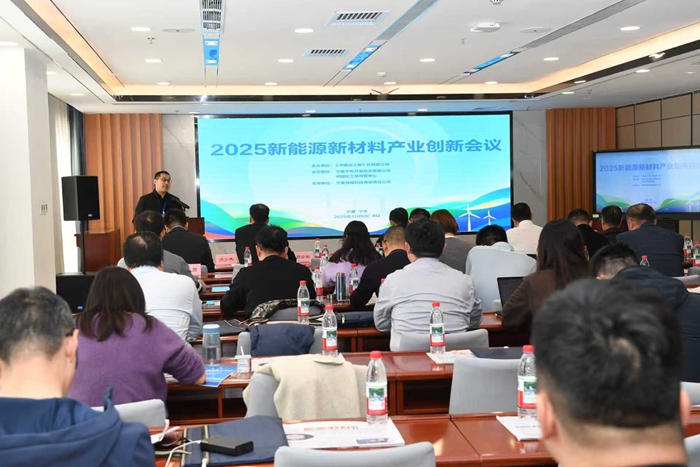
引领“双新”创新 前瞻产业未来——2025石油和化工行业推进中国式现代化发展大会分论坛“新能源新材料产业创新会议”观点集萃
Zhong Guo Hua Gong Bao· 2025-11-21 04:38
Core Insights - The conference focused on the modernization of the oil and chemical industry in China, addressing topics such as MOF materials, AI-driven new material development, flow battery energy storage applications, and green methanol development pathways [1][5]. Group 1: MOF Materials - MOF materials have a vast market potential, with a global market size projected to grow from $410 million in 2024 to $2.1 billion by 2031, representing a compound annual growth rate (CAGR) of approximately 34% [5]. - The unique characteristics of MOF materials include an ultra-high specific surface area, adjustable pore sizes for efficient gas separation, and strong designability for various applications in clean energy, semiconductors, catalysis, and biomedicine [5][6]. Group 2: AI in Material Development - The application of artificial intelligence (AI) is transforming the research paradigm in new material development, significantly enhancing the efficiency and accuracy of material discovery processes [8][9]. - A new molecular language model has been developed to predict and generate over 2 million structures in just a few hours, improving material discovery efficiency by over 80% with an accuracy rate exceeding 90% [8]. Group 3: Industry Trends and Strategic Directions - The chemical industry is shifting towards high-quality development in response to global competition, particularly between major powers like China and the U.S., with a focus on meeting societal needs through innovation and collaboration [11]. - The demand for new materials is surging, particularly in the fields of new energy and electrification, driven by the rapid growth of electric vehicles and renewable energy sectors [11]. Group 4: Flow Battery Technology - Flow batteries, particularly vanadium flow batteries, are gaining traction due to their safety, long lifespan, and suitability for large-scale energy storage applications [13]. - China leads the global market in vanadium production, accounting for 72% of global output, and is expected to achieve complete domestic control of the flow battery supply chain soon [13]. Group 5: Green Methanol Development - Green methanol is positioned as a key player in the energy revolution and carbon neutrality goals, with significant potential in various applications including automotive fuel and as a low-carbon chemical feedstock [15]. - Over 100 green methanol projects have been signed or registered in China, with a cumulative planned annual production capacity exceeding 50 million tons, although only a few projects have been realized [15]. Group 6: Innovation and Sustainability - Innovation is identified as the core support for carbon reduction and efficiency enhancement in the chemical industry, with a focus on high-efficiency heat transfer technologies [17][18]. - The chemical industry is expected to see a total sustainable investment of $20 trillion to $33 trillion by 2030, emphasizing the need for accelerated technology development and application [20][21]. Group 7: Intellectual Property and Competitive Strategy - Intellectual property protection is crucial for overcoming "involution" in the chemical industry, which is characterized by homogeneous products competing on price [25]. - Companies are encouraged to shift from quantity-driven growth to quality-focused operations, emphasizing the importance of high-value patents and strategic IP management [25].

展现广阔应用前景 “热门”方向终于不负众望
Ke Ji Ri Bao· 2025-10-09 08:40
Core Viewpoint - The awarding of the Nobel Prize in Chemistry for 2025 to three scientists for their work on Metal-Organic Frameworks (MOFs) is seen as timely, despite being slightly delayed, due to the significant scientific breakthroughs and broad application prospects associated with MOFs [1][2]. Group 1: Research and Development of MOFs - Over the past two decades, research on MOFs has been one of the most active and fruitful areas in chemistry and materials science, with the awarded scientists previously receiving the "Citation Laureates" award, often considered a precursor to the Nobel Prize [2]. - The core breakthrough in MOF technology was achieved in the late 20th century, and its academic influence has been widely recognized. Recent applications of MOFs have progressed from laboratory settings to demonstration phases, allowing for clearer assessments of their potential societal value [2]. - MOFs are crystalline porous materials formed by the self-assembly of inorganic metal centers and organic ligands, characterized by high surface area and pore volume, which enable various unique functions such as gas adsorption and separation, energy storage, and drug delivery [2]. Group 2: Overcoming Challenges - Despite being a popular research direction, MOFs have faced skepticism regarding their high costs and short lifespans, which have hindered their transition from laboratory to practical applications [3]. - Richard Robson, a foundational figure in MOF research, theoretically validated the feasibility of these materials, while North River Jin overcame early criticisms by synthesizing the first stable three-dimensional MOF that could reversibly adsorb gases [3]. - Omar Yaghi, inspired by water scarcity in his childhood, successfully synthesized a stable two-dimensional structure and coined the term "Metal-Organic Framework," contributing significantly to the theoretical framework of MOF research [3]. Group 3: China's Position in MOF Research - China has emerged as one of the most active countries in the global MOF research field, ranking among the world's leaders in terms of publication volume, citation frequency, and high-level original contributions [4]. - Research teams, such as those at Beijing University of Chemical Technology, are focusing on the large-scale preparation and electrochemical applications of MOFs. Addressing the technical challenges in scaling up and cost-effective industrial applications could unlock even greater value for these materials [4].