MoPPS

Search documents
训练加速1.8倍,推理开销降78%,精准筛选题目高效加速RL训练
3 6 Ke· 2026-02-09 10:39
Core Insights - The article discusses the introduction of MoPPS, a new framework for model predictive prompt selection that aims to enhance the efficiency of reinforcement learning fine-tuning for large language models by accurately predicting question difficulty without the need for expensive evaluations from large models [5][26]. Group 1: Training Efficiency - MoPPS significantly reduces computational costs associated with training by minimizing the reliance on large model self-evaluations, achieving up to 78.46% reduction in rollouts compared to traditional methods [15][18]. - The framework accelerates training efficiency by 1.6x to 1.8x compared to conventional uniform sampling methods, ensuring that the most critical questions are selected for training [16][26]. Group 2: Methodology - MoPPS employs a lightweight Bayesian model to predict question difficulty, using a Beta distribution to estimate success rates for each question, which allows for efficient updates based on training feedback [8][9]. - The framework utilizes Thompson Sampling for active question selection, balancing exploration and exploitation to identify questions that are optimally challenging for the model [10][12]. Group 3: Performance Metrics - Experimental results indicate that MoPPS maintains a high correlation between predicted and actual question difficulty, demonstrating its reliability and effectiveness in training scenarios [19][22]. - The framework is compatible with various reinforcement learning algorithms and can adapt to different sampling strategies, enhancing its applicability across different training contexts [20][24]. Group 4: Industry Impact - The research has garnered attention from major industry players such as Alibaba, Tencent, and Ant Group, indicating its potential impact on the field of AI and machine learning [4]. - The MoPPS framework represents a significant advancement in the cost-effective fine-tuning of large models, potentially influencing future developments in reinforcement learning applications [26].

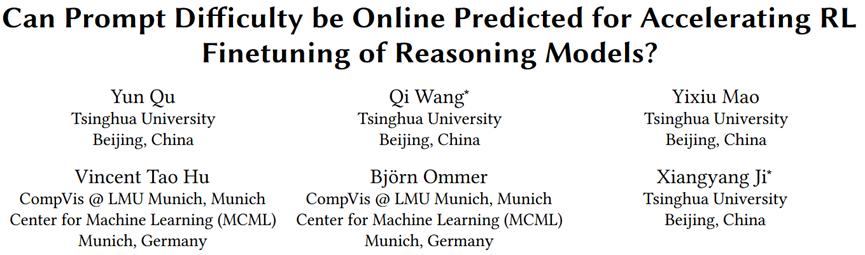
训练加速1.8倍,推理开销降78%!精准筛选题目高效加速RL训练丨清华KDD
量子位· 2026-02-09 09:50
Core Insights - The article discusses the significant advancements in reasoning capabilities of large language models (LLMs) through reinforcement learning fine-tuning, particularly highlighting the high costs associated with inefficient training processes [1][2]. Group 1: Training Efficiency - Traditional training methods like "Uniform Sampling" waste computational resources by randomly selecting questions that do not provide effective learning signals [2]. - The "Dynamic Sampling" approach, while more efficient, still incurs high costs due to the need for extensive self-evaluation by the model [2][6]. - The proposed MoPPS framework aims to dynamically predict question difficulty without the expensive self-evaluation process, thus enhancing training efficiency [3][6]. Group 2: MoPPS Framework - MoPPS utilizes a lightweight Bayesian model to quickly estimate question difficulty, allowing for efficient selection of training data [8][10]. - The framework models each question as a "bandit" problem, using a Beta distribution to estimate success rates based on training feedback [9][10]. - MoPPS introduces a recursive update mechanism that improves difficulty estimation over time, adapting to the model's evolving capabilities [11][13]. Group 3: Performance Improvements - MoPPS has demonstrated a training speed increase of 1.6x to 1.8x while reducing inference costs by up to 78.46% compared to traditional methods [18][21]. - The framework has shown significant advantages across various reasoning tasks, achieving better performance with fewer computational resources [18][21]. - The correlation between predicted and actual question difficulty is high, validating the effectiveness of MoPPS in accurately estimating task challenges [25][29]. Group 4: Versatility and Future Applications - MoPPS is compatible with multiple reinforcement learning algorithms and can adapt to different sampling strategies, enhancing its applicability [26][28]. - The framework's ability to incorporate prior knowledge can further accelerate initial training phases, making it a versatile tool for large-scale model fine-tuning [28][31]. - The research indicates potential for broader applications in the reinforcement learning fine-tuning of larger models in the future [31].