NVQLink

Search documents
Quantum Computing Reaches an Inflection Point With NVIDIA NVQLink | GTC 2026
NVIDIA· 2026-03-20 20:54
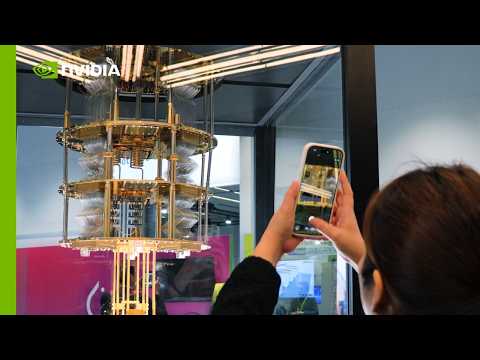
We're standing here at the NVIDIA NVQLink booth here at GTC in San Jose. NVQLink is really the Rosetta Stone for communicating between quantum hardware and classical supercomputing. And that's crucial because, without GPU supercomputers, we’ll never be able to turn the cubits that we have today into useful quantum computers.There are many areas where we don't expect quantum computers to ever be better than conventional computers, but in some areas they're absolutely transformational. And those are things li ...


IBM公布量子芯片路线图
半导体行业观察· 2026-03-17 02:27
Core Insights - The article discusses the integration of quantum computing with classical high-performance computing (HPC) systems, emphasizing that this integration will be crucial for the future of computing [2][3][7]. Group 1: Quantum Computing Integration - Quantum computing is expected to be integrated as a cloud service alongside classical supercomputers, functioning as an accelerator for workloads that are too demanding for classical systems [2]. - Companies like Nvidia are already developing technologies to connect HPC with quantum computing, such as NVQLink for high-speed interconnects [2]. - Startups like Quantum Elements are leveraging AI and digital twin technologies to accelerate the commercialization of fault-tolerant quantum computing [3]. Group 2: Industry Developments - IBM has released a reference architecture that combines quantum and classical computing, which is seen as a roadmap for future workloads in quantum-centric supercomputing (QCSC) [3][10]. - The architecture consists of multiple layers, including a quantum system with classical runtime and interconnected quantum processing units (QPU), and a programmable layer with CPU and GPU systems [7][8]. - The integration of quantum computing into existing supercomputing frameworks is becoming a national security issue, with the U.S. needing to maintain its technological edge [3]. Group 3: Future Trends - IBM has outlined a timeline for the development of quantum and classical computing integration, highlighting key milestones such as the release of the Heron and Nighthawk quantum chips [10][12]. - The architecture aims to demonstrate various use cases that require tight temporal or spatial coupling, guiding the evolution of resource integration [9]. - The article emphasizes that quantum processors will not replace all traditional infrastructure but will become a vital component of the overall architecture [12].


IQM and Zurich Instruments Launch Real-Time Quantum Error Correction Demonstrator with NVIDIA NVQLink
Businesswire· 2026-03-16 21:24
Core Insights - IQM Quantum Computers and Zurich Instruments have launched a real-time quantum error correction demonstrator utilizing NVIDIA's NVQLink platform, marking a significant step towards scalable and fault-tolerant quantum computing for enterprise and datacenter applications [1][2][6] Group 1: Project Overview - The joint project aims to address the challenges of reliably operating quantum computers and integrating them into existing infrastructures, focusing on full-system integration for industrial-grade quantum computing [2][4] - The demonstrator combines IQM's 20-qubit superconducting quantum computer, Zurich Instruments' ZQCS Quantum Control System, and GPU-accelerated classical computing through NVQLink, enabling low-latency decoding and feedback necessary for operating logical qubits at scale [3][6] Group 2: Strategic Importance - This initiative establishes a foundation for standardized enterprise-ready quantum systems and datacenter deployment, paving the way for scalable and fault-tolerant quantum computers [4][6] - The collaboration emphasizes the convergence of quantum processors and supercomputing, expanding the range of problems that can be addressed through advanced computing [8] Group 3: Leadership Perspectives - Jan Goetz, CEO of IQM, highlighted the importance of building infrastructure for widespread and routine use of quantum computing, stating that the demonstrator is a step towards accessible fault-tolerant quantum systems [5] - Andrea Orzati, CEO of Zurich Instruments, noted that the ZQCS is designed to run quantum systems reliably within supercomputing infrastructures, showcasing the integration of logical qubits with real-time classical computing [7]

Rigetti(RGTI) - 2025 Q4 - Earnings Call Transcript
2026-03-04 23:02
Financial Data and Key Metrics Changes - For Q4 2025, revenue was $1.9 million, down from $2.3 million in Q4 2024, influenced by system delivery timing and government contract activity [18] - Gross margins for Q4 were 35%, compared to 44% in the same period last year, primarily driven by contract mix [18][19] - Total operating expenses for Q4 were $23.2 million, up from $19.5 million in Q4 2024, with R&D spending concentrated on engineering and system integration [19][20] - GAAP net loss for Q4 2025 was lower than the previous year, while non-GAAP net loss was $11.3 million or $0.03 per share, compared to a net loss of $14 million or $0.06 per share in Q4 2024 [21] Business Line Data and Key Metrics Changes - The company achieved a 2-qubit gate fidelity of 99.9% at a gate speed of 28 nanoseconds, maintaining 99.9% 1-qubit gate fidelity [7][37] - Multiple systems were deployed to the cloud, including an 84-qubit monolithic chip system and a 36-qubit chiplet-based system [8] - The company received an $8.4 million order from India's C-DAC for a 108-qubit on-premises quantum computer, scheduled for deployment in H2 2026 [10] Market Data and Key Metrics Changes - Increased demand for on-premises quantum systems, particularly from national governments and research institutions [9] - The company is expanding into Japan with a purchase order for a Novera QPU scheduled for delivery in April 2026 [11] Company Strategy and Development Direction - The company focuses on superconducting gate-based quantum computing, emphasizing speed and scalability as key advantages [6] - The strategy includes achieving true quantum advantage, defined as outperforming classical systems on practical workloads [14] - The company plans to deploy a system with more than 150 qubits by the end of 2026, targeting 99.7% median two-qubit gate fidelity [15][92] Management's Comments on Operating Environment and Future Outlook - Management expressed confidence in achieving quantum advantage within approximately three years, emphasizing the importance of precision and credibility in timelines [15] - The company exited the year with approximately $590 million in cash, providing flexibility to execute its roadmap [17] - Management highlighted the importance of patience and technical rigor in the long-term development of quantum computing [17] Other Important Information - The company operates Fab-1, the first dedicated quantum device manufacturing facility, which is seen as a competitive advantage [9] - The company is open to M&A opportunities that could accelerate its roadmap but does not rely on acquisitions for its core strategy [24][59] Q&A Session Summary Question: What are the key remaining gating items to deliver the 108-qubit system as a customer-ready system? - Management confirmed they are on track to deploy the 108-qubit system by the end of March, addressing interactions between tunable couplers [27][28] Question: Would the company consider offering foundry or manufacturing capacity to others in the quantum computing industry? - Management stated they already offer Fab-1 as a foundry to select customers, including government entities [29] Question: Can you clarify the fidelity levels for the 108-qubit system upon launch? - Management confirmed 1-qubit gate fidelity will be 99.9% and 2-qubit gate fidelity will be about 99.5% [33][34] Question: What is the status of the DARPA collaboration? - Management expressed confidence in progressing to Phase B of the DARPA program by the end of the year [38] Question: What is the expected gross margin for the Novera and C-DAC systems? - Management refrained from disclosing specific gross margins for competitive reasons but indicated that margins for Novera systems with dilution refrigeration would be lower [46][47] Question: What is the company's stance on government funding initiatives? - Management noted ongoing discussions at the U.S. government level for quantum computing support and highlighted existing funding from the DoD [67][68]

2 Top Quantum Computing Stocks to Buy in 2026
The Motley Fool· 2026-02-10 10:27
Core Insights - Quantum computing is an emerging technology with significant long-term investment potential, projected to reach a market value of $1 trillion or more in the next decade [2]. Company Summaries IonQ - IonQ is a leading pure-play stock in the quantum computing sector, having invested in the technology for over 20 years [4]. - The company's Tempo computing system offers a computational space 36 quadrillion times larger than competitors, indicating its potential [4]. - IonQ's revenue grew by 222% year-over-year in Q3, with estimates predicting revenue of $192 million for the current fiscal year and $316 million for the next [5]. - The current market cap of IonQ is $13 billion, with a stock price of $35.48, but it has experienced a 58% decline from its recent peak [6][8]. - IonQ's stock trades at a high sales multiple of 109, reflecting the early-stage nature of the technology and the associated risks [8]. Nvidia - Nvidia is a major supplier of GPUs and sees quantum computing as a new market to expand its leadership [9][11]. - The company provides high-speed interconnects that link GPUs to quantum chips, facilitating accelerated computing for quantum systems [11]. - Nvidia generated $99 billion in net income on $187 billion in revenue over the past 12 months, showcasing its financial strength [12]. - The stock trades at 24 times this year's earnings estimate, presenting an attractive valuation compared to IonQ [13].



Will Strategic Partnerships Help Rigetti Reach Quantum Scale Faster?
ZACKS· 2026-01-26 16:20
Core Insights - Rigetti Computing (RGTI) is establishing a unique position by integrating its quantum hardware with AI supercomputing and public-sector research ecosystems, focusing on hybrid computing environments that combine classical and quantum systems [1] - The company is enhancing its partnerships with academic institutions and government entities to foster innovation and talent development, exemplified by its collaboration with Michigan State University and India's C-DAC [2] - RGTI's development roadmap includes the rollout of a 150+ qubit system by late 2026 with approximately 99.7% two-qubit gate fidelity, followed by a 1,000+ qubit platform around 2027 with fidelity nearing 99.8% [3] Group 1 - RGTI is integrating its quantum systems into hybrid AI environments, including support for NVIDIA's NVQLink [8] - The company is expanding academic and government ties with MSU and India's C-DAC to boost R&D and talent [2][8] - RGTI targets 150 qubits by late 2026 and 1,000 qubits by 2027 [3][8] Group 2 - RGTI's collaboration-driven strategy facilitates early validation and real-world testing, increasing the likelihood of achieving scalable, commercially viable quantum platforms [4] - D-Wave Quantum (QBTS) is gaining traction through application-led partnerships with various commercial and research customers, focusing on practical quantum applications [5] - IonQ (IONQ) is expanding its partnerships in national-level infrastructure and commercial applications, including a national quantum communications network in Slovakia and a partnership in regenerative medicine [6][7]
Why Rigetti Computing Stock Soared 45.2% Last Year and Has Kept Gaining in 2026
Yahoo Finance· 2026-01-20 12:05
Core Insights - Rigetti Computing's stock experienced significant gains in 2025, rising 45.2%, outperforming the S&P 500 and Nasdaq Composite [1] Stock Performance - Despite a volatile trading environment, Rigetti's stock closed 2025 with substantial gains, significantly exceeding the broader market indices [1] - The stock initially faced a sell-off due to Nvidia CEO Jensen Huang's comments on quantum computing commercialization but rebounded later in the year [2] Key Partnerships and Contracts - A major valuation boost occurred in September 2025 when Rigetti signed a three-year contract worth $5.8 million with the Air Force Research Laboratory to develop quantum networking technologies in collaboration with QphoX [4] - Another surge in stock price followed the announcement of a collaboration with Nvidia to support the NVQLink platform, integrating AI supercomputers with quantum technology [5] Recent Trends and Analyst Coverage - Rigetti's stock continued to rise in early 2026, gaining 15.7%, outperforming the S&P 500 and Nasdaq Composite [6] - Rosenblatt initiated coverage on Rigetti with a buy rating and set a one-year price target of $40 per share, indicating a potential upside of 56% based on the company's strengths in qubit scaling and partnerships [7]
The 3 Best Quantum Computing Stocks to Buy for 2026
Yahoo Finance· 2026-01-12 20:11
Core Insights - Nvidia is actively involved in quantum computing, providing essential infrastructure and software to support hybrid quantum systems, which enhance AI capabilities in complex applications like drug discovery and materials science [1][7] - The company has launched NVQLink, an architecture that connects GPUs to Quantum Processing Units (QPUs), facilitating real-time tasks essential for practical quantum computing [7][8] - Nvidia's market cap is currently $4.49 trillion, making it the most valuable company globally, with a strong focus on AI and quantum computing as key growth areas [3] Nvidia's Financial Performance - In Q3, Nvidia reported record revenue of $57 billion, a 22% increase from the previous quarter and a 62.5% year-over-year growth, with earnings of $1.30 per share [9] - The data center segment generated $51.2 billion in revenue, up 25% sequentially and 66% year-over-year, driven by accelerated computing and AI applications [9] - Analysts project a 61.68% year-over-year increase in profit to $7.59 per share for fiscal 2027, with revenue expected to grow 50.30% to $320.5 billion [10] Analyst Sentiment - Wall Street analysts have a consensus rating of "Strong Buy" for Nvidia, with 44 out of 48 analysts recommending it, and a mean price target of $256, indicating a 38.5% upside potential [11] Quantum Computing Industry Overview - Quantum computing is evolving into a transformative technology with significant commercial implications, shifting focus from its feasibility to identifying beneficiaries as commercialization progresses [6] - Companies like Amazon and D-Wave Quantum are also positioned to capitalize on quantum computing advancements, with Amazon integrating quantum solutions into its AWS platform and D-Wave being a pure-play quantum computing provider [4][20] D-Wave Quantum's Performance - D-Wave Quantum reported a 100% increase in revenue to $3.7 million in Q3, driven by system upgrades and professional services, although it faced a widening net loss of $140 million [23] - Analysts expect D-Wave's revenue to jump 55.46% year-over-year to $39.82 million in FY26, with a consensus rating of "Strong Buy" among analysts [24][26] Amazon's Quantum Computing Strategy - Amazon is leveraging its AWS platform to lead in quantum computing commercialization, offering a cloud-based quantum research platform and developing its own quantum chip, Ocelot [14][15] - The company reported a 13.4% year-over-year increase in total net sales to $180.2 billion in Q3, with AWS generating $33 billion in revenue, up 20% year-over-year [17] - Analysts forecast an 11.19% year-over-year increase in Amazon's GAAP EPS to $7.86 for 2026, with a consensus rating of "Strong Buy" [18][19]


Want to Invest in Quantum Computing? These 3 Stocks Are Great Buys Right Now.
The Motley Fool· 2026-01-10 19:31
Core Insights - Quantum computing is a rapidly evolving technology that has the potential to revolutionize various fields, including drug discovery, materials science, and cryptography, by enabling computations beyond the capabilities of current supercomputers [2] - Despite its promise, quantum computing is not yet commercially viable due to high error rates and the sensitivity of qubits to external interference [3][5] - Major tech companies are investing in quantum computing, providing alternative investment opportunities beyond pure-play start-ups [9] Group 1: Technology Overview - Quantum computers utilize qubits, which can exist in superposition, allowing for complex calculations that classical bits cannot perform [3][4] - The primary challenge in quantum computing is maintaining qubit stability and reducing error rates, as even minor environmental changes can lead to incorrect results [5][7] - Companies are exploring various methods to create fault-tolerant quantum computers that can manage and correct errors effectively [8] Group 2: Key Players - IBM is heavily invested in quantum computing, developing two chips: Nighthawk, aimed at advanced simulations, and Loon, which targets large-scale fault-tolerant quantum supercomputing [10][11] - IBM is also focused on error mitigation tools and has developed a software stack, Qiskit, to facilitate practical applications of quantum computing [12] - Nvidia and Alphabet are also significant players in the quantum space, with Alphabet achieving a breakthrough in error reduction with its Willow chip [13] - Nvidia is not developing its own quantum chip but is creating systems to integrate traditional and quantum computing, including NVQLink for real-time error correction and an open-source software platform called CUDA-Q [15][16]


3 Top Quantum Computing Stocks to Buy in 2026
The Motley Fool· 2026-01-07 05:00
Core Insights - Quantum computing is poised for significant growth, with projections estimating a market size of $100 billion over the next decade [2] Group 1: Companies in Quantum Computing - **Nvidia**: A leader in GPU technology, Nvidia is exploring quantum computing to enhance AI capabilities. The company has developed NVQLink and CUDA-Q to integrate quantum processors with AI supercomputers, positioning itself at the intersection of current and future computing technologies [4][5][7] - **IBM**: Despite being seen as a legacy company, IBM has adapted by focusing on hybrid cloud computing and quantum technology. It has generated over $1 billion in lifetime revenue from quantum computing and offers Qiskit, a widely used software development kit [8][9][11] - **Microsoft**: A major player in technology, Microsoft is investing in quantum research, having developed the Majorana 1 chip capable of housing 1 million qubits. The company’s strong market presence and resources position it well for future advancements in quantum computing [12][13][15]