NWM(Nio World Model)

Search documents
特斯拉再添一把火,「世界模型」如何重塑自动驾驶?
Tai Mei Ti A P P· 2025-12-02 09:05
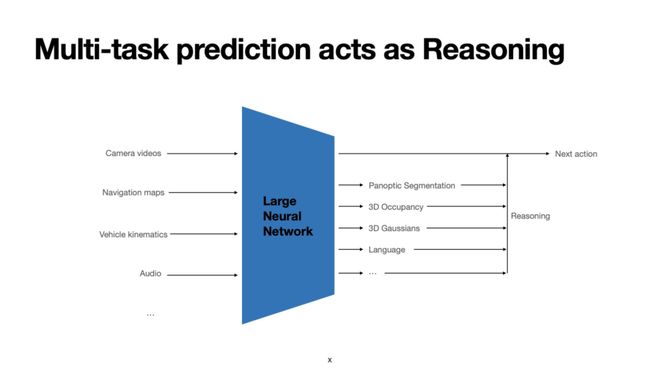
Core Insights - The article discusses the advancements in Tesla's Full Self-Driving (FSD) technology, particularly focusing on the integration of end-to-end models and world models, which are crucial for the evolution of autonomous driving technology [1][3][17]. Group 1: Tesla's FSD Developments - Tesla's AI VP Ashok Elluswamy shared significant updates on FSD, highlighting the use of a multi-modal input system that combines video, navigation maps, and audio signals into a single end-to-end neural network [1][3]. - The end-to-end architecture allows for direct output of control signals, enhancing the system's performance and reducing latency [3][4]. - The challenges faced in building an effective end-to-end system include the "curse of dimensionality," where the input data volume can explode, making real-time processing difficult [4][5]. Group 2: World Model Concept - The world model is described as a generative spatiotemporal neural system that compresses multi-modal inputs into latent states, enabling future environment predictions [18][20]. - It allows for action-conditioned future predictions, providing insights into how different actions will affect the environment, thus enhancing decision-making capabilities [21][22]. - The integration of world models with planning and control systems enables a closed-loop feedback mechanism, allowing for real-time evaluation of actions and risk assessment [22][24]. Group 3: Comparison of Approaches - The article contrasts world models with Visual-Language-Action (VLA) models, noting that world models focus on physical simulation and long-term evaluations, while VLA models leverage language processing for decision-making [46][49]. - World models are seen as more aligned with the physical nature of autonomous driving, while VLA models offer advantages in handling rare scenarios through language-based reasoning [49][50]. - The ongoing debate between these two approaches suggests that the future of autonomous driving may involve a combination of both methodologies [49]. Group 4: Developments in China - Chinese companies like NIO and Huawei are actively developing their own world models, with NIO's NWM (Nio World Model) being a notable example that integrates multi-modal information for future scene predictions [28][30]. - Huawei's WEWA architecture emphasizes direct perception-to-action pathways, avoiding language abstraction to enhance real-time decision-making capabilities [36][40]. - SenseTime's "KAIWU" world model focuses on generating high-fidelity simulation data, showcasing the growing importance of world models in the Chinese autonomous driving landscape [41][45].