Nike Dunk

Search documents
Nike Shoe Prices Rose in Secondary Sneaker Market in January
Yahoo Finance· 2026-02-20 17:33
Core Insights - The secondary sneaker market indicates that Nike's inventory in North America is stabilizing, with positive price trends for Nike brand footwear [1] Price Trends - Nike brand footwear prices in the secondary market increased by 6.8% in January, marking the fourth consecutive month of year-over-year growth, with a notable acceleration from 3.5% growth in December [2] - Jordan brand prices rose by 6% year-over-year in January, showing an 830 basis point improvement from December [2] - The average last sale price for Nike brand products was $142 in January '26 compared to $133 in January '25, while the Jordan brand's average last sale price was $202 in January '26 versus $190 in January '25 [3] Competitor Comparison - In contrast, Adidas brand products experienced a 13.3% decline in average last sale price year-over-year in January, dropping from $120 in January '25 to $104 in January '26 [4] - New Balance brand products saw a slight decrease of 1.9% in average last sale price year-over-year, from $128 in January '25 to $126 in January '26, although this was an improvement from a 3.7% decline in December [5] Style-Specific Insights - Notable price increases for specific Nike styles included: - Nike Air Max: average last sale price of $154 in January '26 versus $139 in January '25 - Nike Air Vapormax: average last sale price of $171 in January '26 compared to $139 in January '25 - Nike Dunk: average last sale price of $116 in January '26 versus $94 in January '25 - The Nike Zoom saw a decrease in average last sale price to $119 in January '26 from $133 in January '25 [7]

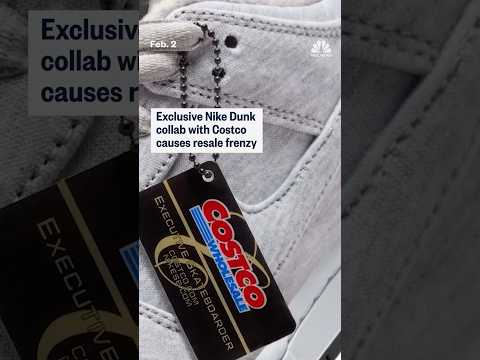
Exclusive Nike Dunk collab with Costco causes resale frenzy
NBC News· 2026-02-02 17:55
Costco members lined up for an exclusive Nike Dunk collab with Kirkland, the wholesale giant's in-house brand. The $135 sneakers quickly resold online for hundreds and in some cases thousands. According to multiple outlets, the drop hit select stores Friday in New York, California, Oregon, and Washington with resale prices as high as $5,000 on stock on sites like StockX and eBay. ...

Where Will Nike Be in 5 Years?
Yahoo Finance· 2026-01-10 21:01
Core Viewpoint - Nike has experienced a significant decline in stock price, dropping 55% since January 2021, and currently trades 63% below its peak, raising questions about its future performance over the next five years [1]. Group 1: Strategic Changes and Challenges - The COVID-19 pandemic has altered Nike's strategic priorities, shifting consumer behavior towards online shopping and away from physical retail [2]. - Previous leadership focused on core franchise products, which may have lost their appeal due to excessive supply, while also aggressively pursuing direct-to-consumer sales and reducing third-party retail partnerships [3]. - As the economic environment and consumer behavior normalized, Nike struggled to maintain momentum, leading to pressure on sales and profits [4]. Group 2: Leadership and Turnaround Strategy - CEO Elliott Hill, who took over in October 2024, has initiated a "Win Now" strategy that focuses on product innovation, improving relationships with wholesale accounts, and strengthening the brand [4]. - Hill described the company's current phase as being in the "middle innings" of a turnaround, acknowledging the challenges and uncertainties ahead for potential investors [5][7]. Group 3: Financial Outlook - Analyst estimates project Nike's revenue to reach $46.7 billion in fiscal 2026, reflecting a 0.9% year-over-year increase, while earnings per share are expected to decline by 28% [8].
硕远咨询:2025年国潮鞋转售行业市场研究报告
Sou Hu Cai Jing· 2025-12-25 08:14
Core Insights - The report analyzes the development status, market characteristics, competitive landscape, and future trends of the Chinese sneaker resale industry, highlighting its integration of fashion culture and commercial value [2]. Industry Overview - Sneaker resale involves the transaction of limited edition, collaborative, and classic replica sneakers, forming a complete ecosystem that includes brands, resale platforms, authentication agencies, and logistics providers [2][8]. - The Chinese sneaker resale market, which started late, has rapidly grown, surpassing hundreds of billions in market size by 2024, with an average annual growth rate exceeding 30% [2][21]. - The market is primarily concentrated in first-tier and new first-tier cities, with the eastern coastal regions as the core area, while the central and western regions are emerging as new growth points [2][21]. Market Demand - The core consumer group consists of young white-collar workers and university students aged 18-35, with a slight male majority, but female consumers are growing significantly [2][31]. - Purchasing motivations include collection, self-expression, social interaction, and practical needs, with consumers valuing design, scarcity, and comfort [2][36]. - Online professional resale platforms have become mainstream channels due to authentication guarantees and transaction convenience, with KOLs and social media significantly influencing consumer decisions [2][36]. Competitive Landscape - Leading platforms include Dewu, Poison App, and Xianyu, each with unique advantages: Dewu is known for its professional authentication system, Poison App focuses on community building, and Xianyu benefits from a broad user base [2][3]. - International brands leverage design and brand heritage, while local brands rapidly rise through localized operations and cultural innovation, intensifying competition [2][3]. - Platforms primarily profit through commission and membership models, with authentication services as a core competitive advantage [2][3]. Channels and Technology - There is a clear trend of online and offline integration, with professional resale platforms, second-hand trading platforms, and offline exhibitions collaborating to enhance consumer experience [2][3]. - Technologies such as blockchain for anti-counterfeiting, big data analysis, and AR virtual try-ons empower the industry, improving transaction efficiency and user experience [2][3]. Future Trends - The industry is expected to develop towards professionalization, digitization, and standardization, with deeper blockchain application, intensified market segmentation, and accelerated internationalization as key trends [2][3]. - Healthy industry development relies on improved laws and regulations, established industry standards, brand building, and technological innovation to create a transparent and trustworthy trading environment [2][3].

2025年国潮鞋转售行业市场研究报告-硕远咨询
Sou Hu Cai Jing· 2025-12-24 19:06
Core Insights - The report provides a comprehensive analysis of the development status, competitive landscape, consumer characteristics, and future trends of China's sneaker resale industry, offering a panoramic reference for industry participants [1] Industry Overview - The sneaker resale industry merges trend culture, collectible value, and investment attributes, covering various categories such as limited editions, collaborations, and classic replicas, forming a complete industry chain from brands to consumers [1] - The market is rapidly growing, with a projected market size exceeding hundreds of billions by 2024 and an average annual growth rate exceeding 30%, significantly outpacing the traditional footwear market [1][21] - The primary consumer base is the 18-35 age group, particularly young professionals and college students, with a notable increase in female consumers [1][28] Market Demand Analysis - Consumers are motivated by factors such as investment, personal expression, social needs, and practicality, with scarcity, design, and comfort being key selection criteria [1][30] - Online channels dominate transactions, with platforms like Dewu and Du App leading due to authentication services and transaction guarantees, while KOL recommendations and social media significantly influence purchasing decisions [1][36] Competitive Landscape - Leading platforms have established differentiated advantages: Dewu leads with a strict authentication system and diverse product offerings, Du App focuses on community building, and Xianyu benefits from a broad user base [2] - International brands leverage design and brand influence, while local brands like Li Ning and Anta gain recognition through culturally empowered and localized operations [2][51] - The introduction of blockchain technology enhances authentication transparency and credibility, while platforms typically operate on a commission model of 10%-20% [2] Future Trends - The industry is expected to evolve towards specialization, digitization, and standardization, with deepening blockchain applications, intensified market segmentation, and international expansion as key trends [2][20] - Challenges such as counterfeit proliferation, authentication difficulties, and regulatory gaps need to be addressed for sustainable growth [2] Recommendations - Companies should strengthen brand building and community operations, deepen technology applications, and ensure compliance with regulations [3] - Government should enhance legal frameworks and market supervision to protect intellectual property rights [3]

Nike CEO Shares the Company’s Biggest Issues and Its Reinvention Plan | WSJ
The Wall Street Journal· 2025-11-15 17:01
Business Strategy & Performance - Nike is refocusing on the athlete as the central point of its strategy [2][16] - The company aims to improve competitiveness and drive revenue and market share gains by segmenting brands by sport [10] - Nike is working to ensure a consumer-right assortment for each shopper and location, aiming to elevate presentation and drive sell-through [13] - Nike is focused on being the most profitable brand wherever its products are sold, driving revenue and profit for both the company and its retailers [13][14] Product & Inventory Management - Nike is addressing over-reliance on Air Jordan 1, Air Force One, and Nike Dunk franchises [4] - The company is still working to clean up Dunk inventory, with analysts estimating $4 billion in revenue from Nike Dunk in fiscal year 2025 [4][5] - Nike is phasing out the Dunk and working with wholesale partners to clear remaining stock [5] - Air Force One is returning to a good inventory position [4] - A Caitlyn Clark shoe is in development, with careful attention to her logo and product preferences [7][8] Distribution & Partnerships - Nike is re-engaging with retail partners like Macy's, DSW, and Academy Sports to boost sales [12] - The company is back on Amazon with a thoughtful assortment strategy tailored to specific consumers [10][11] Employee Morale - Nike has shifted back to its core mission of serving the athlete, which has elevated morale and focus among employees [16]

Nike CEO Shares the Company's Biggest Issues and Its Reinvention Plan | WSJ
Youtube· 2025-11-15 17:01
Core Insights - Nike is refocusing on its core mission of putting athletes at the center of its strategy after experiencing significant market value loss due to previous missteps [2][16] - The company is working to clear excess inventory, particularly for its major franchises like Air Jordan 1, Air Force One, and Nike Dunk, which have seen a decline in consumer interest [3][5] - Nike is re-engaging with retail partners to boost sales after years of focusing on direct-to-consumer strategies, ensuring a thoughtful assortment of products across different retail environments [12][14] Inventory Management - Nike has been slashing prices to manage excess inventory, particularly for the Nike Dunk, which generated an estimated $4 billion in fiscal 2025 but is now being phased out [3][5] - The company acknowledges the need to improve inventory levels for its key franchises, with ongoing efforts to restore the appeal of the Dunk and Air Jordan 1 [4][5] Product Development and Innovation - Nike is launching new products, including a 4-in-1 jacket for the upcoming Olympics and a shoe for athlete Caitlyn Clark, indicating a commitment to innovation and women's sports [6][7] - The company is enhancing its competitive edge in the running category by appointing a general manager for Nike running, focusing on product quality and storytelling [10] Retail Strategy - Nike is returning to retail partnerships with stores like Macy's and DSW, aiming to present its products in a premium manner while catering to diverse consumer needs [12][14] - The strategy includes ensuring that the brand's premium image is maintained across all sales channels, whether direct or through wholesale [13] Employee Morale and Company Culture - The leadership is focused on improving employee morale by emphasizing a return to the company's foundational mission of serving athletes, which has positively impacted the workplace environment [16][17]