PHY

Search documents
楠菲微电子拟上市:注册资本增22%至4亿元,董秘倪正清身兼三职
Sou Hu Cai Jing· 2026-02-13 01:28
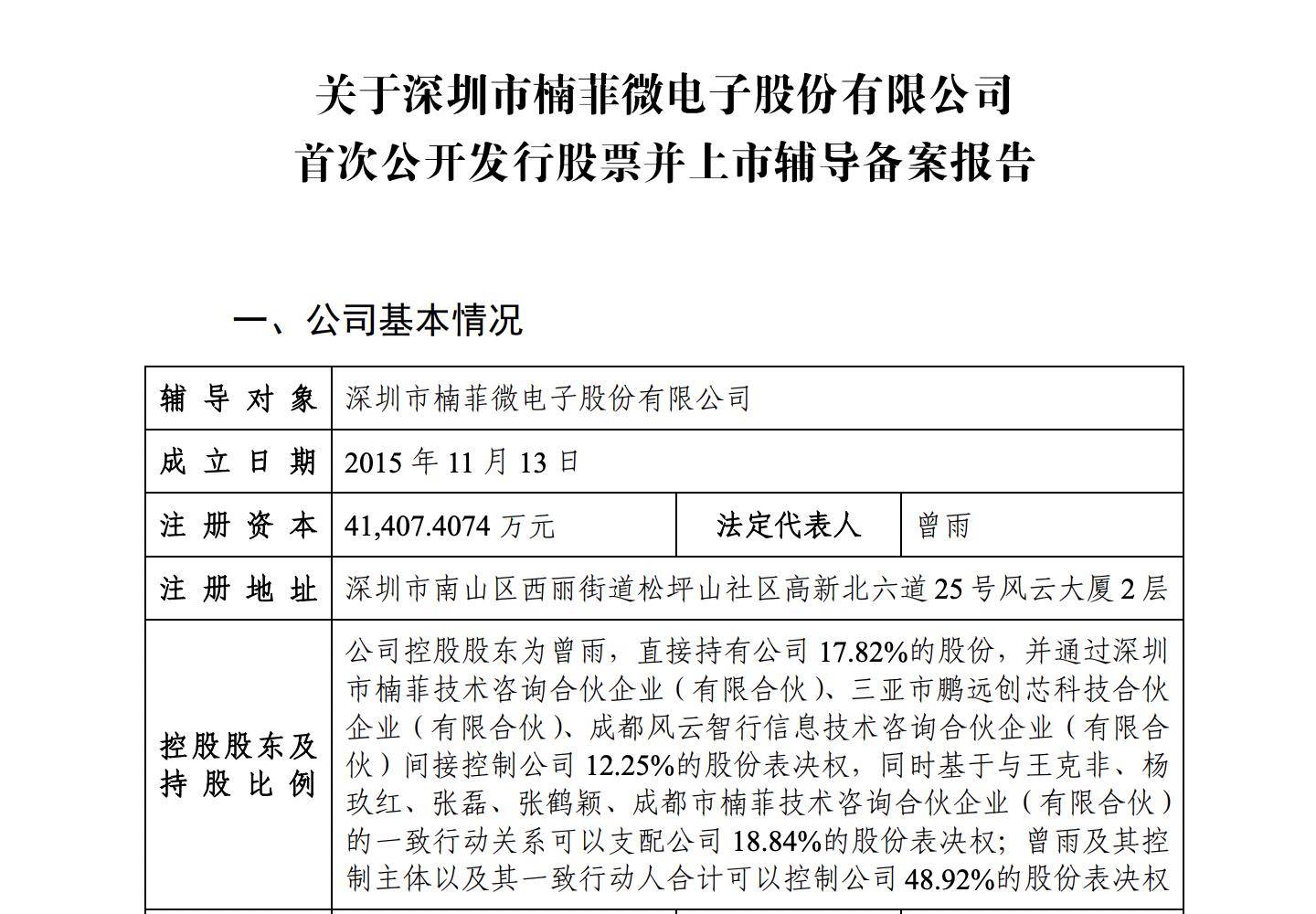
Group 1 - The core viewpoint of the news is that Shenzhen Nanfeng Microelectronics Co., Ltd. has completed its IPO counseling filing with the Shenzhen Securities Regulatory Bureau and plans to list on the A-share market, with CITIC Securities as the counseling institution [1][2]. - Shenzhen Nanfeng Microelectronics was established on November 13, 2015, with a registered capital of 414.074074 million yuan, and is primarily engaged in the design, production, sales, and service of Ethernet data switches, smart network cards, PHY, and PCIe switches [2]. - The company has established R&D and operational sales centers in multiple cities, including Shenzhen, Beijing, Shanghai, Chengdu, Changzhou, and Changsha, employing nearly 400 people, with over 85% being R&D personnel [2]. Group 2 - The controlling shareholder of the company is Zeng Yu, who directly holds 17.82% of the shares, while the controlling entity and its concerted actors can collectively control 48.92% of the voting rights [1][2]. - The registered capital of Nanfeng Microelectronics was increased from 340 million yuan to 414.074 million yuan, representing a growth of 21.79% [2][3]. - The company has made changes to its senior management, with key positions including Ni Zhengqing as the board secretary, financial officer, and deputy general manager, and Wang Kefa as a manager [3].

X @Binance Wallet
Binance Wallet· 2025-07-24 03:10
Listing Announcement - Binance Alpha 将于 7 月 26 日上线 DePHY Network (PHY) [1] - 符合条件的用户可以在交易开放后使用 Binance Alpha Points 在 Alpha Events 页面上领取空投 [1] User Engagement - 更多详细信息将很快公布 [1] - 请关注 Binance 官方渠道以获取最新更新 [1]
X @Binance
Binance· 2025-07-24 03:06
Listing Announcement - Binance Alpha 将于 7 月 26 日上线 DePHY Network (PHY) [1] - 符合条件的用户可以在交易开放后使用 Binance Alpha Points 在 Alpha Events 页面上领取空投 [1] User Engagement - 更多细节将很快公布 [1] - 请关注 Binance 官方渠道以获取最新更新 [1]
重要芯片技术,常被忽视
半导体行业观察· 2025-07-19 03:21
Core Viewpoint - The article emphasizes the critical role of the physical layer (PHY) in data communication, particularly in the context of emerging technologies such as artificial intelligence and high-performance computing, highlighting its importance in meeting the increasing demands for bandwidth, low latency, and energy efficiency [3][6][11]. Summary by Sections Importance of PHY - The physical layer has evolved from supporting traditional industries to becoming foundational for AI factories and large-scale data centers, acting as a key driver for data transmission and communication [3]. - As data centers handle massive amounts of data, the significance of PHY increases, especially for AI and HPC workloads that require unprecedented system performance [3][6]. Standards and Applications - Understanding the physical layer is crucial for maintaining competitiveness in various applications, with different standards developed to address specific issues [4]. - Standards like HDMI and DisplayPort illustrate the need for compatibility and efficiency in system design, balancing cost and functionality [5]. Design Challenges - Designing PHY for speeds exceeding 100G presents numerous challenges, including process technology dependence, signal integrity, system design constraints, and packaging integration [8]. - The transition from NRZ to PAM signaling represents a significant shift in technology, necessitating advanced design techniques to meet increasing bandwidth demands [7][8]. Chip-to-Chip Communication - The development of chip-to-chip communication standards, such as UCIe, aims to achieve high bandwidth with low power consumption, which is essential for modern 3D systems [9]. - The integration of multiple dies in a system-on-chip (SoC) architecture requires careful consideration of physical layer protocols to optimize performance [9][10]. Collaboration Between Disciplines - Effective collaboration between analog and digital engineers is necessary to bridge the gap between different domains, ensuring that physical effects are adequately addressed in system design [10][11]. - A comprehensive understanding of how physical effects impact system performance is vital for optimizing designs and achieving desired outcomes [11]. Future Outlook - As the industry progresses towards higher standards like 448G, the challenges will intensify, particularly with the emergence of chip decomposition and optical I/O [11]. - The PHY layer is increasingly viewed as a strategic enabler, necessitating continuous innovation and commitment to pushing technological boundaries [11].