Prodigy通用处理器

Search documents
一款内存新标准,速度飙升
半导体行业观察· 2025-11-27 00:57
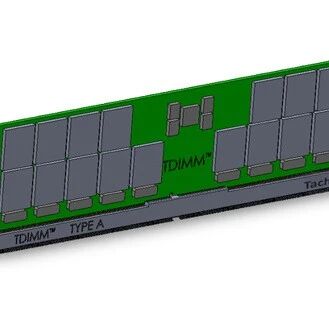
Core Viewpoint - Tachyum has introduced the open-source TDIMM memory standard, significantly enhancing bandwidth and capacity compared to existing memory solutions [1][6][8]. Group 1: TDIMM Memory Standard Features - The TDIMM standard offers a bandwidth increase of 5.5 times, from 51 GB/s to 281 GB/s compared to standard RDIMM [1][8]. - TDIMM supports various capacities: standard size at 256 GB, higher size at 512 GB, and extra tall size up to 1 TB [1][8]. - The new design utilizes a 484-pin connector, allowing for optimized connectivity and signal integrity [2][9]. Group 2: Cost and Efficiency - TDIMM reduces the required DRAM IC count by 10%, leading to a projected cost reduction of 10% [2][9]. - The power consumption of TDIMM is expected to be 30% higher, but it achieves double the bandwidth of RDIMM [10]. - The anticipated cost for AI systems using TDIMM is projected to drop from $3 trillion and 25 million watts to $27 billion and 540 megawatts [6][8]. Group 3: Future Developments - By 2028, the TDIMM standard is expected to evolve, achieving a bandwidth of 27 TB/s, surpassing the upcoming DDR6 standard [4][11]. - The open-source nature of TDIMM is expected to drive widespread adoption and cost reduction across the industry [11][12]. - Tachyum plans to further open-source its instruction set architecture (ISA) and software, expanding its technology's reach [11].

这颗芯片,又双叒叕延期了
半导体行业观察· 2025-10-17 01:12
Core Insights - Tachyum announced an increase in the core count of its Prodigy processor for AI and HPC applications, now featuring 256 cores per chip, up from 192 and initially 128 cores, promising performance three times that of the highest-performing x86 processors and six times that of top HPC GPGPUs [3][4] - The company completed a Series C funding round totaling $220 million from a European investor, along with a $500 million purchase order for Prodigy processors [1][3] - Prodigy processors have not yet been taped out, and final specifications are still undetermined, indicating that mass production is still years away [1][3] Funding and Production Timeline - The funds from the Series C round will be used to complete the tape-out process for the Prodigy chip, with expectations to finalize RTL and physical design within a month after funding is received [5][6] - The first batch of silicon is expected to be obtained within 4 to 4.5 months after the GDSII files are sent to manufacturing partners, potentially leading to silicon availability by February or March 2026 [5][6] - If the production timeline proceeds smoothly, commercial shipments of the Prodigy processor could begin in mid-2027, aligning with a potential IPO for Tachyum [6][7] Development Delays - The development of the Prodigy processor has faced multiple delays, initially planned for tape-out in 2019 and market release in 2020, with subsequent postponements to 2021, 2022, 2023, and now 2024 [7][9] - The company remains optimistic despite these setbacks, emphasizing the competitive landscape of AI and the potential for a disruptive chip at a fraction of the cost of existing solutions [7][9] Technical Specifications - The Prodigy architecture integrates a new microarchitecture designed for both general computing and highly parallel AI and HPC tasks, featuring a rich set of vector and matrix instructions [9][10] - The instruction set architecture (ISA) combines elements of RISC and CISC designs, standardizing instructions to 32 or 64 bits to enhance performance [10] - Prodigy includes built-in performance counters for real-time monitoring and analysis, aiding developers in optimizing code for high-demand computing tasks [10][11]