Pura系列

Search documents
手机市场混战下的新变数:规模与利润之间的博弈,华为、苹果成最大赢家
Tai Mei Ti A P P· 2026-01-15 03:57
Group 1 - In 2025, global smartphone shipments reached 1.26 billion units, marking a 1.9% year-over-year growth, while the Chinese market saw a decline of 0.6% with shipments of approximately 285 million units [2][9][10] - Apple and Samsung maintained their leadership in the high-end market, with Apple achieving a market share of 19.7% and Samsung at 19.1%, both showing significant year-over-year growth [6][7] - Huawei regained the top position in the Chinese market with a market share of 16.4%, despite a slight decline in shipments compared to 2024 [9][10] Group 2 - Apple's iPhone 17 series significantly boosted its performance, leading to a record-breaking market share in China, with a 21.5% year-over-year increase in Q4 shipments [5][6] - Samsung achieved a remarkable 7.9% growth in 2025, the highest among the top five brands, driven by the popularity of its Galaxy A series [7][8] - The smartphone market is expected to face challenges in 2026 due to rising storage costs and changing consumer demands, with predictions of a potential decline in shipments [12][14] Group 3 - The competitive landscape is shifting towards high-end products, with brands focusing on premium offerings to counteract market pressures [16][17] - Xiaomi experienced a mixed performance, benefiting from government subsidies but facing significant declines in Q4, highlighting the volatility in the market [11] - The ongoing shortage of storage chips is anticipated to impact production costs and pricing strategies, leading to adjustments in product specifications and offerings [13][14]



黄仁勋“救了”雷军,但苦了明年买手机的人
3 6 Ke· 2025-11-20 09:28
Core Insights - The price increase of the Redmi K90 series is attributed to the significant rise in memory costs, which has affected multiple smartphone manufacturers [2][6][24] - The surge in memory prices is primarily driven by the booming demand for AI-related products, particularly from companies like NVIDIA, which has led to a reallocation of production capacity away from traditional memory products [7][12][24] - The smartphone market is expected to experience a polarization, with high-end brands like Apple and Huawei less affected by memory price increases compared to budget brands like Xiaomi and OPPO, which may struggle to maintain profitability [13][17][24] Price Increases and Market Dynamics - The Redmi K90 standard version is priced at 2599 yuan, which is 300 yuan more than its predecessor, with additional costs for higher storage options [2] - Many smartphone manufacturers, including Xiaomi, OPPO, and Vivo, are facing pressure to increase prices due to rising memory costs, with some already raising prices for flagship models [18][19] - TrendForce predicts that the overall smartphone prices will increase by 5%-15% in 2026, with an average increase of around 500 yuan per device [18][24] Impact of AI on Memory Prices - The demand for AI computing has drastically increased the need for high-bandwidth memory (HBM), leading manufacturers to prioritize HBM production over traditional memory types [9][12] - The profit margins for HBM are significantly higher than those for standard mobile memory, incentivizing manufacturers to allocate more resources to AI-related products [12][11] - The current memory price surge is expected to last longer than typical cycles due to cautious production expansion by suppliers fearing an AI bubble [24] Consumer Experience and Product Adjustments - Many smartphone manufacturers are resorting to reducing specifications in new models to offset rising costs, which has become a common practice in the industry [19][22] - The reduction in features, such as screen resolution and camera quality, reflects a broader trend of cost-cutting measures in response to increased material costs [22] - The high-end brands like Apple and Huawei are less likely to pass on costs to consumers, maintaining their pricing strategies without significant adjustments [16][17]

中国手机市场新格局:华为夺魁,小米放缓,苹果重返前三
Tai Mei Ti A P P· 2025-07-05 01:53
Group 1 - The core viewpoint of the articles highlights the resurgence of several smartphone brands, particularly Apple, driven by national subsidy policies and promotional events like the 618 shopping festival [2][3][8] - Apple's strategic price adjustments in May, just before the 618 sales, significantly boosted its sales, allowing it to reclaim a top position in the Chinese market [3][5] - Despite facing challenges such as innovation stagnation and AI development issues, Apple's competitive edge remains strong when prices are adjusted appropriately [3][7] Group 2 - Huawei is projected to be the fastest-growing brand in China for Q2 2025, benefiting from national subsidies and maintaining a loyal customer base [8][10] - Xiaomi's performance in Q2 was lackluster, failing to enter the top three in sales, attributed to market saturation and insufficient competitive pricing [12][14] - The overall smartphone market in China is expected to see only modest growth, with a forecasted increase of around 2.3% for the year, indicating a slowdown in consumer spending [14][16] Group 3 - The national subsidy program has not generated significant new demand but rather pre-empted existing demand, leading to a decline in the effectiveness of such incentives [14][16] - The smartphone market is experiencing intensified competition, particularly in the mid-range segment, where brands are struggling to differentiate themselves [12][14] - The lack of revolutionary innovations in the smartphone sector is hindering the creation of new demand, posing a challenge for the industry to stimulate growth [16]
中国智能手机市场: 2024 年高端化趋势持续增强
Counterpoint Research· 2025-03-05 09:45
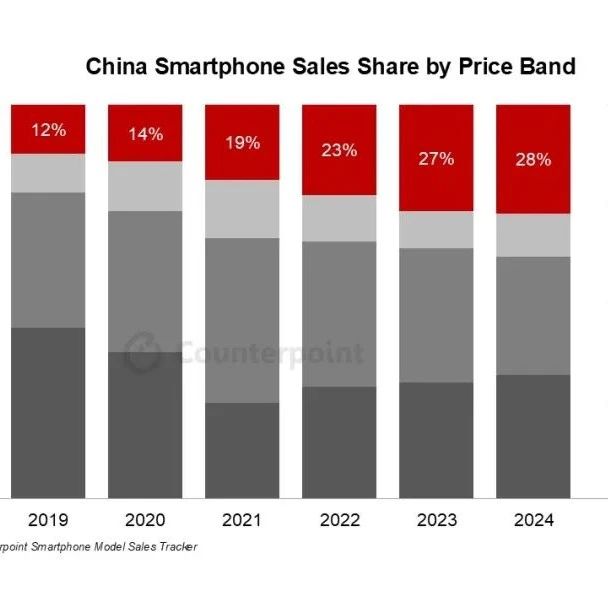
Core Insights - The high-end smartphone market in China (priced at $600 and above) is projected to reach a sales share of 28% in 2024, a significant increase from 11% in 2018, indicating a clear trend towards premium devices in the Chinese smartphone market [1][2][4]. Group 1: Market Trends - The trend towards high-end smartphones has accelerated since 2017, particularly following the U.S. ban on Huawei, which has further propelled this shift [1][2]. - Huawei has emerged as a key driver of this trend, with its market share in the high-end segment increasing to 29%, the highest among Chinese smartphone brands [2][4]. - Other Chinese brands have also intensified their focus on the high-end market, with their overall market share in this segment rising from 5% in 2020 to 15% in 2024 [2][5]. Group 2: Competitive Landscape - Apple and Huawei continue to dominate the high-end smartphone market, together accounting for 83% of total sales in this segment in 2024 [4]. - Huawei's recovery, following the return of its 5G Kirin chips, has led to a market share increase from 20% in 2023 to 29% in 2024, with a remarkable 37% overall sales growth and a 52% increase in the high-end market [4][5]. - Other major Chinese brands, such as Xiaomi and Vivo, have seen approximately 50% year-on-year growth in the high-end market, although they still face challenges in establishing a significant presence [5]. Group 3: Future Outlook - The trend towards high-end smartphones in China is expected to continue, with local brands solidifying their dominance in the $400-$600 price range, increasing their market share from 89% in 2023 to 91% in 2024 [5]. - As competition intensifies, smartphone manufacturers will need to focus on product innovation, localization, and brand differentiation to stand out in this rapidly evolving market [5].