RY7P250BM

Search documents
AI时代的芯片机会,罗姆怎么看?
半导体芯闻· 2025-12-18 10:24
Core Viewpoint - The article discusses the significant impact of artificial intelligence (AI) on various sectors, particularly focusing on the increasing power consumption of AI servers and the need for efficient power solutions to address this challenge [2][4][10]. Group 1: AI Server Demand and Power Consumption - The demand for AI servers is surging, leading to a notable increase in power consumption, with projections indicating that by 2030, AI will consume approximately 1000 TWh, accounting for at least 10% of global electricity [4][10]. - The rise in power consumption presents challenges, especially for regions with limited energy supply, necessitating solutions to either increase power generation or reduce power consumption in AI servers [7][10]. Group 2: Solutions and Industry Response - The industry is focusing on developing low-energy solutions to mitigate the power consumption issue, with companies like NVIDIA leading the charge in creating more efficient chips and systems [7][12]. - High voltage systems, such as ±400V DC and 800V DC, are being promoted to reduce current and copper usage, which is essential for improving efficiency in AI server operations [10][12]. Group 3: Impact of Increased Power Consumption - Increased power consumption leads to several challenges, including: 1. Power loss due to resistance in cables, resulting in energy waste and heat generation [11]. 2. Physical limitations in handling high currents, leading to increased costs and space issues in data centers [11]. 3. The need for advanced cooling systems to manage heat generated from power consumption [11]. 4. Limits on scalability for existing architectures to support high power densities [11]. 5. Rising operational costs, with nearly 60% of data center operating costs attributed to electricity [11]. Group 4: Role of Rohm Semiconductor - Rohm Semiconductor is positioned to provide comprehensive solutions for AI servers, focusing on power electronics and analog technologies to support the growing demand for efficient power management [14][16]. - The company is developing a diverse range of products using silicon, silicon carbide (SiC), and gallium nitride (GaN) to address various power needs in AI applications [16][19]. - Rohm's advancements include the introduction of fifth-generation SiC products, which significantly reduce on-resistance and support low-loss operation under high-temperature and high-load conditions [19][24]. Group 5: Product Offerings and Innovations - Rohm offers a variety of power MOSFETs and other components designed for high voltage applications, such as the RY7P250BM and RS7P200BM, which are suitable for AI server power supplies [22][26]. - The company emphasizes the importance of high power efficiency and density in its product development to meet the evolving needs of AI server technology [24][26].

ROHM Introduces a New MOSFET for AI Servers Featuring Industry-Leading* SOA Performance and Ultra-Low ON-Resistance
Globenewswire· 2025-07-01 21:00
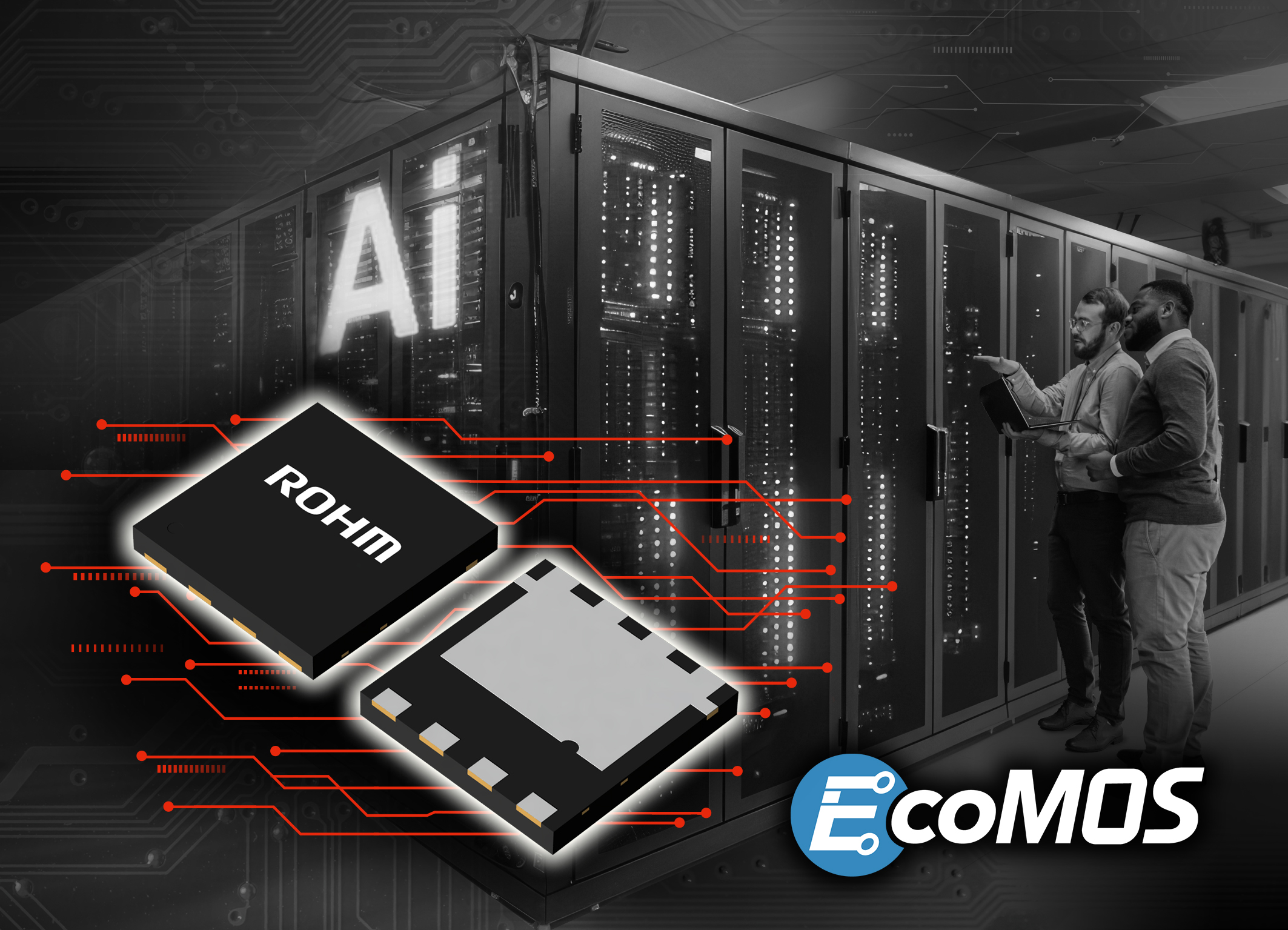
Core Insights - ROHM Semiconductor has launched the RY7P250BM, a 100V power MOSFET designed for hot-swap circuits in 48V power systems, particularly for AI servers and industrial power supplies [1][5] - The shift from 12V to 48V power architectures is driven by the increasing power demands of AI technology and high-performance GPUs, necessitating improved power efficiency and higher current support [2][6] Product Features - The RY7P250BM is packaged in a compact 8080-size, reducing power loss and cooling requirements while enhancing server reliability and energy efficiency [3][6] - It features a low ON-resistance of 1.86mΩ, which is approximately 18% lower than the typical 2.28mΩ of existing wide SOA 100V MOSFETs, making it suitable for hot-swap operations [3][4] - The product achieves wide SOA tolerance, supporting 16A at 10ms and 50A at 1ms, which is critical for handling large inrush currents in AI server applications [4][5] Market Adoption - The RY7P250BM has been certified as a recommended component by a leading global cloud platform provider, indicating its expected widespread adoption in next-generation AI servers [5][9] - ROHM plans to expand its lineup of 48V-compatible power solutions, contributing to sustainable ICT infrastructure and energy savings [6][8] Application Areas - The product is applicable in various sectors, including 48V AI server systems, industrial equipment power systems, battery-powered industrial equipment, and UPS systems [7][8]
ROHM Builds the Future of AI with Optimized Solutions for NVIDIA 800V Architecture
Globenewswire· 2025-06-12 17:00
Core Insights - The article highlights ROHM's role as a key silicon provider for NVIDIA's new 800 V High Voltage Direct Current (HVDC) architecture, which is a significant advancement in data center design aimed at enhancing efficiency, scalability, and sustainability in AI factories [1][4]. Group 1: ROHM's Technology and Offerings - ROHM's power device portfolio includes both silicon and wide bandgap technologies, such as silicon carbide (SiC) and gallium nitride (GaN), providing strategic solutions for data center designers [2]. - The RY7P250BM, a 100V power MOSFET, is specifically designed for hot-swap circuits in 48V power systems, featuring ultra-low ON resistance of 1.86 mΩ, which is crucial for high-density cloud platforms [3]. - ROHM's SiC MOSFETs excel in high-voltage, high-power environments, offering higher efficiency and reliability, aligning with the requirements of NVIDIA's 800 V HVDC architecture [5]. Group 2: Industry Collaboration and Future Directions - The transition to an 800V HVDC infrastructure is a collaborative effort, with ROHM committed to working with industry leaders like NVIDIA and data center operators to provide essential silicon technologies for next-generation AI factories [8]. - ROHM is advancing its EcoGaN™ brand, which includes GaN technologies that perform exceptionally well in the 100V to 650V range, supporting the demand for smaller, efficient power systems in AI data centers [6]. - The company offers high-power SiC modules optimized for high-efficiency power conversion, particularly suited for the centralized power systems envisioned in NVIDIA's architecture [7].