
Refined Copper

Search documents
2025年全球铜冶炼市场现状分析:消费及通用产品、制冷领域与电子领域为全球精炼铜最大消费行业【组图】
Qian Zhan Wang· 2026-02-08 04:08
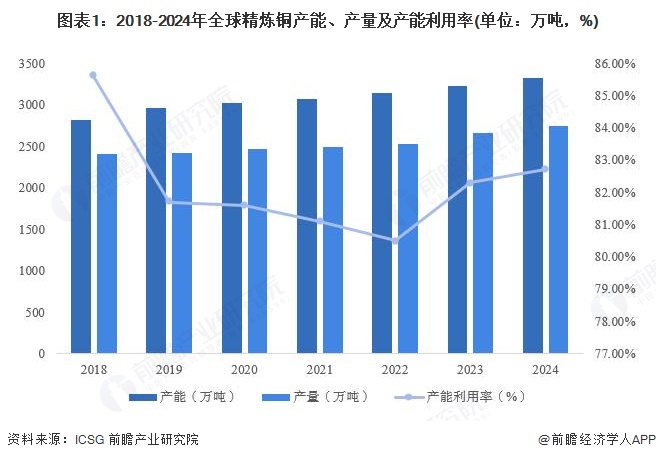
Core Insights - The global refined copper production capacity and output are projected to increase annually from 2018 to 2024, with a capacity of 33.236 million tons and an output of 27.486 million tons expected in 2024, resulting in a capacity utilization rate of 82.70% [1] - The global refined copper consumption is also on the rise, expected to reach 27.348 million tons in 2024, reflecting a year-on-year increase of 2.8% [5] - Major consumption sectors for refined copper include consumer and general products, refrigeration, and electronics, accounting for approximately 23% of total consumption, while the construction sector represents 26% [7] Production and Capacity - The refined copper production capacity is forecasted to reach 33.236 million tons by 2024, with a production output of 27.486 million tons, including 4.581 million tons of recycled refined copper, which is a 2.0% increase year-on-year [1] - The compound annual growth rate (CAGR) for global copper smelting output is estimated at 3.3% from 2024 to 2028, with a projected output of 33.20 million tons by 2030 [11] Demand Drivers - The demand for refined copper is primarily driven by the acceleration of global electrification, the booming electric vehicle industry, and large-scale renewable energy projects, all of which require copper for its excellent conductivity [14] - Additional demand growth is anticipated from the recovery of the global economy and increased infrastructure investments in construction, industrial, and consumer goods sectors [14] - The refined copper usage is expected to grow at a CAGR of 3.0% from 2025 to 2030, reaching 32.75 million tons by 2030 [14]

【前瞻分析】2025年中国铜冶炼行业供需现状及发展趋势分析
Sou Hu Cai Jing· 2026-02-03 20:57
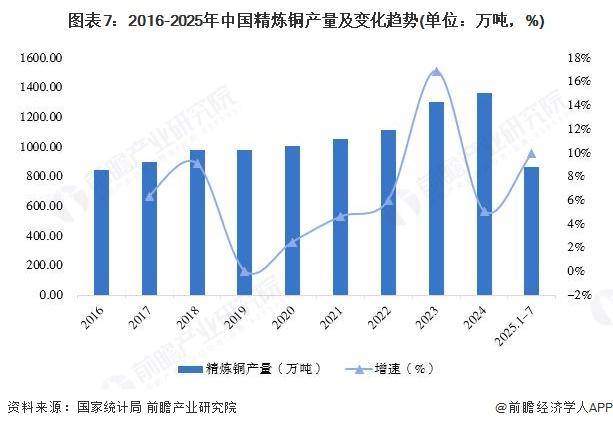
Group 1 - The core viewpoint of the articles highlights the growth and transformation of China's copper smelting industry, emphasizing the shift towards green and intelligent manufacturing in response to global trends and domestic demands [2][6]. - China's refined copper production is projected to reach 13.644 million tons in 2024, marking a 5.1% increase from 2023, with a year-on-year growth of 9.9% observed in the first seven months of 2025 [1][2]. - The copper smelting industry in China is experiencing a continuous trade deficit, with the total import and export value of related products reaching 811.856 billion yuan in 2024, and the trade deficit expanding by 114.513 billion yuan [6][7]. Group 2 - The average import price of copper smelting-related products has shown an upward trend from 2019 to July 2025, with significant increases during the 2020-2021 period due to supply chain disruptions caused by the COVID-19 pandemic [8]. - China's position as a major consumer in the global refined copper market is expected to strengthen, with the country's share of global refined copper production and sales anticipated to increase further [2].





矿业策略-中国需求:2025 年 11 月显现放缓信号-Mining Strategy_ China Demand_ Signals slow in Nov-25
2025-12-20 09:54
Summary of Key Points from Conference Call Industry Overview - **Industry Focus**: The conference call primarily discusses the mining and commodities sector, with a specific emphasis on iron ore, base metals, coal, and battery raw materials in the context of China's economic indicators and demand trends. Core Insights and Arguments Mining Strategy - **China's Commodity Demand**: In November 2025, commodity demand indicators in China showed significant weakness, with retail sales underperforming expectations, marking the weakest result in three years. The downturn in the property sector has worsened, leading to potential downside risks for demand expectations and prices. Economic decision-makers may delay policy changes until the 15th Five-Year Plan is finalized in March 2026 [1][6]. Iron Ore - **Market Weakness**: The property sector's weakness has accelerated, with construction starts and sales down 21% and 9% year-over-year, respectively. Crude steel output in October decreased by 11% year-over-year. Iron ore port inventories increased by 4% month-over-month. Despite recent support for iron ore prices, factors such as the ramp-up of Simandou and steel production management in northern China may exert pressure on prices into early 2026 [2][6]. Base Metals - **Consumption Risks**: Retail sales growth was only 1.3% year-over-year, significantly below the previous 2.9% and consensus expectations. Weak demand for durable goods and ongoing property market issues are contributing to muted consumption prospects. Industrial production growth also slowed to 4.8% year-over-year. The fragile internal consumption environment presents significant macro risks for industrial metals, with potential for downside if economic trends continue [3][6]. Coal - **Demand Dynamics**: Coal production and imports rose by 6% month-over-month, driven by thermal demand rather than steel-making needs. However, flat coke production and declining daily steel output indicate subdued blast furnace activity, reflecting ongoing weakness in property and construction sectors. Increased coal supply without a corresponding rise in steel demand raises caution regarding the metallurgical coal outlook [4][6]. Battery Raw Materials - **EV Market Strength**: Electric vehicle (EV) output remained stable with a year-over-year increase of 17%. Demand for battery raw materials is expected to accelerate, particularly due to the strength in EVs and anticipated growth in battery energy storage systems (BESS) [5][6]. Additional Important Insights - **UBS View on Growth**: The data from November 2025 indicates a slowdown in growth, with the finalization of the 15th Five-Year Plan and potential stimulus being key factors to watch. Rising iron ore inventories and pressures on the steel sector pose risks to iron ore prices, while base metal prices are also vulnerable due to retail sales softness. The coal market outlook is uncertain, requiring stronger demand outside of China to support prices [6][8]. - **Economic Indicators**: Key economic indicators from China show a decline in manufacturing PMI and retail sales, with implications for various sectors, including steel and construction. The overall economic environment suggests a cautious outlook for commodity demand moving into 2026 [8][9]. This summary encapsulates the critical points discussed in the conference call, highlighting the challenges and potential opportunities within the mining and commodities sector in relation to China's economic landscape.
A股指数集体低开:创业板指跌超2%,下跌个股近4800只
Feng Huang Wang Cai Jing· 2025-11-05 01:37
Market Overview - Major indices opened lower with the Shanghai Composite Index down 0.95%, Shenzhen Component down 1.68%, and ChiNext down 2.08% [1] - Nearly 4,800 stocks declined across the Shanghai, Shenzhen, and Beijing markets, with significant drops in computing hardware, semiconductor chips, and precious metals [1] Index Performance - Shanghai Composite Index: 3922.58, down 0.95% with 172 gainers and 1992 losers [2] - Shenzhen Component: 12953.84, down 1.68% with 136 gainers and 2633 losers [2] - ChiNext Index: 3068.95, down 2.08% with 50 gainers and 1310 losers [2] - Northbound trading saw a decline in the Northbound 50 index, down 1.61% [2] External Market Impact - U.S. stock market faced adjustments with the S&P 500 down 1.17%, Nasdaq down 2.04%, and Dow Jones down 0.53% [3] - Chinese concept stocks were affected, with the Nasdaq Golden Dragon China Index down 2.05% [3] - Notable declines in major Chinese companies: Alibaba down 2.02%, JD.com down 2.93%, and NIO down 3.5% [3] Industry Insights - CITIC Securities predicts an expanding supply-demand gap for copper, with prices potentially exceeding $10,000 per ton by 2026 due to declining production and stable demand [4] - CITIC Jiantou reports a record high in institutional holdings in the communication sector, with a strong recommendation for the AI computing sector [5] - Huatai Securities anticipates continued high demand for fiberglass, carbon fiber, and electronic new materials through 2026, suggesting investment in undervalued companies and those benefiting from domestic demand recovery [6]


Metals Traders Are Enjoying Their Most Profitable Year on Record
Yahoo Finance· 2025-10-17 10:40
Core Insights - The global metal trading industry is experiencing its most profitable year ever, driven by supply disruptions and record-high prices [1][2] - Major players like Glencore Plc and Trafigura Group are on track for their best performance in metal trading, while IXM has already surpassed last year's profits [2] - The surge in metal trading profits contrasts with declining margins in other commodities such as gas, oil, and grains [3] Company Performance - Glencore Plc and Trafigura Group are leading the market, both expected to achieve record profits in metal trading [2] - IXM, the third-largest metals trader, is set to report its third consecutive year of record profits [2] - Mercuria Energy Group Ltd. has made approximately $300 million in trading profits this year, benefiting from increased demand in the metals sector [2] Market Dynamics - The current boom in metal trading profits follows a period of weak demand and volatile prices that previously affected profitability [3] - Supply squeezes and upheavals have significantly contributed to the profits of larger players in the metal trading market [4] - The introduction of potential import tariffs on refined copper by the US government created a significant arbitrage opportunity, leading to unprecedented price premiums for US copper [5]

Freeport-McMoRan: Buying The Dip In America's Copper Behemoth
Seeking Alpha· 2025-09-01 05:39
Group 1 - Freeport-McMoRan is the leading copper producer in the U.S., accounting for over 70% of the country's refined copper production [1] - The stock is trading significantly below its peers based on forward EV/EBITDA metrics, indicating potential undervaluation [1] - Technical indicators for Freeport-McMoRan are showing bullish trends, suggesting positive market sentiment [1]

铜金属评论_精炼铜豁免 232 条款关税,维持伦敦金属交易所(LME)价格预测-Base Metals Comment_ Copper_ Refined Copper Exempt From Section 232 Tariff, Holding To LME Price Forecast
2025-08-05 03:20
Summary of Key Points from the Conference Call Industry Overview - The conference call primarily discusses the **copper industry**, particularly focusing on the implications of recent tariff announcements by the Trump Administration regarding copper imports [2][2]. Core Insights and Arguments - On July 30, the Trump Administration announced a **50% tariff** on US imports of semi-finished copper products and copper-intensive derivative products, effective August 1 [2][2]. - **Refined copper and concentrate** are exempt from this tariff, which is crucial as the US relies on imports for **50%** of its domestic copper demand. In contrast, net imports of semi-finished products account for only **7%** of demand [2][2]. - A decision regarding a potential **15% refined copper import tariff** will be made by mid-2026, with the possibility of implementation in 2027 [2][2]. - The near-complete rollback of proposed copper tariffs indicates the Trump Administration's focus on ensuring a secure supply of copper, allowing the US to pursue minerals deals overseas [2][2]. - Following the tariff announcement, the **COMEX copper contract** dropped by **20%** to approximately **$4.46/lb** ($9,830/t), reducing the COMEX-LME arbitrage to about **$150** or a **~2% implied tariff**, down from over **30%** earlier in the week [2][2]. - The market is advised to consider at least a **25% probability** that the Trump Administration will impose the **15% tariff** in 2027, which would likely keep COMEX prices aligned with LME prices [2][2]. - The **50% tariff** on semi-finished products is expected to have minimal impact on exchange prices, and the US has mandated that **25%** of high-grade scrap and concentrate must remain in the US, maintaining the status quo [2][2]. Additional Important Information - The forecast for LME copper prices remains unchanged, with expectations of a low of **$9,550/t** in August, rising to **$9,700/t** by December [2][2]. - The analysis suggests that the recent tariff announcements do not alter the fundamental market dynamics for copper [2][2]. This summary encapsulates the critical points discussed in the conference call regarding the copper industry and the implications of recent tariff announcements.
51页PPT详解铜产业链深度报告
材料汇· 2025-05-19 15:22
Core Viewpoint - The copper industry is facing a structural shift characterized by a rigid supply shortage at the mining end, excess smelting capacity, and a transition between old and new demand drivers, leading to a long-term upward trend in copper prices [19][24][25]. Group 1: Upstream Resources (Mining and Recycling) - Global copper reserves are approximately 980 million tons, with a mining lifespan of about 40 years based on current production levels [32]. - In 2024, global copper mine production is expected to reach 23 million tons, with a year-on-year growth of 1.8% [35]. - China's copper mine production is projected at 1.8 million tons in 2024, a decline of 1.1% year-on-year, primarily due to resource depletion and environmental restrictions [42][46]. Group 2: Recycling Sector (Recycled Copper) - The recycled copper market is supported by national strategies, aiming for a production target of 4 million tons by 2025, with recycled metal supply accounting for over 24% [4]. - In 2024, China is expected to import 2.25 million tons of scrap copper, with domestic recycling capacity reaching 2.49 million tons [5][48]. - The price of recycled copper is projected to show significant fluctuations, with an average price of 70,400 yuan per ton in 2024 [5]. Group 3: Midstream Smelting - The global refined copper production in 2024 is estimated at 27.634 million tons, with a year-on-year increase of 4.3% [9]. - China is the largest producer of refined copper, accounting for 49.9% of global production in 2024, with a projected output of 13.644 million tons [10]. - The smelting industry is experiencing a decline in processing fees, with long-term contracts expected to drop to $21.25 per ton by 2025, significantly below the breakeven point [8][20]. Group 4: Midstream Processing (Copper Products) - In 2024, China's copper processing output is expected to reach 23.503 million tons, representing over 50% of global production [11]. - The industry is characterized by low concentration, with the top five companies holding only 30% of the market share [11]. - The demand for high-end copper products is increasing, driven by the growth in new energy and infrastructure sectors [12][13]. Group 5: Downstream Demand (End Applications) - Global refined copper consumption in 2024 is projected at 27.33 million tons, with China accounting for 58% of this demand [14]. - The demand structure in China shows that electricity and power grids account for 46% of refined copper consumption, while new energy applications are rapidly growing [15]. - The transition from traditional to new energy applications is expected to drive significant growth in copper demand, particularly in sectors like electric vehicles and renewable energy [19][21]. Group 6: Supply and Demand Balance - The global refined copper supply-demand balance is expected to show a surplus of 19,000 tons in 2025, a decrease from the previous year's surplus of 30,200 tons [16]. - China's refined copper consumption is projected to grow by 2.9% in 2025, reaching 16.21 million tons, driven by new energy infrastructure investments [18]. - The copper market is anticipated to face a tightening supply situation due to the rigid shortage of mining resources and the acceleration of smelting capacity clearance [19][20]. Group 7: Investment Recommendations - Key investment opportunities include resource leaders like Zijin Mining and Longyan Copper, which are positioned to benefit from global resource control [21]. - Smelting leaders such as Jiangxi Copper are expected to gain from policy-driven supply-side reforms and the elimination of inefficient capacity [20]. - Companies focusing on high-end processing and recycled copper, such as Hailiang Co. and Gree Environmental, are likely to benefit from technological advancements and policy support [21].




ICSG:今明两年全球精炼铜市场料分别过剩28.9万吨和20.9万吨
Wen Hua Cai Jing· 2025-04-28 13:26
Group 1 - The International Copper Study Group (ICSG) held a meeting on April 25, 2025, in Lisbon, Portugal, discussing key issues affecting the global copper market [2] - Global copper mine production is expected to grow by 2.3% in 2025, reaching 23.5 million tons, driven by expansions in Kamoa (Democratic Republic of Congo) and Oyu Tolgoi (Mongolia), along with the new Malmyz mine (Russia) [3] - In 2026, global copper mine production is projected to increase by 2.5%, supported by ongoing expansions and improvements in production from Chile and Zambia [4] Group 2 - Global refined copper production is anticipated to grow by approximately 2.9% in 2025, with support from capacity expansions in China and new capacities in Indonesia, India, and the Democratic Republic of Congo [5] - Primary electrolytic refined production is expected to increase by 3%, while secondary production from scrap is projected to grow by 2.2% in 2025 [6] - In 2026, global refined copper production is expected to decline by 1.5%, primarily due to limited supply of concentrates, despite growth in wet smelting and secondary production [6] Group 3 - Global apparent refined copper usage is projected to grow by about 2.4% in 2025 and by 1.8% in 2026, with a downward adjustment from previous forecasts due to uncertainties in international trade policies [8][9] - China’s refined copper usage is expected to grow by approximately 2% in 2025 and 0.8% in 2026, while Asia remains the main driver of global growth [10] - The overall global usage is expected to benefit from improvements in key copper end-use sectors, energy transition, urbanization, and digitalization [10] Group 4 - The global refined copper balance is forecasted to show a surplus of approximately 289,000 tons in 2025 and about 209,000 tons in 2026 [11][12] - The surplus forecast for 2025 is higher than the previous estimate of 194,000 tons, indicating potential changes in production and usage dynamics [12] - ICSG acknowledges that unforeseen developments may alter the actual market balance compared to predictions [11]
