Remote OK

Search documents
一人公司是传统公司的终点,也是无人公司的起点?
虎嗅APP· 2025-12-29 13:33
Core Viewpoint - The article discusses the evolution of business models from traditional companies to one-person companies and ultimately to zero-person companies, highlighting the advantages and challenges of each model, particularly focusing on the case of Pieter Levels, who successfully operates multiple million-dollar services without a team or external funding [2][8][62]. Group 1: One-Person Company (OPC) - One-person companies are not mere small workshops; they represent a powerful enhancement of traditional companies under digital leverage, capable of achieving significant results [8]. - Pieter Levels exemplifies the one-person company model, generating approximately $2.7 million annually through services like Nomad List and Remote OK, without a team or external funding [5][7]. - The operational speed of one-person companies is significantly faster than traditional firms, as they eliminate coordination friction and leverage skills and tools, particularly AI [18][17]. Group 2: Key Advantages of Pieter Levels' Model - Levels combines personal branding with product development and marketing, using his social media presence to promote his products without traditional advertising costs [26]. - He employs a strict utilitarian approach to technology, using simple and cost-effective tools to minimize development and maintenance costs, which enhances survival and profit margins [30][31]. - Levels targets niche markets that larger companies overlook, allowing him to build a successful business in areas that are too small for giants like Google and Facebook [33]. Group 3: Challenges Faced by One-Person Companies - Despite the advantages, one-person companies face limitations, such as the physical constraints of time and energy, as well as societal infrastructure that is not designed for individual operators [40][41]. - The pressure of administrative tasks can overwhelm individual entrepreneurs, leading them to consider hiring help, which can dilute their advantages [46][47]. - Levels maintains a principle of automating tasks to avoid hiring, evolving from a mere operator to a system architect who utilizes automation to manage operations [48][50]. Group 4: Transition to Zero-Person Companies - The concept of zero-person companies emerges as a natural evolution, where the operational core shifts from human operators to automated systems, allowing for greater efficiency and scalability [51][52]. - Future companies may rely on AI systems as the primary operational engine, with human founders acting as visionaries and overseers rather than day-to-day operators [55][59]. - The article emphasizes the importance of leveraging automation and AI to reduce operational complexity and enhance growth potential, marking a significant shift in how businesses are structured and evaluated [61][62].


为什么说一人公司是传统公司的终点,也是无人公司的起点?细看一个年270万美金的故事
3 6 Ke· 2025-12-29 00:31
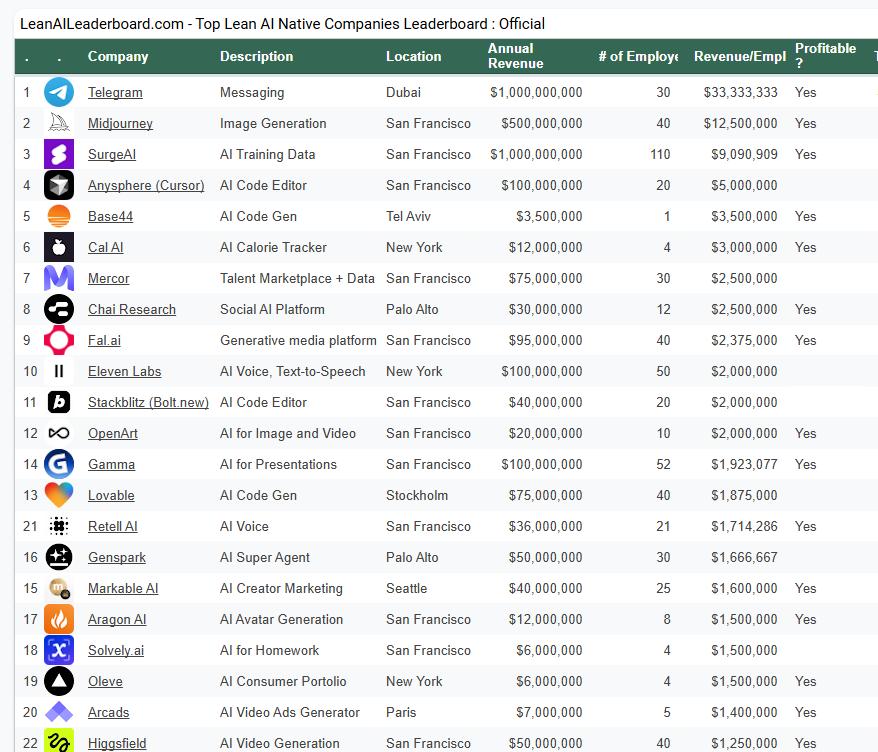
Core Insights - The article discusses the emergence of "one-person companies" and their potential to outperform traditional large corporations by leveraging technology and personal branding [1][6][58] - Pieter Levels is highlighted as a key figure exemplifying this model, successfully generating significant revenue without a traditional team structure [4][18] Group 1: One-Person Companies - One-person companies (OPC) are seen as enhanced versions of traditional companies, utilizing digital leverage to achieve significant results [7][58] - Pieter Levels operates multiple successful services like Nomad List and Remote OK, generating around $2.7 million annually without a team [4][5] - The operational model of one-person companies eliminates coordination friction, allowing for rapid decision-making and execution [13][14] Group 2: Advantages of One-Person Companies - One-person companies can achieve high levels of creativity and flexibility, amplified by AI tools, although they may lack the overall power of larger firms [15][58] - Pieter Levels combines product development and marketing, using his personal brand as a powerful marketing tool, which allows him to avoid traditional advertising costs [20][21] - His approach emphasizes practical technology use, opting for simpler, cost-effective solutions that reduce operational expenses [22][25] Group 3: Market Strategy - Levels targets niche markets that larger companies overlook, such as the digital nomad community, which allows him to thrive in less competitive environments [30][31] - The focus on long-tail markets enables one-person companies to accumulate sufficient revenue while maintaining low operational costs [33][35] Group 4: Challenges and Limitations - Despite the advantages, one-person companies face limitations, including the physical and mental strain on the individual, as well as societal infrastructure not being designed for solo operators [39][40] - The pressure of managing various business aspects alone can lead to burnout, highlighting the need for efficient systems to handle operational tasks [42][44] Group 5: Future of Business Models - The evolution from one-person companies to "zero-person companies" is discussed, where automation and AI take over operational roles, allowing founders to focus on strategic oversight [51][56] - The article suggests that future business success will increasingly depend on automation capabilities rather than employee count, marking a shift in how companies are evaluated [60][62]
都说“一人公司”好,那为什么没有遍地都是?
虎嗅APP· 2025-12-24 10:17
Core Viewpoint - The article discusses the emergence of "One-Person Companies" (OPC) in the AI era, highlighting how individuals can leverage technology to create successful businesses with minimal resources, contrasting this with traditional business models [4][6][12]. Group 1: Emergence of One-Person Companies - A new business model is emerging where a few employees can connect seamlessly to global markets, generating millions in revenue as "super individuals" [5][6]. - Sam Altman predicted that the AI era would give rise to a new type of startup: the one-person unicorn company [6][7]. - Nathan Baschez noted that startups are becoming "smaller, faster, cheaper, and weirder" [9]. Group 2: Characteristics of One-Person Companies - The key differentiator for OPCs is leverage, with AI acting as a powerful tool that allows individuals to achieve productivity levels previously only possible with larger teams [14][16]. - Examples include Pieter Levels, who operates a one-person company generating $2.5 million annually without employees, and Vivian Kaye, who achieved over $6 million in sales with her brand [16][18]. - The operational model of OPCs often involves a "front-end individual, back-end network" approach, utilizing AI and outsourcing to manage tasks efficiently [19][20]. Group 3: Challenges Faced by One-Person Companies - Many OPCs face a revenue ceiling, with most generating between $100,000 and $500,000 annually, which can lead to operational challenges if they attempt to scale beyond this range [30][31]. - The lack of redundancy in OPCs makes them vulnerable; any personal issue can jeopardize the entire business [33][34]. - There is a risk of becoming overly dependent on platforms, where changes in algorithms can drastically affect business viability [36][37]. Group 4: The Chinese Context - Lingang Experiment - The Lingang area in China is developing a more resilient and systematic growth model for OPCs, addressing key pain points such as cost anxiety and resource isolation [38][39]. - The Lingang ecosystem, termed "OPC5," aims to provide support in cost, connectivity, opportunity, convenience, and community for individual entrepreneurs [40][41]. - The area offers significant cost advantages, such as rent-free first-year support, and fosters a collaborative community among entrepreneurs [43][44]. Group 5: Future Economic Structure - The article suggests a shift towards a "dumbbell" economic structure, with a few large platforms at one end and numerous super individuals at the other, while traditional mid-sized companies may struggle to survive [56][57]. - Investment strategies are evolving, focusing more on investing in individuals rather than companies, with a potential rise in revenue-sharing models [59][60]. - The Lingang OPC model presents an attractive option for young entrepreneurs, allowing them to achieve financial independence and creative freedom without the pressures of traditional corporate structures [62].