Rubin架构AI GPU

Search documents
黄仁勋抛出5000亿美元AI算力蓝图 英伟达(NVDA.US)站在AI盛世与泡沫争议的十字路口
智通财经网· 2025-11-18 02:04
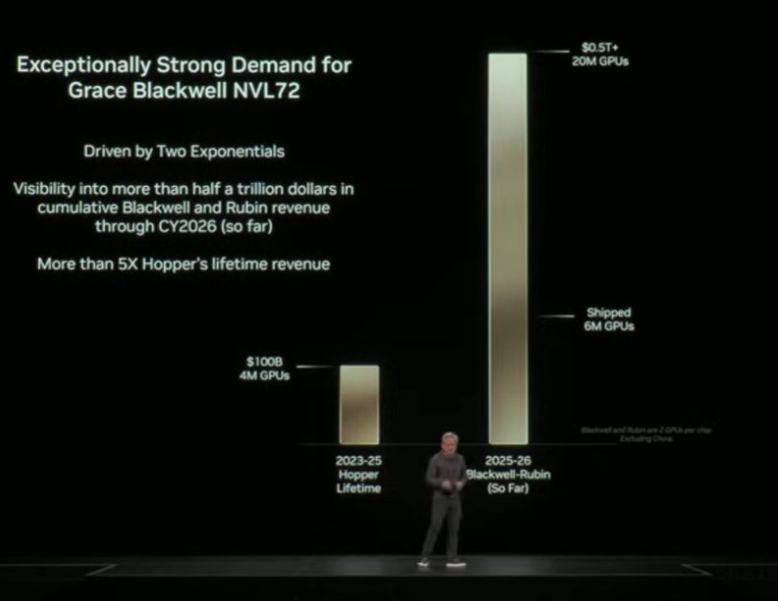
Core Insights - Nvidia's CEO Jensen Huang announced at the GTC conference that the company has up to $500 billion in AI GPU infrastructure orders for the years 2025 to 2026, driven by the Blackwell architecture and the upcoming Rubin architecture [1][3][4] - Huang's statement has sparked significant interest among investors, as it suggests a strong growth outlook for Nvidia amidst ongoing debates about an "AI bubble" in the market [1][2][6] Financial Performance - Nvidia's revenue has grown nearly 600% over the past four years, indicating strong market demand for AI chips [2] - Analysts expect Nvidia's Q3 earnings per share to be $1.25, with revenue around $54.9 billion, reflecting a year-over-year growth of 56% [7] - The anticipated revenue for Nvidia in 2026 is projected to be approximately $286.7 billion, significantly higher than previous Wall Street estimates [7][6] Market Dynamics - The demand for AI computing power is surging globally, supported by substantial investments from the U.S. government and major tech companies [2][4] - Nvidia's market share in the AI GPU sector exceeds 90%, but competition is increasing from companies developing custom AI chips [11][12] - Major clients like Amazon and Google are increasingly promoting their own AI ASIC chips, which could impact Nvidia's market position [11] Strategic Partnerships - Nvidia has made significant investments, including a potential $100 billion investment in OpenAI, which will purchase millions of Nvidia GPUs [10] - The company has also invested $5 billion in Intel to enhance collaboration between their CPU and GPU technologies [10] - Nvidia's recent $1 billion investment in Nokia aims to integrate its AI GPU infrastructure into Nokia's cellular network hardware [10] Future Outlook - Huang expressed confidence in achieving the $500 billion revenue target, indicating a "clear visibility" of this growth [8] - Analysts believe that the ongoing AI capital expenditure trend reflects a persistent demand for AI computing resources, despite concerns about potential overinvestment [10][12] - The potential for the Chinese market remains uncertain, with Nvidia's previous AI chip sales being restricted, but analysts see it as a future opportunity [12]


“AI信仰”再掀巨浪! Blackwell与Rubin将托起5万亿美元AI帝国 黄仁勋坚信AI纪元已至
智通财经网· 2025-10-29 10:15
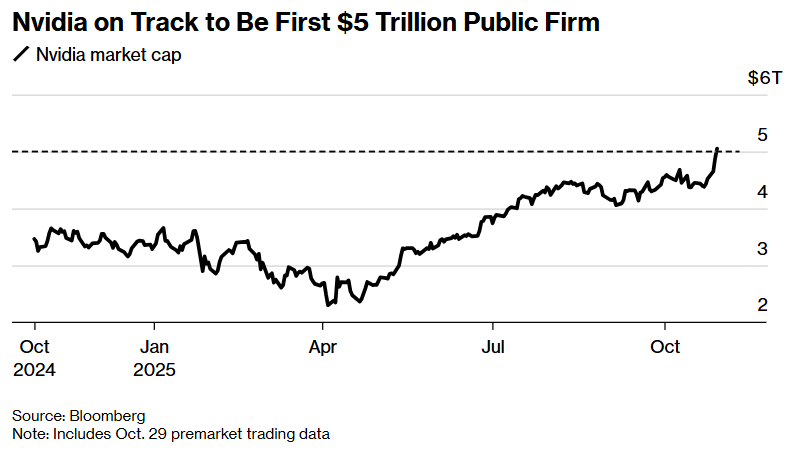
Core Insights - Nvidia's CEO Jensen Huang unveiled significant advancements in AI technology at the GTC conference, including a native AI 6G network platform, a Robotaxi fleet based on Nvidia's autonomous driving platform, and the next-generation AI GPU architecture, Rubin, which shows substantial performance improvements over Blackwell [1][3][4] - Following these announcements, Nvidia's stock surged over 6%, closing at $201, with a market capitalization reaching $4.9 trillion, just shy of the $5 trillion milestone [1] - Huang projected that Nvidia's data center business revenue would exceed $500 billion over the next five quarters, driven by the Blackwell and Rubin architectures, significantly surpassing Wall Street's expectations [3][6] Nvidia's AI Strategy - Nvidia is transitioning from a chip design company to a comprehensive AI technology platform, which includes a full-stack infrastructure and an operational ecosystem for AI [3][4] - The company aims to be the strongest foundation for AI, with a focus on high-performance, low-energy AI GPU architectures, and plans to release the Rubin Ultra architecture by late 2027 [5][9] Market Reactions and Predictions - Goldman Sachs reported that Nvidia's projected $500 billion revenue is significantly higher than market consensus, indicating a renewed investor enthusiasm for AI-related investments [3][12] - Major financial institutions, including HSBC, have raised their target price for Nvidia's stock to $320, suggesting a bullish outlook that could see Nvidia's market cap surpass $7 trillion [4][11] AI Infrastructure and Collaborations - Nvidia is investing heavily in AI infrastructure, including a $1 billion stake in Nokia to develop AI-native 6G networks and partnerships with companies like Uber and Eli Lilly to enhance AI applications in various sectors [10][11] - The company is also focusing on the development of advanced AI computing systems, with the Rubin architecture expected to deliver significant performance improvements over previous models [9][10] Long-term AI Market Outlook - The demand for AI computing power is expected to continue growing, driven by substantial investments from both the government and tech giants in AI infrastructure [12][14] - Analysts predict that the current AI investment wave could reach $2 trillion to $3 trillion, indicating a robust long-term growth trajectory for companies like Nvidia and its peers in the AI computing space [14][15]