S80

Search documents
心智观察所:摩尔线程无法回避的尴尬
Guan Cha Zhe Wang· 2025-12-18 02:00
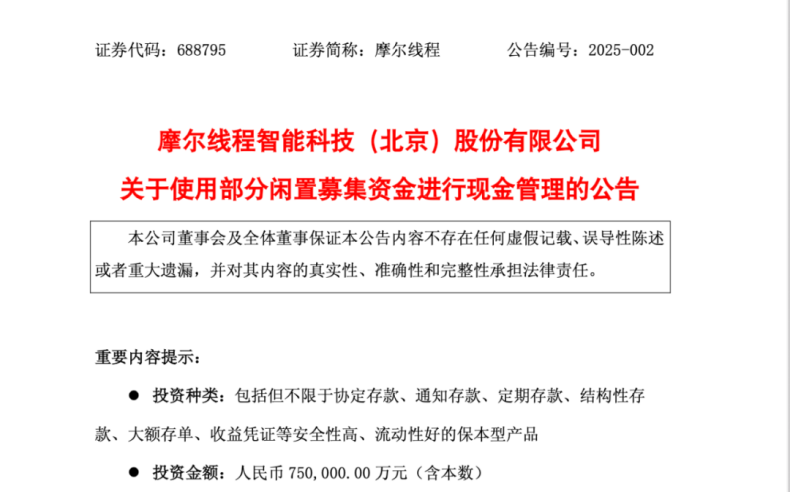
Core Viewpoint - The capital market in December 2025 is dominated by domestic GPUs, with companies like Moer Thread and Muxi experiencing significant stock price surges, but underlying issues reveal the challenges faced by the domestic GPU industry [1][2]. Fundraising and Financial Management - Moer Thread's decision to invest approximately 7.5 billion yuan of its raised funds into financial products instead of immediate R&D has sparked controversy, raising questions about the company's commitment to innovation [2][3]. - The company plans to allocate 2.5 billion yuan for AI training chip development, 2.5 billion yuan for graphics chip development, and 2 billion yuan for AI SoC chip development, but its current revenue is significantly low, indicating a potential misalignment in resource allocation [3][4]. Market Performance and Competition - Moer Thread's revenue for 2024 is projected to be less than 500 million yuan, with only slight improvements expected in 2025, highlighting the company's struggle to compete in a mature and highly competitive graphics card market [3][5]. - The company's main consumer-grade product, the S80, is underperforming compared to its competitors, with actual gaming performance lagging behind older models, which raises concerns about its market viability [8][9]. Industry Challenges and Comparisons - The domestic GPU sector is facing significant challenges, as evidenced by the failures of companies like Xiangdixian and Lishuan Technology, which highlight the harsh realities of the industry [10][11]. - The reliance on foreign technology and the complexities of GPU design contribute to the difficulties faced by domestic companies, as they struggle to establish a competitive edge against established players like NVIDIA [12][17]. Financial Health and Future Outlook - Moer Thread has accumulated losses exceeding 5 billion yuan from 2022 to 2024, with expectations of continued losses, indicating a prolonged "burn rate" before achieving profitability [14][15]. - The company’s revenue concentration risk is high, with 56% of its income derived from a single major client, which poses significant operational risks if market conditions change [15][16]. Strategic Insights - The industry is witnessing a shift towards AI computing, with Moer Thread's revenue from AI computing accounting for 77.63%, indicating a strategic pivot away from consumer-grade graphics [9][10]. - The need for a robust ecosystem and technological advancements is critical for the survival of domestic GPU companies, as they face increasing pressure from both domestic and international competitors [17][19].

国产图形GPU的困局
傅里叶的猫· 2025-08-03 10:44
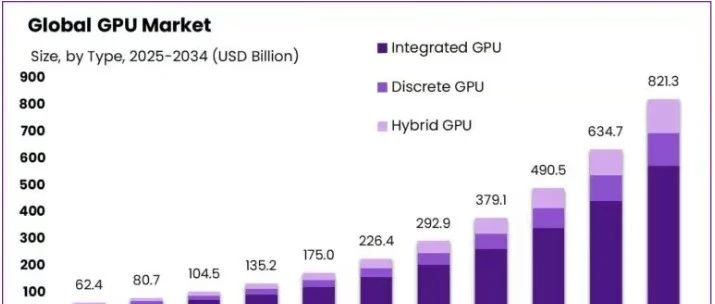
Core Viewpoint - The article discusses the current state and future potential of the domestic graphics GPU market in China, highlighting the recent success of Lisan Technology's 7G100 series GPU and the challenges faced by domestic manufacturers in competing with established players like NVIDIA and AMD [2][28]. Market Size and Growth - The global graphics GPU market is projected to reach approximately USD 80 billion by 2025, with a significant growth rate of 33.65% CAGR expected from 2025 to 2030, leading to a market size of USD 352.55 billion by 2030 [4][6]. - The Chinese graphics GPU market is estimated to be USD 13.18 billion in 2025, up from USD 10.08 billion in 2024 [8]. Market Composition - In 2024, integrated GPUs will dominate the GPU market with a share of approximately 69.7%, while discrete GPUs will account for 30.3% [11]. - For the Chinese discrete GPU market, the estimated size in 2024 is around USD 30.54 million [11]. Competitive Landscape - NVIDIA and AMD hold a combined market share of about 98% in the discrete GPU market, leaving only a small portion for other manufacturers [12][16]. - The remaining market for other GPU manufacturers in China is estimated to be less than USD 500 million [16]. Challenges for Domestic Manufacturers - Domestic GPU manufacturers face several challenges, including: 1. **Technical Gap**: Domestic GPUs typically achieve only 60%-70% of the performance of comparable NVIDIA products due to insufficient technological accumulation and R&D capabilities [20]. 2. **Production Capacity**: Many domestic GPUs rely on TSMC for manufacturing, leading to issues with scheduling and cost control [20]. 3. **Software Support**: Most models and algorithms are optimized for NVIDIA chips, creating a significant hurdle for domestic GPUs [20]. Comparison with Other Domestic Players - The article compares Lisan Technology with other domestic companies like Moore Threads and Jingjia Micro, noting that Moore Threads has shifted focus away from gaming GPUs due to performance issues and is now concentrating on AI computing [22][25]. - Jingjia Micro's products target the mid-to-low-end market, with performance metrics significantly lower than NVIDIA's offerings [25][26]. Conclusion - The discrete GPU market presents opportunities, but for Lisan Technology to gain traction against NVIDIA and AMD, it will face significant challenges in the short term [28].