SaaS software

Search documents
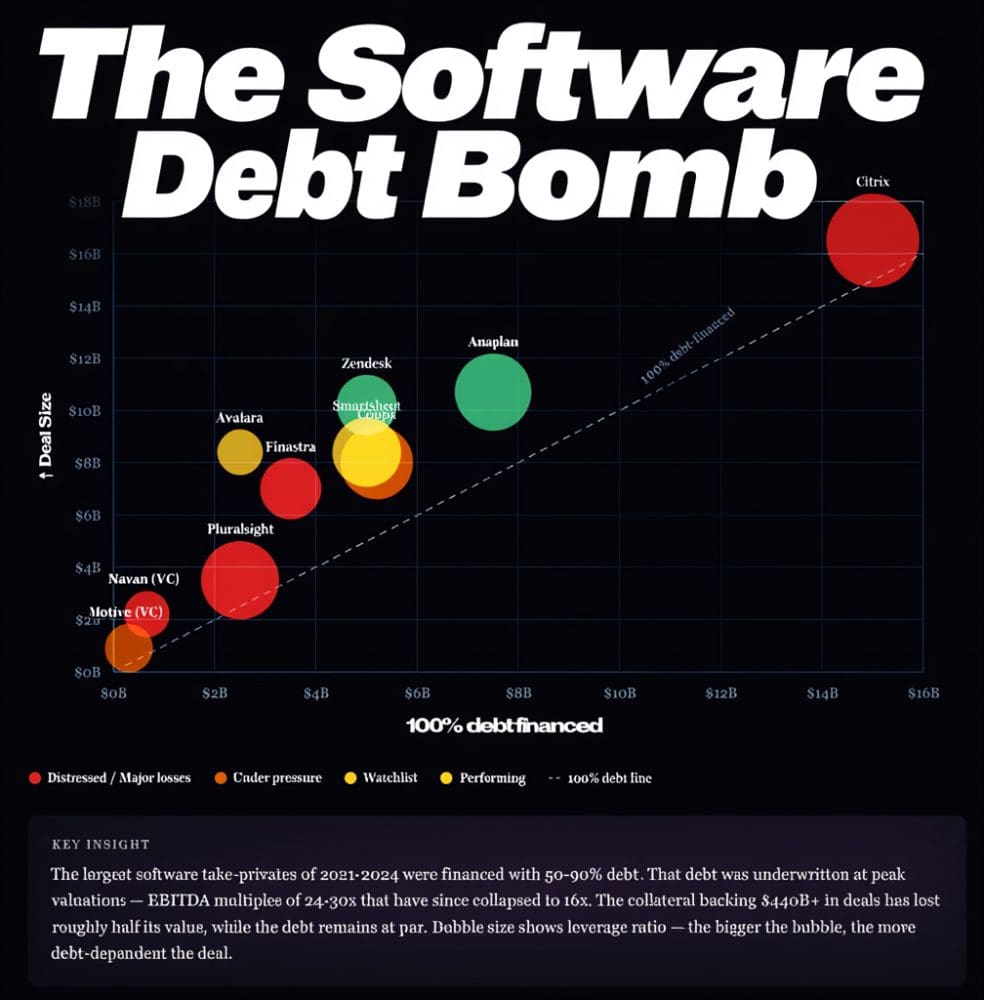
AI冲击下的软件债务炸弹:千亿美元杠杆正在逼近到期日
美股研究社· 2026-03-16 12:07
过去二十年,软件行业几乎是资本市场最确定的增长叙事。 这不仅仅是一个关于财务杠杆的问题,更是一个关于商业模式底层逻辑是否依然成立的深刻拷 问。 从 " 资 本 宠 儿 " 到 " 债 务 堰 塞 湖 " : 软 件 行 业 的 隐 藏 杠 杆 "软件吞噬世界"的逻辑,让 SaaS 企业成为轻资产、高利润、高估值的代名词。投资者曾经坚 信,一旦企业安装了某种软件,极高的迁移成本将锁定未来十年的现金流。这种确定性,使得 软件公司在一级市场和二级市场都享受着近乎无限的宽容。 但在 AI 革命与高利率周期叠加的背景下,这个曾经最具确定性的行业,正悄然进入一场压力 测试。 在过去十多年里,软件行业一直是资本市场最受欢迎的赛道之一。 云计算与 SaaS 商业模式的兴起,彻底改变了企业的成本结构。软件公司拥有极高的资本效 率:不需要像制造业那样投入巨额资金建设厂房,也不需要像零售业那样维护庞大的库存。它 们只需要编写代码,然后通过订阅模式获得持续、可预测的现金流。 【如需和我们交流可扫码添加进社群】 宏观环境的剧变正在剥离软件行业的光环。当巨额债务集中到期与技术范式转移同时出现,一 个过去很少被讨论的问题开始浮出水面: 如 ...


SaaS Markets Have Crashed in 2026. But Is Private Credit the Even Bigger Risk?
SaaStr· 2026-02-20 15:10
Core Insights - The software stock market has entered a bear phase in 2026, with significant declines in valuations and market capitalizations, raising concerns about the private credit market's exposure to software companies [1][2][52] - The private credit market, valued at $3 trillion, has a substantial portion tied to software, with estimates indicating that 20-35% of private credit deals involve SaaS companies [8][9] - The potential for widespread defaults in private credit could have far-reaching implications for the entire financial ecosystem supporting B2B operations, including venture debt and M&A activities [7][52] Market Performance - The IGV index has dropped over 23% year-to-date, with $285 billion in market cap lost in a single day, and software price-to-sales ratios have decreased from 9x to 6x [1] - Major software IPOs have seen drastic declines, with Figma down over 80% from its peak and Navan down 60% since its IPO [5][27] Private Credit Exposure - Private credit's exposure to software companies is estimated between $600 billion and $750 billion, raising concerns about the reliability of debt repayment [2][52] - The private credit market has financed over $440 billion in software acquisitions from 2015 to 2025, with many loans now under stress due to changing market conditions [9][10] Distressed Debt Levels - As of early February, $46.9 billion in US tech company loans are trading at distressed levels, with a record $25 billion of software-sector loans below the distress threshold [15][16] - The average EBITDA multiples for software companies have collapsed from 30x at the end of 2022 to approximately 16x today, indicating a significant reduction in collateral value for loans [21] Risk of Defaults - Default rates for US private credit could reach 13% if AI disruption accelerates, significantly higher than projected high-yield default rates [30] - The interconnectedness of private credit and the broader financial system poses risks, as tightening credit conditions could lead to a cascade of defaults across the software sector [36][50] Structural Issues - The private credit market operates differently from public equity markets, with illiquid loans often held to maturity and valued by lenders themselves, which can delay the recognition of problems [34] - The potential for a "doom loop" scenario exists, where missed payments lead to markdowns, triggering redemption requests that funds may struggle to meet [37][50] Industry Outlook - The SaaSpocalypse reflects a broader concern about the sustainability of software companies in an AI-driven market, where traditional revenue models may no longer hold [6][52] - The private credit market's heavy reliance on software companies, combined with the current economic climate, suggests a challenging environment ahead for both lenders and borrowers [52][53]

Alarm.com(ALRM) - 2025 Q4 - Earnings Call Transcript
2026-02-19 22:32
Financial Data and Key Metrics Changes - SaaS and license revenue for Q4 was $180 million, an increase of 8.8% year-over-year [3][21] - Adjusted EBITDA for Q4 was $55 million, with full year adjusted EBITDA increasing to $206 million, representing 16.9% year-over-year growth [3][24] - Total revenue exceeded $1 billion for the full year, growing 8% year-over-year in Q4 [3][21] - GAAP net income for Q4 was $34.7 million, or $0.66 per diluted share, while non-GAAP adjusted net income grew 19.2% year-over-year to $38.9 million [24] Business Line Data and Key Metrics Changes - The core residential business continues to grow primarily through ARPU expansion, with significant contributions from residential video solutions [9][11] - The commercial security and energy businesses contributed 25% of SaaS revenue for the full year, growing about 25% year-over-year [11][14] - EnergyHub's connected devices under management increased by more than 50% in 2025, with utilities increasing the number of calls on EnergyHub VPPs by 25% [16][17] Market Data and Key Metrics Changes - The company has a strong market share in the US and Canada for professionally installed smart home security solutions [8] - The international market is being developed as a natural extension of the platform strategy, with video attachment rates increasing to 33% in 2025 [18] Company Strategy and Development Direction - The company is focused on leveraging R&D and delivery channels to expand into additional markets, creating a more diversified and durable business [4][19] - The acquisition of Resideo Grid Services (RGS) is expected to enhance EnergyHub's capabilities and expand its utility client base [16][28] - The company aims to maintain a competitive position by prioritizing high-return organic investments and selective acquisitions [29] Management's Comments on Operating Environment and Future Outlook - Management expressed confidence in the underlying demand environment in the commercial market despite economic uncertainties [11] - The company does not foresee AI impacting its fundamental business model structure, as its SaaS revenue is driven by connected devices rather than seat-based pricing models [6][7] - The outlook for Q1 2026 expects SaaS and license revenue between $175.8 million and $176 million, with full year 2026 SaaS and license revenue projected between $743 million and $745 million [30][32] Other Important Information - The company retired $500 million of convertible notes, removing potential dilution from its share count [26] - Non-GAAP free cash flow for Q4 was $35.1 million, with a total of $137 million for the full year [25] Q&A Session Summary Question: SaaS guidance raise and organic growth assumptions - Management noted that the SaaS guidance increase includes contributions from RGS and better-than-expected performance in Q4, with organic growth slightly better than previously projected [36][37] Question: Competitive environment and EnergyHub's market position - Management discussed the competitive landscape, emphasizing their strong position and the potential for growth in the EnergyHub business due to network effects and utility partnerships [40][42] Question: AI integration and monetization - Management highlighted ongoing efforts to enhance product capabilities with AI, focusing on improving user interfaces and productivity [46][48] Question: Impact of tariffs on demand and manufacturing costs - Management indicated no significant demand degradation from tariff pass-throughs and noted that they are monitoring manufacturing costs closely [49][50] Question: EnergyHub growth metrics and KPIs - Management outlined key metrics for EnergyHub's growth, including the percentage of market serviced and enrollment rates in utility programs [97][98]

Alarm.com(ALRM) - 2025 Q4 - Earnings Call Transcript
2026-02-19 22:30
Financial Data and Key Metrics Changes - SaaS and license revenue for Q4 2025 was $180 million, an increase of 8.8% year-over-year [4] - Adjusted EBITDA for Q4 2025 was $55 million, with full-year adjusted EBITDA increasing to $206 million, representing 16.9% year-over-year growth [21][24] - Total revenue for the full year exceeded $1 billion, marking a significant growth milestone [4][17] Business Line Data and Key Metrics Changes - The core residential business continues to grow primarily through ARPU expansion, with a strong market share in the U.S. and Canada [9] - The commercial security and energy businesses contributed 25% of SaaS revenue for the full year, growing approximately 25% year-over-year [11] - EnergyHub's connected devices under management increased by over 50% in 2025, with utilities increasing their calls on EnergyHub VPPs by 25% [14] Market Data and Key Metrics Changes - The company serves approximately 50 million meters in North America, with a current enrollment rate of about 5% [36][95] - The residential video attachment rate increased to 33% in 2025, reflecting growing adoption of video solutions [15] Company Strategy and Development Direction - The company is focused on leveraging R&D to expand into additional markets and diversify its business [5] - The acquisition of Resideo Grid Services (RGS) is expected to enhance EnergyHub's capabilities and expand its utility client base [14][15] - The company aims to maintain a competitive edge by focusing on organic R&D investments and selective acquisitions [24][25] Management's Comments on Operating Environment and Future Outlook - Management expressed confidence in the underlying demand environment for commercial security solutions despite economic uncertainties [11] - The company anticipates continued revenue growth and profitability while investing in long-term opportunities [28] - Management noted that AI will enhance internal productivity and capabilities without fundamentally changing the business model [8] Other Important Information - The company retired $500 million of convertible notes, reducing potential dilution in share counts [22] - Non-GAAP free cash flow for Q4 was $35.1 million, with a total of $137 million for the full year [22] Q&A Session Questions and Answers Question: Can you break down the SaaS guidance raise and the organic growth assumptions? - The SaaS guidance increased by about $21 million, with contributions from RGS and better-than-expected performance excluding RGS [32][33] Question: What is the competitive environment for EnergyHub and its market size? - EnergyHub aims to be the most appealing partner for device manufacturers, with a current market coverage of about 50 million meters and a goal to increase enrollment rates [35][36] Question: How is the company addressing AI opportunities in R&D? - The company is enhancing its solutions with AI capabilities, focusing on making data more accessible and improving productivity [44] Question: How are tariff passthroughs impacting demand and manufacturing costs? - There has been no discernible decrease in demand due to tariff passthroughs, and the company is monitoring potential manufacturing cost increases [48][50] Question: What are the growth drivers for EnergyHub? - Growth drivers include increasing enrollment rates, adding more utilities, and expanding the range of devices serviced [95]
What We’re Reading (Week Ending 08 February 2026) : The Good Investors %
The Good Investors· 2026-02-08 01:00
Group 1: Software and AI Trends - SaaS software stocks have seen a significant decline since October 2025 due to concerns about software being disrupted by AI, leading to an overly pessimistic market outlook [3] - The future of work is shifting towards AI agents handling low-value tasks, allowing humans to focus on higher-value creative and strategic tasks [4] - High-value, mission-critical software, such as cybersecurity and payment systems, is expected to remain robust, while low-value software may face challenges [9] Group 2: Data Center Power Demand and Supply - Current power consumption by data centers is approximately 45 GW, with estimates suggesting it could rise to 90-95 GW by 2030 and around 160 GW by 2035 [10][11] - Utilities are working on connecting around 140 GW of near-term supply, which is nearly sufficient to meet the projected demand by 2030 [11][13] - The demand forecasts for data centers are subject to change, with moderate confidence in current estimates due to rapid advancements in technology and efficiency [14] Group 3: Community Banks and Financial Reporting - Call Reports provide a more accurate picture of a community bank's financial health compared to public financial statements, which often misrepresent economic reality [19][20] - The economic book value of a bank is better reflected in the Call Report, showing total bank equity capital significantly higher than what public financials indicate [21][23] - For example, West Shore Bank's Call Report shows total bank equity capital at approximately $73 million, while public financials suggest a much lower figure [22][23]

A deep dive into RMD shares
Rask Media· 2025-12-24 21:27
Company Overview - ResMed is a medical equipment company based in San Diego, California, originally founded in Australia, specializing in cloud-connectable CPAP machines for obstructive sleep apnea treatment [2] - The company operates globally with over 10,000 employees and a presence in more than 140 countries, divided into two main business units: Sleep and Respiratory Care, and Software as a Service (SaaS) [3] - ResMed's products include industry-leading CPAP machines and software for durable medical equipment, focusing on out-of-hospital care [3][4] Market Performance - The ASX:RMD share price has decreased by 2.0% since the start of 2025 [1] - The S&P/ASX200 Healthcare Index has returned -4.53% per year over the last 5 years, contrasting with a 5.51% annual return from the broader ASX 200 [5] Revenue Stability - Healthcare spending is considered essential, leading to stable and consistent revenue streams, often referred to as 'sticky' revenue, which remains resilient during economic downturns [6] - Historical performance indicates that healthcare was the best-performing sector during the Global Financial Crisis (GFC) [6] Growth Potential - Global healthcare spending, particularly in the US, is projected to grow significantly, with estimates of 7% annual growth from 2022 to 2027, reaching US$819 billion [7] - Sub-sectors such as healthcare IT and SaaS are expected to see revenue growth exceeding 15% per year from 2024 to 2030, attracting investor interest [8] Ethical Investment Trends - A Morgan Stanley survey indicates that over half of investors plan to increase their allocation to sustainable investments in 2024, positioning healthcare sectors favorably for attracting new capital [9] Valuation Insights - ResMed shares currently have a price-to-sales ratio of 5.08x, below the 5-year average of 8.70x, suggesting that shares may be undervalued or that sales have increased [11]


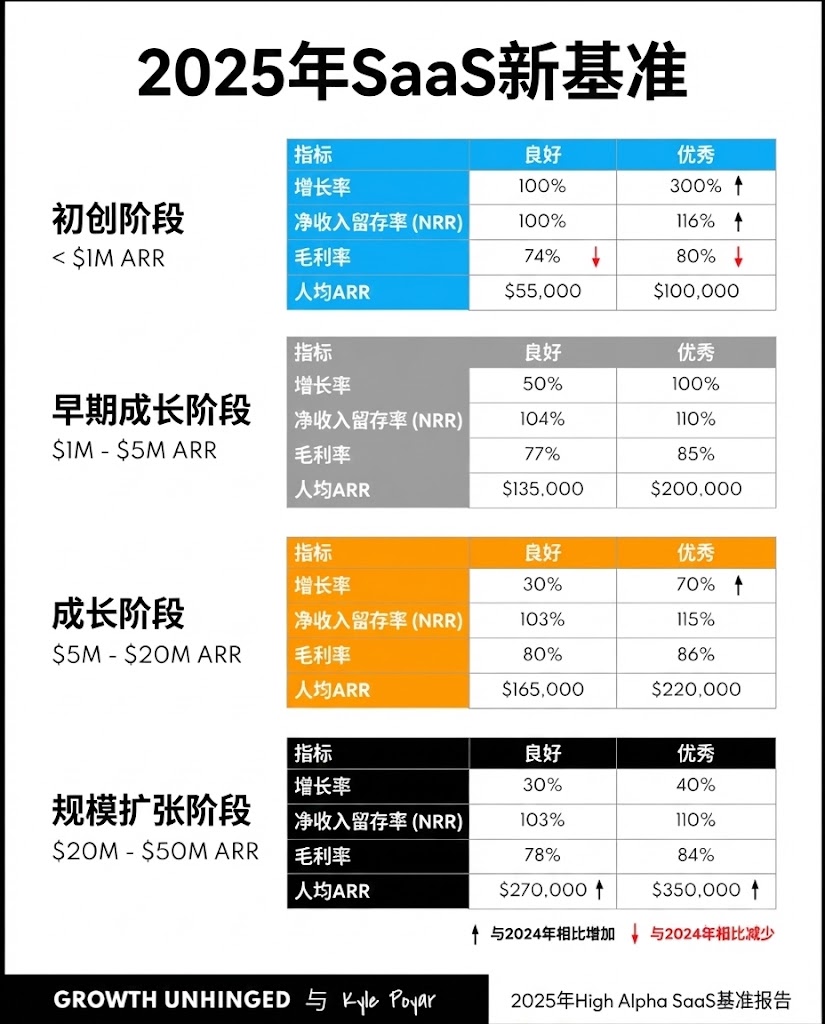
SaaS不再相信“烧钱换增长”:一份2025年的存活指南
3 6 Ke· 2025-12-16 06:13
Group 1 - The core viewpoint of the article highlights that while the market appears stable, AI-native companies are experiencing a threefold increase in growth, which is impacting margins and R&D positions. The traditional SaaS logic is failing, leading to a brutal efficiency war [1][6][7]. Group 2 - The 2025 SaaS Benchmark Report is based on a survey of over 800 B2B SaaS companies, aiming to provide insights into growth rates, personnel size, pricing strategies, and operational efficiency [2][3]. - The report identifies key performance indicators for SaaS companies, including growth rates, net revenue retention (NRR), gross margins, and revenue per full-time employee (FTE) [3][5]. Group 3 - The efficient growth matrix suggests that traditional metrics like LTV:CAC should be reconsidered, emphasizing the importance of combining CAC payback period and NRR for clearer insights into long-term profitability [6][10]. - AI-native startups are growing at a significantly faster rate than traditional B2B SaaS companies, with a notable difference in growth rates across various annual recurring revenue (ARR) brackets [11][19]. Group 4 - AI is reshaping technology roles, particularly in engineering, with significant reductions in workforce due to AI integration. The most affected roles include engineering, customer success, and marketing [17][21]. - The report indicates that companies with higher productivity, measured by revenue per employee, are achieving substantial gains, with top companies exceeding $580,000 in revenue per employee [18]. Group 5 - Pricing sweet spots have been identified, with optimal transaction sizes for growth and retention being between $10,000-$25,000 and $50,000-$100,000. Companies in these ranges tend to experience the best growth rates and retention [22][25][26].





Tyler Technologies (NYSE:TYL) FY Conference Transcript
2025-12-10 22:57
Tyler Technologies (NYSE: TYL) FY Conference Summary Company Overview - **Company**: Tyler Technologies - **Industry**: Software, specifically focused on SaaS (Software as a Service) solutions for public sector clients Key Points and Arguments Financial Performance and Guidance - Tyler Technologies raised guidance for the second quarter, marking the third consecutive quarter of guidance increases [5] - The company is on track to achieve or exceed its 2025 and 2030 long-term objectives set during the 2023 investor day [5] - SaaS revenue growth for 2026 is expected to be around 20%, with 12% of this growth coming from deals already signed by the end of 2025 [6][7] - The breakdown of the 20% growth includes: - 12% from backlog deals signed in 2024 - 5% from new bookings in 2025 - 3% from migrating on-prem customers to the cloud [8][9] SaaS Transition and Customer Migration - The company is experiencing a typical uplift of 1.7-1.8 times maintenance revenues as customers transition to SaaS [9] - The peak of the customer migration curve is expected to occur in the next two to three years, with an increasing number of flips contributing to revenue growth [9][36] - Tyler aims for 80%-85% of its on-prem customer base to migrate to the cloud by 2030, with a long-term goal of 100% [33] Revenue Dynamics and Metrics - New Annual Recurring Revenue (ARR) is considered the most important metric for gauging the health of the SaaS business, regardless of its source [12][13] - The relationship between SaaS bookings and revenue can be impacted by factors such as deal duration and the lag between signing and revenue recognition [16][18] - Transaction-based revenues are also contributing to overall revenue, sometimes at the expense of SaaS bookings [20][22] Profitability and Margin Targets - Tyler Technologies is ahead of its plan for operating margins, targeting 30% or more by 2030 [37] - The path to achieving these margins is not linear, with expected slower improvements in 2026 due to ongoing investments in AI and client experience [40][41] Free Cash Flow Expectations - The company is on track to achieve high 20s to 30% free cash flow margins by 2030, driven by improved operating margins and working capital management [42][43] - Tyler aims to generate $1 billion in free cash flow annually by 2030 [43] Capital Allocation Strategy - The company plans to repay a $600 million convertible debt due in March, with ample liquidity available [46] - M&A activity is expected to increase as the company has completed debt repayment and is more open to acquisitions [47] - Share repurchases will continue to be opportunistic, particularly during dips in stock price [48] Additional Important Insights - The company has successfully transitioned all customers to AWS, closing its second proprietary data center, which will contribute to cost savings over time [39] - The competitive advantage of Tyler Technologies lies in its ability to offer transaction-based revenue models, which can reduce the need for upfront SaaS fees from clients [21][22] This summary encapsulates the key insights from the Tyler Technologies FY Conference, highlighting the company's financial performance, strategic direction, and market positioning within the software industry.

An easy way to value RMD and NWL shares
Rask Media· 2025-09-13 19:57
Company Overview - ResMed is a medical equipment company based in San Diego, California, originally founded in Australia, specializing in cloud-connectable CPAP machines for obstructive sleep apnea treatment [2] - The company operates globally with over 10,000 employees and a presence in more than 140 countries, divided into two primary business units: Sleep and Respiratory Care, and Software as a Service (SaaS) [3] - Netwealth is a wealth management software business that provides a platform for financial planners, with over 140,000 account holders and $88 billion in funds under administration as of 2024 [5] Business Model and Services - ResMed's Sleep and Respiratory Care unit offers industry-leading CPAP machines, catering to a wide range of patients from those needing nightly therapy to those requiring life-support ventilation [3] - The SaaS unit provides software for durable or home medical equipment, enhancing out-of-hospital care [3][4] - Netwealth's platform allows users to manage investments, track performance, and access financial reports through a user-friendly interface [6] Financial Performance and Valuation - ResMed shares have a current price-sales ratio of 5.63x, significantly lower than its 5-year average of 8.70x, indicating potential undervaluation or increased sales [8] - In contrast, Netwealth shares trade at a price-sales ratio of 30.23x, above its 5-year average of 23.72x, suggesting a higher valuation relative to historical performance [9]