TAVP框架

Search documents
突破机器人空间感知瓶颈!中山大学与拓元智慧团队提出TAVP框架
具身智能之心· 2025-10-29 00:03
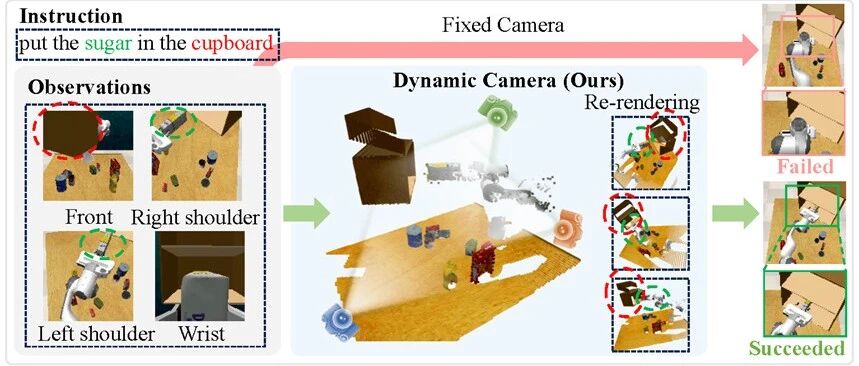
Core Viewpoint - The article discusses the introduction of the Task-Aware View Planning (TAVP) framework by Sun Yat-sen University and Tuoyuan Wisdom, which addresses the limitations of current visual-language-action (VLA) models in robotic multi-task manipulation by enhancing action prediction accuracy and task generalization capabilities in complex environments [1][5]. Research Background - The main challenges faced by existing VLA models, such as OpenVLA and π0.5, include incomplete 3D perception due to fixed viewpoints and significant task interference caused by shared encoders [3][5][7]. Core Innovations - TAVP framework introduces two innovative modules: Multi-View Exploration Policy (MVEP) and Task-Aware Mixture of Experts (TaskMoE), which work together to optimize the perception-action link in robotic manipulation [6][9]. Module Details - **Multi-View Exploration Policy (MVEP)**: This module dynamically captures key perspectives to address 3D perception occlusion by selecting optimal virtual camera positions through reinforcement learning [9][11]. - **Task-Aware Mixture of Experts (TaskMoE)**: It decouples task features to eliminate multi-task interference using dynamic expert routing and gating mechanisms [12][11]. - **Three-Stage Training Strategy**: Ensures module collaboration and performance stability through parameterization of viewpoints, efficient policy training, and dynamic re-rendering of images [11][20]. Experimental Validation - TAVP outperformed existing baseline models in 18 tasks on the RLBench benchmark, achieving an average success rate of 86.6%, particularly excelling in occlusion-prone tasks [13][14]. - Ablation studies confirmed the necessity of core modules, with the removal of TaskMoE leading to a drop in success rate to 85.6% and random viewpoints resulting in a drastic decline to 8.9% [15][21]. Generalization and Efficiency Analysis - TAVP demonstrated improved zero-shot capabilities, achieving a success rate of 12.0% on unseen tasks, while the model without TaskMoE failed to succeed [22][16]. - Despite increased computational costs from dynamic viewpoint re-rendering, TAVP maintained an average inference time of 0.436 seconds, only slightly higher than the baseline [22]. Real-World Robustness Testing - In robustness tests, TAVP showed superior adaptability compared to baseline models, achieving 100% success rates in various scenarios, including unseen instances and backgrounds [18][19][23]. Research Significance and Future Directions - The TAVP framework represents a new paradigm for robotic multi-task manipulation, enabling dynamic viewpoint planning and task-aware encoding to overcome existing limitations [25]. - Future work will focus on enhancing robustness against reflective and transparent objects and exploring multi-sensor fusion to expand the boundaries of robotic manipulation tasks [25].