
Tablet

Search documents
最高1500元!河南2026年家电、数码产品补贴实施细则公布
Xin Lang Cai Jing· 2026-02-28 03:43
Core Viewpoint - The Henan Province has announced the implementation details for the 2026 subsidy program for replacing old household appliances and digital products, following the earlier vehicle trade-in subsidy policy [1][3]. Subsidy Scope - The subsidy covers six categories of household appliances: refrigerators (including freezers), washing machines (including washer-dryer combos), televisions (including laser TVs, excluding projectors), air conditioners (including home central air conditioning), computers (branded, excluding assembled machines), and water heaters (including wall-mounted boilers) [2][5]. - It also includes four categories of digital and smart products: mobile phones, tablets, smartwatches (bands), and smart glasses, with a single item sales price not exceeding 6,000 yuan [2][5]. Subsidy Standards - For household appliances, a subsidy of 15% of the final sales price is provided for energy-efficient or water-efficient products, with a maximum subsidy of 1,500 yuan per item for each consumer [6]. - For digital and smart products, a similar subsidy of 15% applies, with a maximum of 500 yuan per item for each consumer [6]. Participation Process - Consumers must log into the Yunshangfu APP for real-name registration and obtain subsidy vouchers [7]. - Upon purchasing eligible products, consumers will receive an immediate discount at the point of sale, and merchants must issue invoices reflecting the actual payment plus the government subsidy [7]. - Merchants are required to collect necessary information for subsidy verification, including product serial numbers and activation codes for certain devices [8]. Basic Conditions for Participants - Participants must be legally registered entities with independent accounting, primarily engaged in retail of household appliances and digital products, and must have the capability for after-sales services [9]. - They must have a good credit status, with no significant safety incidents or violations in the past two years [9]. - Participants must publicly disclose product pricing and ensure compliance with subsidy regulations [10]. Responsibilities and Requirements - The business department is responsible for determining and publishing the list of participating entities, overseeing compliance, and managing funds [12]. - The finance department will handle fund disbursement and monitoring, aiming for efficient subsidy payments [12]. - Market regulation departments will ensure product quality and price monitoring, protecting consumer rights [12]. - Participants must adhere to legal regulations and avoid fraudulent practices, with penalties for violations [14].
内存供应挑战持续:IDC大幅下调今年智能手机全球出货量,同比下滑近13%
Sou Hu Cai Jing· 2026-02-27 09:17
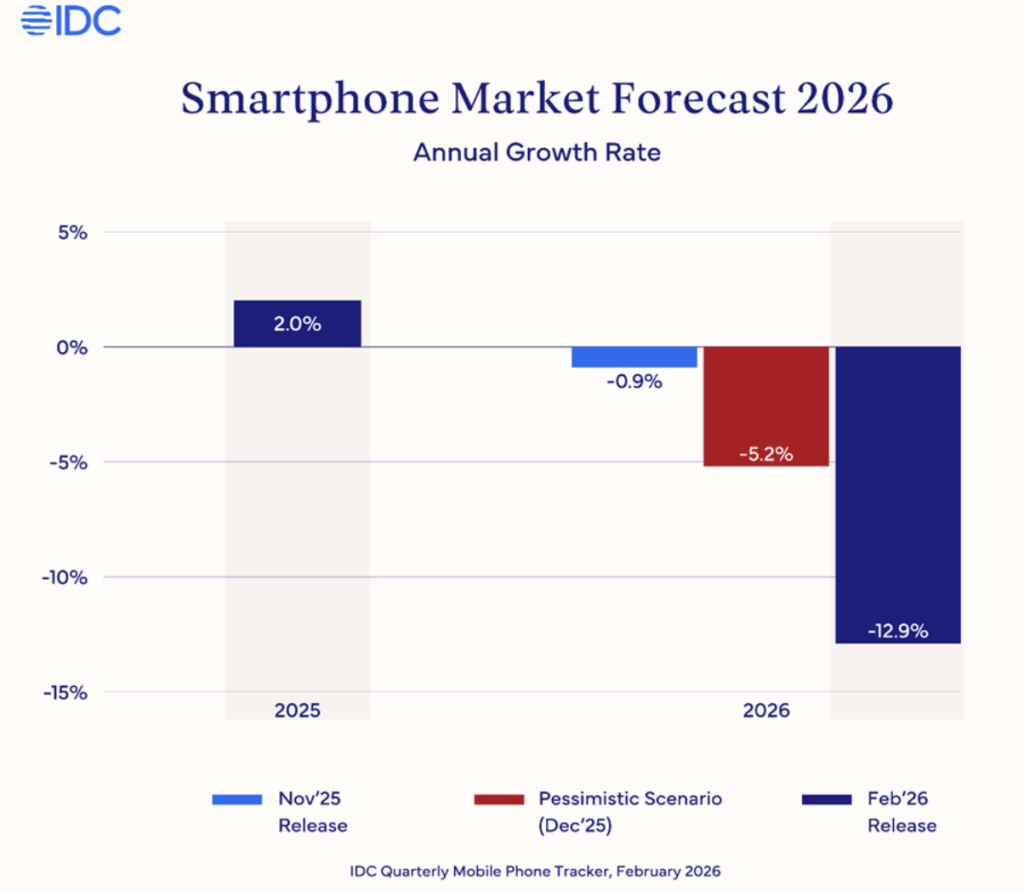
Core Insights - IDC has significantly revised down its forecast for global smartphone shipments in 2026 to approximately 1.1 billion units, a decrease from 1.26 billion units in the previous year, indicating a rare year-on-year decline of nearly 13% in the smartphone market [1] Group 1: Smartphone Market Outlook - The smartphone market is expected to decline by 12.9% in 2026, with a slight revenue decrease of 0.5%. A modest growth of 1.9% is anticipated in 2027, followed by a strong rebound of 5.2% in 2028 [4] - The ongoing memory supply challenges are projected to persist until at least 2026, potentially extending into 2027, with memory prices expected to remain elevated and not return to 2025 levels [4][5] Group 2: Memory Supply Crisis - The structural factors causing the memory shortage include surging demand for AI infrastructure and competition for DRAM and NAND flash capacity from consumer electronics [5] - IDC's Senior Research Director, Nabila Popal, emphasized that the current memory crisis is more significant than previous challenges such as tariffs and pandemic impacts, predicting a dramatic transformation in the smartphone market's scale, average selling price, and competitive landscape by mid-2027 [5] Group 3: Broader Market Implications - The crisis is expected to reshape not only the smartphone market but also the personal computer market, as well as the competitive dynamics of tablets, XR headsets, wearables, and gaming consoles [6]

China's Lenovo warns of PC shipment pressure from memory shortage
Reuters· 2026-02-12 07:28
Core Viewpoint - Lenovo warns of increasing pressure on PC shipments due to a worsening memory-chip shortage, which is impacting margins and production targets in the industry [1] Financial Performance - Lenovo's third-quarter revenue increased by 18% to $22.2 billion, surpassing expectations of $20.6 billion [1] - Net profit decreased by 21% to $546 million, affected by a $285 million restructuring charge [1] - Adjusted net profit, excluding one-time items and non-cash charges, rose by 36% to $589 million [1] Business Segments - The PC, tablet, and smartphone segment, which constitutes about 70% of total revenue, reported a revenue increase of 14.3% [1] - The digital infrastructure group, including the AI server business, grew by 31% despite an operating loss of $11 million due to investments in AI capabilities [1] - Lenovo's AI server business experienced high-double-digit revenue growth, driven by strong demand and deployment of Nvidia-based solutions [1] Strategic Focus - Lenovo is shifting its focus towards the AI inference market, anticipating that this market will triple by 2028 [1] - The company has introduced new enterprise servers for AI inference workloads in collaboration with AMD [1]


最高补贴2万元!2026年青海省以旧换新补贴比例公布
Sou Hu Cai Jing· 2026-01-16 06:54
Core Insights - Qinghai Province is set to further optimize its consumer goods trade-in policy by 2026, aiming to boost consumption and economic development [1] Group 1: Investment and Economic Impact - In 2025, Qinghai Province invested a total of 1.69 billion yuan, benefiting over 1.52 million people and stimulating consumption worth 19.7 billion yuan [1] - The province achieved significant results in vehicle and appliance upgrades, with 92,000 new cars, 496,000 home appliances, 615,000 digital products, and 31,900 home decor items purchased through the trade-in program [1] Group 2: Policy Adjustments - The central government will continue to allocate long-term special treasury bond funds to support the trade-in policy, with local governments providing matching funds [1] - In 2026, Qinghai will implement further optimizations to the trade-in policies for automobiles, home appliances, and digital products [1] Group 3: Specific Subsidy Standards - The subsidy for old car trade-ins will be adjusted to a percentage of the vehicle price, with new energy vehicles receiving 12% of the price (up to 20,000 yuan) and fuel vehicles receiving 10% (up to 15,000 yuan) [2] - For home appliances, consumers will receive a 15% subsidy on qualifying products, with a maximum of 1,500 yuan [2] - The subsidy for digital products will also be set at 15% for items priced under 6,000 yuan, with a maximum of 500 yuan [2]
促进人工智能技术与制造业应用“双向赋能”
Ke Ji Ri Bao· 2026-01-09 01:17
Core Viewpoint - The "Artificial Intelligence + Manufacturing" Special Action Implementation Opinion aims to deeply integrate AI technology with the manufacturing industry, promoting innovation and application in both sectors by 2027 [1] Group 1: Key Objectives - By 2027, China aims to achieve secure and reliable supply of key AI technologies, maintaining a leading position in industry scale and empowerment levels [1] - The plan includes the application of 3-5 general large models in manufacturing, the launch of 1,000 high-level industrial intelligent entities, and the creation of 100 high-quality industrial data sets [1] - The initiative seeks to cultivate 2-3 globally influential ecosystem-leading enterprises and a number of specialized small and medium-sized enterprises [1] Group 2: Major Tasks - The implementation outlines seven major tasks including innovation foundation, intelligence upgrade, product breakthroughs, entity cultivation, ecosystem expansion, safety assurance, and international cooperation [1] - Specific measures include enhancing AI computing power, supporting the development of intelligent chips, and creating high-performance algorithm models tailored for manufacturing [2] - The initiative emphasizes the need for deep integration of AI in production processes and encourages leading enterprises to pioneer AI applications [2] Group 3: Product Development - The plan promotes the integration of AI technology in major equipment development such as aircraft and ships, and supports testing of smart connected vehicles [3] - It aims to accelerate the upgrade of smart terminals and foster innovation in AI-enabled products like smartphones and smart home devices [3] - The initiative includes policy support to guide enterprises in differentiated development and prevent excessive competition within the industry [3]
今起实施!2026年浙江消费品以旧换新,操作指引来了
Xin Lang Cai Jing· 2026-01-01 07:30
Group 1: Core Points - The Zhejiang province will implement a vehicle trade-in program from January 1, 2026, to December 31, 2026 [1][25] - The program aims to encourage consumers to replace old vehicles with new ones, providing subsidies for eligible purchases [3][18] Group 2: Subsidy Details - For scrapping and updating vehicles, personal consumers can receive a subsidy of 12% of the vehicle price, with a maximum subsidy of 20,000 yuan for new energy vehicles and 15,000 yuan for fuel vehicles [7][9][19] - The eligibility for the subsidy requires that the old vehicle must be registered in the applicant's name before January 8, 2025, and the new vehicle must be purchased within the program period [13][21] Group 3: Application Process - Consumers can apply for subsidies through platforms like Alipay and WeChat by searching for the "Zhejiang Auto Trade-in" mini-program [17][22] - Required documents for application include the scrapping certificate, vehicle deregistration certificate, sales invoice, and vehicle registration certificate, all of which must be obtained after January 1, 2026 [13][21] Group 4: Additional Consumer Products - The program also includes subsidies for household appliances such as televisions, refrigerators, washing machines, air conditioners, computers, and water heaters, with a subsidy of 15% of the actual sales price and a maximum of 1,500 yuan per item [30][31] - Consumers can participate in both online and offline activities to claim these subsidies, with specific guidelines for each method [32][43]
@北京消费者,家电、数码以旧换新补贴元旦开领
Xin Lang Cai Jing· 2025-12-31 13:47
Core Viewpoint - Beijing will implement a subsidy program for the replacement of old household appliances and digital products starting January 1, 2026, aimed at encouraging consumer spending in these sectors [1]. Subsidy Details - The subsidy will apply to six categories of household appliances (refrigerators, washing machines, televisions, air conditioners, water heaters, and computers) and four categories of digital products (mobile phones, tablets, smartwatches, and smart glasses) [1][10]. - The subsidy amount will be 15% of the final sales price after discounts, with a maximum of 1,500 yuan for household appliances and 500 yuan for digital products per item [1][10]. Qualification Process - Consumers can obtain subsidy qualifications through the "Jingtong" mini-program starting at 8 AM daily, with qualifications valid for the month of issuance [1][4]. - The program allows for both online and offline redemption, with specific platforms and stores designated for each [4][12][13]. Redemption Guidelines - For online purchases, consumers must complete the qualification process in the mini-program and then use the generated code on designated e-commerce platforms [6][7]. - For offline purchases, consumers must show the qualification QR code to participating retailers for verification [7]. Additional Information - The program includes a mechanism for reissuing qualifications if they expire without use, allowing consumers to reapply [1][4][16]. - The initiative is part of a broader effort to stimulate economic activity in the consumer electronics sector [1].

Omdia: China's PC market growth softened in Q3 2025 as consumer subsidy effects diminished
Businesswire· 2025-12-02 01:38
Core Insights - China's PC market experienced a 2% year-over-year growth, reaching 11.3 million units in Q3 2025 [1] Desktop Segment - Desktop shipments, including workstations, totaled 3.3 million units, marking an 8% increase [1] - The growth in desktop shipments was primarily driven by strong demand from the commercial segment, which saw a 9% increase in shipments [1] Notebook Segment - Notebook shipments, including mobile workstations, remained flat at 8.0 million units [1] - The stagnation in notebook shipments was attributed to the weakening impact of consumer subsidies during the quarter [1] Tablet Market - The tablet market continued its trend, although specific data was not provided in the excerpt [1]


Omdia: Global Tablet Shipments Rose 5% in Q3 2025, Extending Two-Year Growth Streak
Businesswire· 2025-11-06 02:39
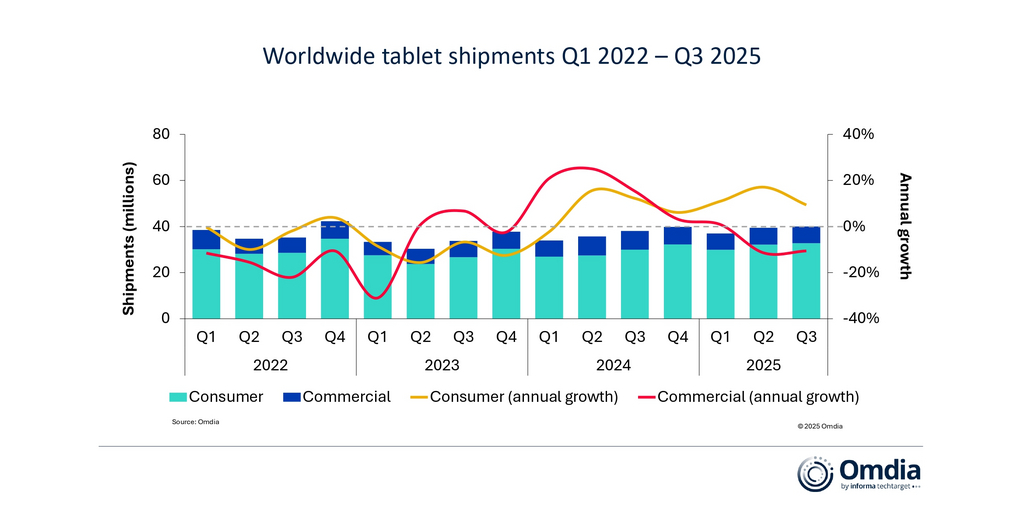
Core Insights - The global tablet market experienced a 5% year-on-year growth in Q3 2025, with shipments reaching 40 million units, marking the seventh consecutive quarter of growth [1][5]. Market Performance - The tablet market remains largely consumer-driven and has shown resilience despite macroeconomic challenges, driven by strong demand in regions like the Middle East, Central Europe, and China [2][3]. - Seasonal sell-in ahead of holiday periods contributed to the growth, although expectations for Q4 2025 indicate muted sell-in and a potential softening in tablet replacement demand into 2026 [3]. Vendor Analysis - Apple maintained a market share of 35.6% with 14.3 million units shipped, showing flat growth [4][5]. - Samsung also recorded flat growth with 6.9 million units shipped, holding a 17.3% market share [4][5]. - Lenovo led the growth among major vendors with a 23% year-on-year increase, shipping 3.7 million units [5]. - Huawei and Xiaomi followed with 3.2 million and 2.6 million units shipped, respectively, showing growth rates of 11.5% and 2.3% [5]. Chromebook Market Insights - The Chromebook market grew by 3.1% in Q3 2025, with Lenovo leading the segment, shipping 1.4 million units and achieving a 54.6% year-on-year growth [7][9]. - Acer and HP followed with market shares of 18% and 16.1%, respectively, while Asus also showed significant growth at 58.5% year-on-year [7][9].
小米集团(1810.HK)业绩回顾:2025年第一季度业绩因AIoT/电动汽车业务及强劲的中国销售而超预期;未来一个月将有重要事件;上调目标价并重申买入
Goldman Sachs· 2025-05-30 02:30
Investment Rating - The report maintains a "Buy" rating for Xiaomi Corp. (1810.HK) with a target price raised to HK$65 from HK$62, indicating a 26% upside potential [1][18]. Core Insights - Xiaomi's 1Q25 results exceeded expectations, with revenue growing by 47% year-over-year (yoy) to Rmb111 billion, and adjusted net profit increasing by 65% yoy to Rmb10.7 billion [1]. - Key growth drivers included AIoT and electric vehicles (EV), with AIoT revenue growing by 59% yoy, significantly outperforming the market [2][34]. - The gross profit margin (GPM) for AIoT reached a record high of 25.2%, up 5.4 percentage points yoy, making it the largest gross profit contributor for Xiaomi [3][58]. Financial Performance - Revenue from smart EVs showed a gross profit margin expansion to 23.2%, attributed to strong pricing power and lower bill of materials (BOM) costs [4]. - Smartphone revenue grew by 9% yoy to Rmb50.6 billion, with a market share increase in China to 19%, marking Xiaomi's first position in the market after 10 years [28]. - Internet services revenue increased by 13% yoy to Rmb9.1 billion, driven by a 20% growth in advertising revenue [67]. Segment Analysis - AIoT and lifestyle products contributed significantly to revenue, with smart large home appliances seeing a revenue growth of 114% yoy [42]. - Tablet shipments grew by 56% yoy, with Xiaomi achieving the No.3 market share globally and in China [47]. - Wearables revenue increased by 56.5% yoy, with Xiaomi maintaining a leading position in the global market [58]. Future Outlook - The company anticipates continued growth in AIoT, projecting a 22% compound annual growth rate (CAGR) for overseas revenue from 2024 to 2027 [61]. - Upcoming events to watch include the 6.18 shopping festival and a new product release event, which are expected to drive further consumer interest and sales [19].