Tabnine

Search documents
专家解读“AI应用创业”产业链
2025-12-12 02:19
Summary of Key Points from the Conference Call Industry Overview - The discussion revolves around the **AI application startup industry**, focusing on software development tools and backend services like BaaS (Backend as a Service) [1][2][5]. Core Insights and Arguments 1. **Design Tools**: - Figma and Sketch are leading design tools, with Figma being web-based and supporting real-time collaboration, while Sketch is limited to Mac OS [3][4]. - Adobe XD and Photoshop are also used but are less efficient for multi-page handling [3]. 2. **Development Tools**: - Visual Studio Code (VS Code) is the most widely used IDE due to its free access and extensibility [3][4]. - For mobile development, Android Studio and Xcode are recommended, along with cross-platform frameworks like Flutter and React [4]. 3. **Backend Services**: - BaaS simplifies backend management, allowing developers to focus on core business logic [5]. - Firebase is highlighted as a BaaS provider with easy integration into the Google Cloud ecosystem but has limitations in real-time updates and cost management as traffic increases [1][17]. 4. **AI's Role in Software Development**: - AI tools like Cursor, GitHub Copilot, and Tabnine lower the barriers to programming, but complex functionalities still require professional developers [2][32]. - The development of large language models has made it easier for individual creativity to translate into applications [2][33]. 5. **Cost Reduction Strategies**: - Utilizing SaaS can significantly reduce development costs, but it limits customization [7]. - BaaS options like Firebase and Superbase reduce the need for backend developers and operations staff [8][19]. 6. **Advantages and Disadvantages of BaaS**: - Advantages include ease of use, real-time data synchronization, and automatic scaling [9]. - Disadvantages involve migration difficulties, rising costs with increased traffic, and limited customization [9]. 7. **Custom Backend Frameworks**: - Custom frameworks allow complete control and predictable costs but are slower to develop and require manual scaling [10]. 8. **Microservices Architecture**: - This architecture is beneficial for AI applications as it allows independent updates and scaling of services, supporting multiple programming languages and frameworks [14]. 9. **Market Share in Cloud Services**: - Amazon AWS holds 30%-40% of the global server market, followed by Microsoft Azure at around 20% and Google Cloud at approximately 10% [25]. 10. **Cost Comparisons**: - Verso offers competitive pricing compared to AWS, especially for small-scale applications, where AWS can become significantly more expensive [26][27]. Other Important Insights - The need for a comprehensive ecosystem that includes design tools, IDEs, cross-platform frameworks, and cloud services is emphasized for AI-assisted software development [5]. - The challenges of mobile development include the separation of backend and frontend systems, which complicates the development process [13]. - Security solutions vary based on the scale of the website, with small sites using cost-effective options like Cloudflare, while larger enterprises require more robust solutions [30]. This summary encapsulates the key points discussed in the conference call, providing insights into the current state and challenges of the AI application startup industry and software development landscape.

告别碎片化补全,拥抱引导式开发流程优化
Sou Hu Cai Jing· 2025-07-14 04:38
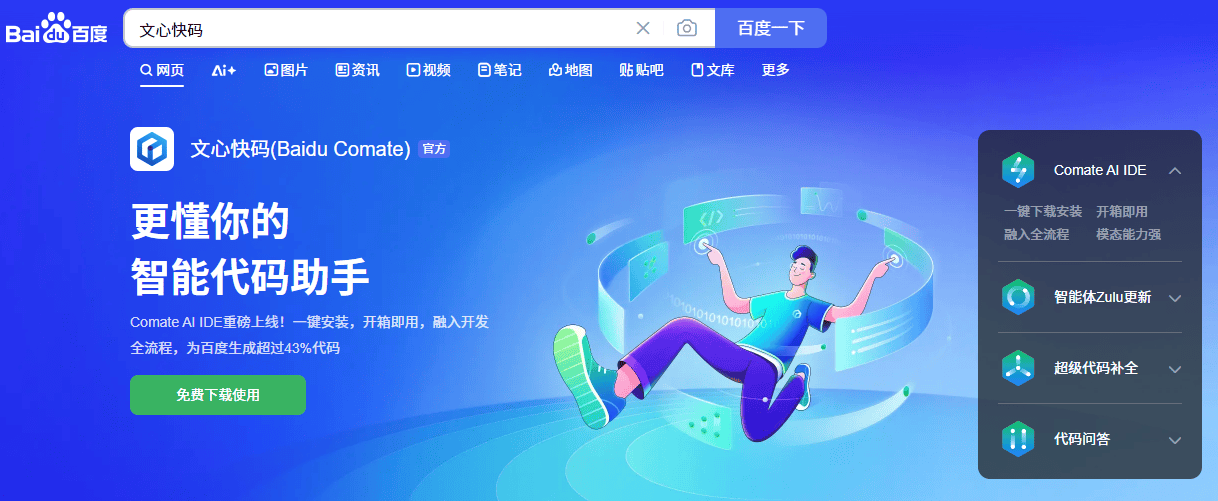
Core Insights - The article discusses the limitations of existing AI coding tools like Copilot and Tabnine, which primarily focus on local code generation and lack comprehensive support for overall development process optimization [1][2] - The introduction of Baidu's Wenxin Kuai Ma (文心快码) is highlighted, showcasing its capability to manage the entire development pipeline rather than just providing code snippets [3][4] Group 1: Tool Comparison - Existing tools are described as advanced code suggestion tools that struggle with larger tasks such as refactoring or streamlining deployment processes [1][2] - Wenxin Kuai Ma's Zulu intelligent agent offers a more systematic workspace, moving beyond simple chat interfaces to a structured approach for project management [4] Group 2: Project Implementation - The company tested Zulu on a real internal project, which involved a Python Flask backend with issues like high coupling and low test coverage [3][5] - Zulu's approach included guiding the user through requirement analysis, identifying key issues, and proposing a structured refactoring plan that included clear steps and generated code snippets [5] Group 3: Efficiency Gains - The article emphasizes the significant efficiency improvements provided by Zulu, allowing users to focus on core business logic rather than the organization of code and scaffolding [5]