ThinkSystem SR675i推理服务器

Search documents
四大芯片巨头CEO罕见同台
Di Yi Cai Jing Zi Xun· 2026-01-07 08:19
Core Insights - The article highlights the collaboration and competition among four major chip companies: NVIDIA, Intel, AMD, and Qualcomm, during the Lenovo Tech World event, emphasizing the evolving landscape of the AI industry [2] - A new partnership between Lenovo and NVIDIA aims to quadruple their business collaboration over the next three years, focusing on AI infrastructure and deployment [3][4] - The shift from traditional computing to AI-driven applications is reshaping the IT industry, with an estimated investment of $10 to $15 trillion needing upgrades to accommodate new AI architectures [4] Group 1: Collaboration and Partnerships - Lenovo and NVIDIA announced a new initiative called "Lenovo AI Cloud Super Factory," which aims to standardize AI infrastructure and streamline AI deployment for clients [5] - This collaboration is expected to help cloud service providers reduce the "time to first token" for AI deployment and scale up to 100,000 GPUs [7] - Lenovo will also be one of the first adopters of AMD's Helios AI platform, indicating a strategic partnership to address enterprise needs for local inference and data security [8] Group 2: Industry Trends and Innovations - NVIDIA's focus is on GPU-accelerated computing, while AMD emphasizes system-level architecture, showcasing the need for a comprehensive computing ecosystem rather than a single chip solution [8] - Intel's new AI PC, Aura Edition, represents a shift in the traditional PC market towards AI integration, highlighting the convergence of legacy computing systems with new AI paradigms [9] - Qualcomm is targeting AI-native endpoints, collaborating with Lenovo to develop wearable devices that function as "personal intelligent companions," indicating a trend towards low-power, always-connected devices [10] Group 3: Market Potential and Future Outlook - The wearable device market is projected to exceed one billion units, showcasing significant growth potential in this segment [11] - The article emphasizes that the true value of AI lies not in having the most powerful chip but in the ability to transform computing power into usable capabilities for businesses and consumers [11]




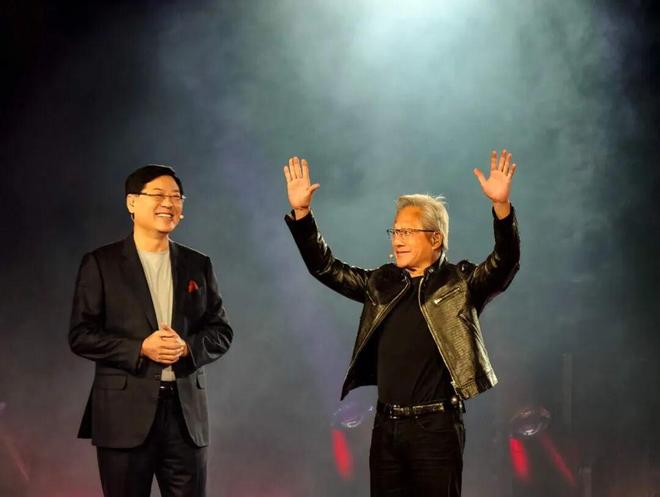
四大芯片巨头CEO罕见同台
第一财经· 2026-01-07 08:06
Core Viewpoint - The article highlights the collaboration and competition among major chip manufacturers, including NVIDIA, Intel, AMD, and Qualcomm, during the Lenovo Tech World event, emphasizing the shift in the AI landscape from training to inference and the need for integrated systems that can leverage diverse computing power [3][4]. Group 1: Collaboration and New Opportunities - NVIDIA's CEO Jensen Huang and Lenovo's Chairman Yang Yuanqing aim to quadruple their business collaboration over the next three years, reflecting a long-standing partnership that has evolved through various technological shifts [5][6]. - The collaboration focuses on the "Lenovo AI Cloud Super Factory," which aims to standardize AI infrastructure, transforming highly customized AI deployments into industrialized solutions [6][8]. - This partnership is expected to help cloud service providers reduce the "time to first token" for AI deployment and scale up to support trillion-parameter models [8]. Group 2: Competitive Landscape - AMD's CEO Lisa Su introduced the Helios rack-level AI platform, positioning it as a challenge to NVIDIA's GPU-centric approach, emphasizing the need for robust system-level infrastructure to support larger models and higher throughput [10][11]. - Intel's new CEO Pat Gelsinger announced the Aura Edition AI PC, showcasing a shift from traditional PCs to AI-enhanced computing experiences, indicating a blend of legacy computing with new AI paradigms [11]. - Qualcomm's CEO Cristiano Amon focused on AI-native endpoints, highlighting the evolution of wearable devices into "personal intelligent companions," which aligns with Lenovo's strengths in ecosystem and global channels [12]. Group 3: Industry Trends and Insights - The article notes that the market for wearable devices is expected to exceed one billion units, indicating significant growth potential in this segment [13]. - The collaboration among the four chip giants illustrates a new industry consensus that the true value of AI lies not in having the most powerful chip, but in the ability to transform computing power into usable capabilities for businesses and users [13].