Uber One订阅服务

Search documents
优步(UBER.US)Q4营业利润创新高但盈利展望疲软 管理层拥抱“Robotaxi增长叙事”
智通财经网· 2026-02-04 13:25
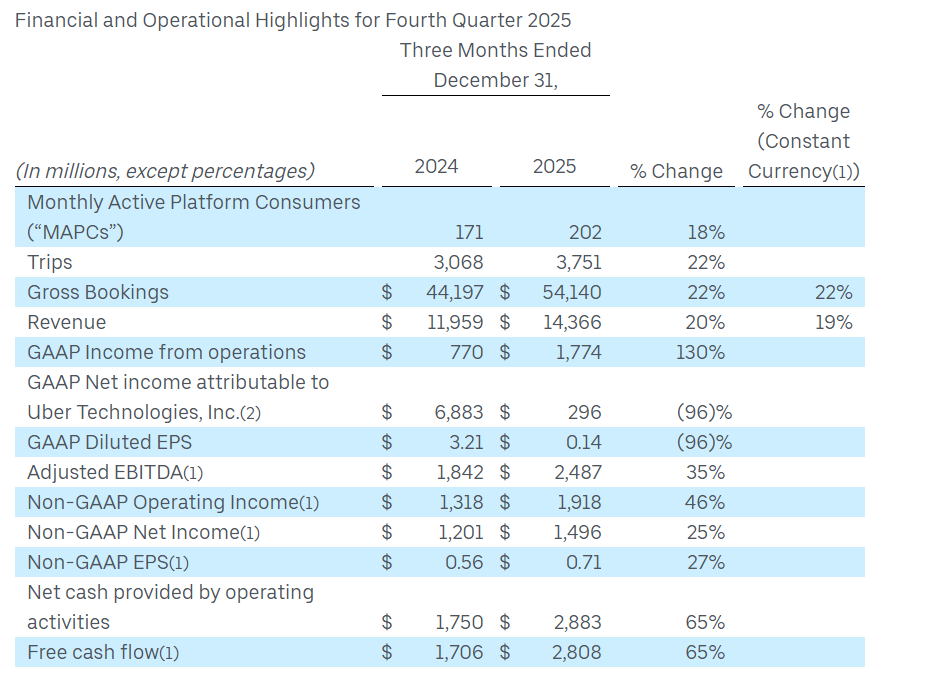
Core Viewpoint - Uber Technologies Inc. reported weak earnings guidance while announcing the appointment of Balaji Krishnamurthy as the new CFO, indicating a strategic focus on the development of Robotaxi services as a key revenue driver for the future [1][5]. Financial Performance - Uber's adjusted earnings per share (EPS) for Q1 is projected to be between $0.65 and $0.72, below Wall Street's expectation of approximately $0.77 [2]. - The total bookings for Q1 are expected to be between $52 billion and $53.5 billion, representing a year-over-year growth of 17% to 21%, which exceeds Wall Street's average expectations [2]. - In Q4, Uber reported a GAAP operating income of $1.8 billion, a 130% increase year-over-year, with total revenue of approximately $14.37 billion, up 20% year-over-year, aligning with Wall Street's expectations [2][4]. Strategic Developments - Balaji Krishnamurthy, known for his support of Uber's autonomous driving strategy, has been appointed as CFO, succeeding Prashanth Mahendra-Rajah [1][5]. - Uber has invested hundreds of millions in autonomous driving technology and plans to scale Robotaxi deployment across its platform [4][10]. - The company aims to launch Robotaxi services in over ten markets by the end of the year, including Houston, Hong Kong, Madrid, and Zurich [8][10]. Market Dynamics - Uber's CEO highlighted strong demand in the ridesharing market, with expectations for growth in trip volume and total bookings in the U.S. market by 2026 [6]. - The company reported a 22% increase in total bookings to $54.1 billion, driven by new product launches and increased subscription services [7]. - Uber's delivery business also saw significant growth during the holiday shopping season, setting records for sales [7]. Competitive Landscape - Uber's Robotaxi strategy is positioned as a key growth area, with the potential to shift the cost structure of the ridesharing market from driver-dependent to vehicle and operational costs [10][11]. - The company emphasizes its unique advantages in high-frequency dispatch networks and dynamic pricing compared to competitors like Waymo and Tesla [11].


自动驾驶的大赢家!Uber 的增长之路为何才刚刚起步
美股研究社· 2025-05-12 10:48
Core Viewpoint - Uber has transformed from a company with low profitability and weak unit economics to a profitable entity with a strong growth trajectory, making it an attractive investment opportunity with a valuation of approximately $83 per share [3]. Business Overview - Uber, founded in 2009, has expanded its services to include online food delivery, retail, package delivery, and freight, operating in over 15,000 cities with 171 million monthly active users and an annual order volume of $180 billion [2]. Financial Performance - In 2023, Uber achieved profitability and has been steadily increasing its profit margins while growing revenue at a rate of 20% annually, which has helped it capture market share and innovate its services [3]. Competitive Advantage - Uber's dual-platform model for ride-hailing and delivery creates a significant competitive edge, allowing drivers to maximize their income potential through multiple revenue streams [4]. - The interoperability of Uber's services enhances user experience and loyalty, with multi-product consumers spending 3.4 times more than single-product consumers [5]. Operational Efficiency - Uber's scale and user liquidity contribute to operational efficiencies, allowing the company to share economic benefits with drivers and customers, thus improving profitability [6]. - The company has a lower commission rate compared to competitors like Lyft, which positions it favorably in terms of value creation for drivers and passengers [6]. Cost Management - Uber is implementing technology initiatives to reduce insurance costs, which are significant for ride-hailing and delivery platforms, thereby improving gross margins [7]. - The introduction of the Uber One subscription service has led to increased customer loyalty and transaction frequency, with subscribers spending three times more than non-subscribers [8]. Advertising Revenue - Uber's advertising business, launched in 2022, is expected to enhance profitability, with a projected revenue run rate of $1.5 billion and a gross margin of at least 70% [9]. Autonomous Vehicles (AV) Impact - The rise of autonomous vehicles presents both a threat and an opportunity for Uber, as it may face competition from AV operators but also has the expertise in fleet management that is crucial for AV commercialization [10][11]. - Uber's extensive user base provides a significant market for AV operators, ensuring fleet utilization and maximizing revenue potential [12]. Market Valuation - Compared to global competitors, Uber's stock appears undervalued, with a price-to-free cash flow ratio that is 30% lower than its peers for 2025, suggesting strong growth prospects and a dominant market position [15].