
Vera Rubin 计算平台

Search documents
英伟达不想只卖 GPU
3 6 Ke· 2026-03-18 23:49
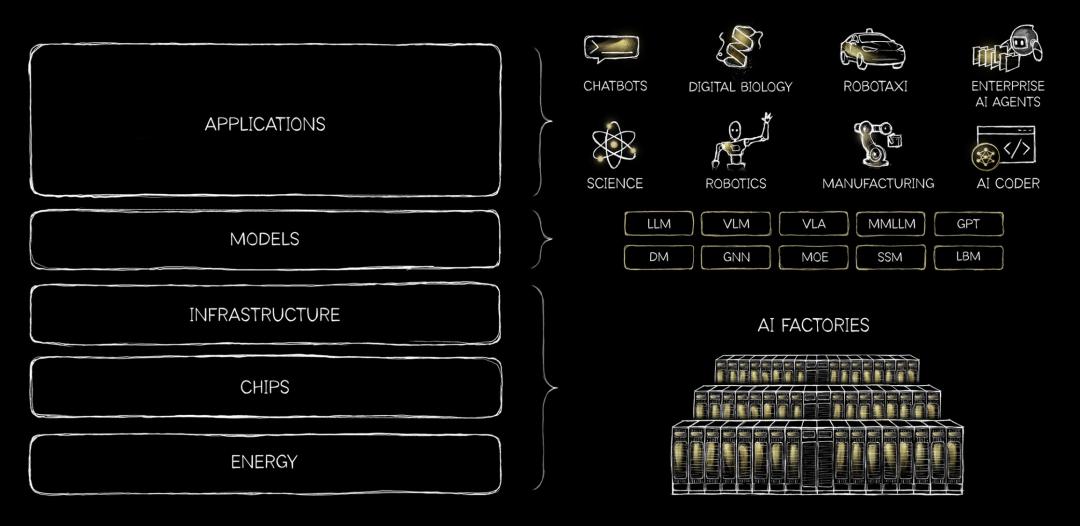
Core Viewpoint - Nvidia is redefining itself as a vertically integrated and horizontally open company, moving beyond its traditional focus on high-performance GPUs to embrace a more comprehensive approach in the AI landscape [1][2]. Group 1: Hardware Developments - The next-generation Vera Rubin computing platform has evolved from a single chip to a complete chip system consisting of 7 custom chips and 5 different racks, connected via the latest NVLink 6 network [3]. - The Vera CPU, integrated with 256 liquid-cooled processors, offers double the computational efficiency of traditional CPUs and is designed specifically for agentic AI [3]. - Nvidia's Vera Rubin platform boasts a single-card inference capability that is up to 5 times better than the previous Blackwell chip, with a 90% reduction in token generation costs [3]. - Nvidia has integrated the Groq 3 LPU into the Vera Rubin platform, which allows for lower latency and more stable AI inference tasks, addressing previous shortcomings in Nvidia's architecture [4]. Group 2: Market Strategy - Nvidia is entering the consumer-grade SoC market with the N1X chip, developed in collaboration with MediaTek, targeting high-end AI PCs and laptops [5][6]. - The strategy aims to raise the competitive barrier, requiring potential competitors to develop not just better GPUs but also superior CPUs, switches, network protocols, and low-latency modules [7]. - Nvidia's approach indicates a desire to capture every aspect of AI infrastructure hardware, aiming to maximize revenue opportunities [8]. Group 3: Software Initiatives - Nvidia has announced a partnership with the open-source project OpenClaw to launch NemoClaw, an open-source AI agent platform that allows enterprises to deploy and manage AI agents without hardware restrictions [9][10]. - The shift from a hardware-centric to a software-centric strategy is driven by the need to retain customers in a market where custom AI chips from cloud providers are gaining significant market share [12]. - Nvidia emphasizes the importance of structured data for enterprise applications, positioning NemoClaw as a key tool for businesses to leverage AI effectively [13][14]. Group 4: AI Ecosystem and Future Outlook - Nvidia's "AI Five-Layer Cake" theory outlines the interdependence of energy, chips, data centers, models, and applications, suggesting that advancements in one layer will drive demand across others [16]. - The company is investing in various sectors, including nuclear energy and medical AI, to ensure a robust AI ecosystem and to avoid bottlenecks in any layer of the AI supply chain [16]. - Nvidia's comprehensive strategy aims to expand the overall AI market, ensuring sustained demand for its computational power [16].


全球AI算力革命,生态之争加速演绎
Huachuang Securities· 2026-01-16 04:15
Investment Rating - The report maintains a "Recommended" investment rating for the computer industry [3] Core Insights - The global AI computing revolution is accelerating, with a significant increase in demand for intelligent computing power, projected to exceed 16 ZFlops by 2030, with intelligent computing accounting for over 90% of this demand [6][14] - NVIDIA leads the market with a nearly 90% share in AI server GPUs, while companies like Broadcom and AMD are also making significant strides in the ASIC chip market [6][19] - The competition in the AI computing ecosystem is intensifying, with a shift from general-purpose to specialized chips, driving a trend towards customized solutions [8][12] Summary by Sections Global AI Computing Revolution - The demand for intelligent computing is rapidly growing, with the global computing power expected to reach 16 ZFlops by 2030, where intelligent computing will dominate [14] - NVIDIA's GPU market share is approximately 90%, with significant growth in AI chip sales projected for the coming years [19] NVIDIA's Data Center Business - NVIDIA has built a comprehensive computing infrastructure, investing over 582 billion in R&D, leading to innovations across chips, systems, and software [49] - The introduction of the Blackwell architecture has significantly enhanced performance, supporting models with up to 100 trillion parameters [53] Broadcom's Rise - Broadcom focuses on ASIC chips, holding a 55%-60% market share in the ASIC market, establishing long-term partnerships with major cloud service providers [43] - The company's AI business revenue reached 20 billion, growing by 65% year-on-year [6] Intensifying Competition in the AI Ecosystem - The AI market is shifting towards specialized chips, with major cloud providers like Google and Amazon developing their own chips to reduce dependency on external suppliers [8][12] - AMD is enhancing its ecosystem, with plans to release new chip series that promise significant performance improvements [19] Investment Recommendations - The report suggests focusing on A-share companies such as Cambricon, Haiguang Information, and Inspur, as well as U.S. companies like NVIDIA, Broadcom, and AMD, as potential investment opportunities in the evolving AI computing landscape [6][8]

