Volt ™ PFA系统

Search documents
强生官宣分拆骨科,雅培210亿豪赌早筛:942亿vs443亿财报背后,中国区成变量
3 6 Ke· 2026-01-28 02:38
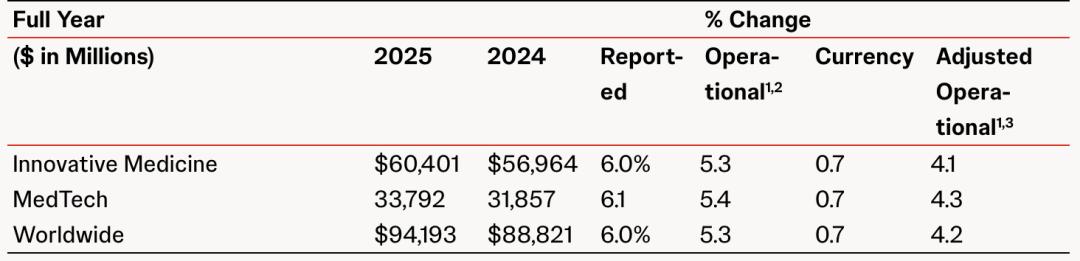
Core Insights - Johnson & Johnson reported a revenue of $94.193 billion for 2025, reflecting a 6% year-over-year growth, but faced a strategic contraction in its orthopedic segment, which grew only 1.1% [1][3][19] - Abbott's revenue for 2025 was $44.328 billion, a 5.7% increase, but its diagnostic business saw a decline of 4.3%, highlighting a need for transformation [2][8][14] - The two companies are adopting different strategies in response to market pressures: Johnson & Johnson is divesting low-growth assets, while Abbott is pursuing acquisitions to drive growth [2][19] Johnson & Johnson Financial Overview - Total revenue for 2025: $94.193 billion, up 6% from $88.821 billion in 2024 [4] - Innovative Medicine segment generated $60.401 billion, accounting for over 65% of total sales, with a 6% growth [4][3] - Medical Technology segment revenue reached $33.792 billion, also up 6.1%, with cardiovascular business showing a strong performance at $8.93 billion, growing 15.8% [4][6][7] Abbott Financial Overview - Total revenue for 2025: $44.328 billion, a 5.7% increase from the previous year [8] - Medical Devices segment was the largest, generating $21.387 billion, with a growth of 12.6% [9][10] - The diagnostic business, however, faced a decline, with revenue of $8.937 billion, down 4.3% [13][14] Strategic Moves - Johnson & Johnson announced the spin-off of its orthopedic business, DePuy Synthes, to focus on higher-growth areas like cardiovascular and surgical robotics [7][19] - Abbott made a significant acquisition of Exact Sciences for $21 billion to bolster its cancer screening capabilities, addressing the decline in its diagnostic segment [14][2] Market Dynamics - Both companies are navigating challenges in the Chinese market, with Abbott facing a $400 million impact from centralized procurement [16][17] - Johnson & Johnson's orthopedic market share in China has significantly dropped, with its spinal business share falling from 16% to below 5% [18][19] - The competitive landscape is intensifying, with both companies adapting their strategies to maintain growth amid external pressures [20]