Water Heater

Search documents
最高1500元!河南2026年家电、数码产品补贴实施细则公布
Xin Lang Cai Jing· 2026-02-28 03:43
Core Viewpoint - The Henan Province has announced the implementation details for the 2026 subsidy program for replacing old household appliances and digital products, following the earlier vehicle trade-in subsidy policy [1][3]. Subsidy Scope - The subsidy covers six categories of household appliances: refrigerators (including freezers), washing machines (including washer-dryer combos), televisions (including laser TVs, excluding projectors), air conditioners (including home central air conditioning), computers (branded, excluding assembled machines), and water heaters (including wall-mounted boilers) [2][5]. - It also includes four categories of digital and smart products: mobile phones, tablets, smartwatches (bands), and smart glasses, with a single item sales price not exceeding 6,000 yuan [2][5]. Subsidy Standards - For household appliances, a subsidy of 15% of the final sales price is provided for energy-efficient or water-efficient products, with a maximum subsidy of 1,500 yuan per item for each consumer [6]. - For digital and smart products, a similar subsidy of 15% applies, with a maximum of 500 yuan per item for each consumer [6]. Participation Process - Consumers must log into the Yunshangfu APP for real-name registration and obtain subsidy vouchers [7]. - Upon purchasing eligible products, consumers will receive an immediate discount at the point of sale, and merchants must issue invoices reflecting the actual payment plus the government subsidy [7]. - Merchants are required to collect necessary information for subsidy verification, including product serial numbers and activation codes for certain devices [8]. Basic Conditions for Participants - Participants must be legally registered entities with independent accounting, primarily engaged in retail of household appliances and digital products, and must have the capability for after-sales services [9]. - They must have a good credit status, with no significant safety incidents or violations in the past two years [9]. - Participants must publicly disclose product pricing and ensure compliance with subsidy regulations [10]. Responsibilities and Requirements - The business department is responsible for determining and publishing the list of participating entities, overseeing compliance, and managing funds [12]. - The finance department will handle fund disbursement and monitoring, aiming for efficient subsidy payments [12]. - Market regulation departments will ensure product quality and price monitoring, protecting consumer rights [12]. - Participants must adhere to legal regulations and avoid fraudulent practices, with penalties for violations [14].
最高补贴2万元!2026年青海省以旧换新补贴比例公布
Sou Hu Cai Jing· 2026-01-16 06:54
Core Insights - Qinghai Province is set to further optimize its consumer goods trade-in policy by 2026, aiming to boost consumption and economic development [1] Group 1: Investment and Economic Impact - In 2025, Qinghai Province invested a total of 1.69 billion yuan, benefiting over 1.52 million people and stimulating consumption worth 19.7 billion yuan [1] - The province achieved significant results in vehicle and appliance upgrades, with 92,000 new cars, 496,000 home appliances, 615,000 digital products, and 31,900 home decor items purchased through the trade-in program [1] Group 2: Policy Adjustments - The central government will continue to allocate long-term special treasury bond funds to support the trade-in policy, with local governments providing matching funds [1] - In 2026, Qinghai will implement further optimizations to the trade-in policies for automobiles, home appliances, and digital products [1] Group 3: Specific Subsidy Standards - The subsidy for old car trade-ins will be adjusted to a percentage of the vehicle price, with new energy vehicles receiving 12% of the price (up to 20,000 yuan) and fuel vehicles receiving 10% (up to 15,000 yuan) [2] - For home appliances, consumers will receive a 15% subsidy on qualifying products, with a maximum of 1,500 yuan [2] - The subsidy for digital products will also be set at 15% for items priced under 6,000 yuan, with a maximum of 500 yuan [2]
中国消费家电_2026 年家电以旧换新补贴及我们的观点-China Consumer Appliances Sector 2026 home appliances trade-in subsidies and our thoughts
2026-01-04 11:34
Summary of the Conference Call on China Consumer Appliances Sector Industry Overview - The conference call focused on the **China Consumer Appliances Sector**, particularly the **2026 home appliances trade-in subsidies** announced by the **National Development and Reform Commission (NDRC)** and the **Ministry of Finance** on December 30, 2025 [2][3]. Key Points and Arguments 1. **Announcement Timing**: The release of the 2026 subsidy policies was slightly ahead of expectations, as the 2025 version was released on January 8, 2025. The overall content aligns with market expectations, benefiting white goods and smart home products [2][3]. 2. **Narrowed Subsidy Scope**: The 2026 subsidies will cover only **6 categories**: fridge, washing machine, TV, air conditioner, PC, and water heater. This is a reduction from the 12 categories in 2025, which included major kitchen appliances and small appliances like range hoods and microwaves. This change may negatively impact companies focused on major and small appliances [3][4]. 3. **Subsidy Structure Changes**: - The subsidy for energy-efficient products will be **15% of the sales price**, with a cap of **Rmb1,500** per category per consumer. This is a decrease from the previous **20%** for Level 1 energy-efficient products and **15%** for Level 2, with a cap of **Rmb2,000** [4]. 4. **Encouragement for Local Governments**: The policy explicitly encourages local governments to subsidize smart home products, including age-adaptive home products. Local governments will have the discretion to set specific categories and standards [5]. 5. **Estimated Total Subsidy Amount**: The total amount for the 2026 subsidies has not been officially released, but estimates suggest it could be around **Rmb250 billion**, slightly lower than the **Rmb300 billion** in 2025. This estimate is based on a recent fund of **Rmb62.5 billion** issued to support consumer goods trade-in [5]. Sector Implications - The focus on white goods is expected to benefit industry leaders such as **Midea** and **Haier**. The support for smart home products may also favor companies like **Roborock** and **Ecovacs**. However, sales for major appliances (e.g., **Robam**) and small appliances (e.g., **Supor**, **Joyoung**) may face challenges due to a high sales base [6]. Risks Identified 1. **Home Appliances Sector Risks**: - Impact of the **China property market** on demand - Elevated raw material prices - Global supply chain constraints affecting exports [9]. 2. **Robotic Vacuum Cleaner Sector Risks**: - Intensifying market competition - Raw material price increases - Foreign exchange losses due to currency fluctuations [10]. 3. **Small Appliances Sector Risks**: - Economic downturn leading to weak consumption - Price competition - Rising raw material costs eroding profitability [10]. Additional Information - The report was prepared by **UBS Securities Asia Limited**, with analysts including **Rennie Pan**, **Christine Peng**, and **Molly Huang** [7]. - The document includes disclaimers regarding the potential conflicts of interest and the nature of the research provided [11][12]. This summary encapsulates the critical insights and implications from the conference call regarding the China Consumer Appliances Sector and the upcoming subsidy policies for 2026.
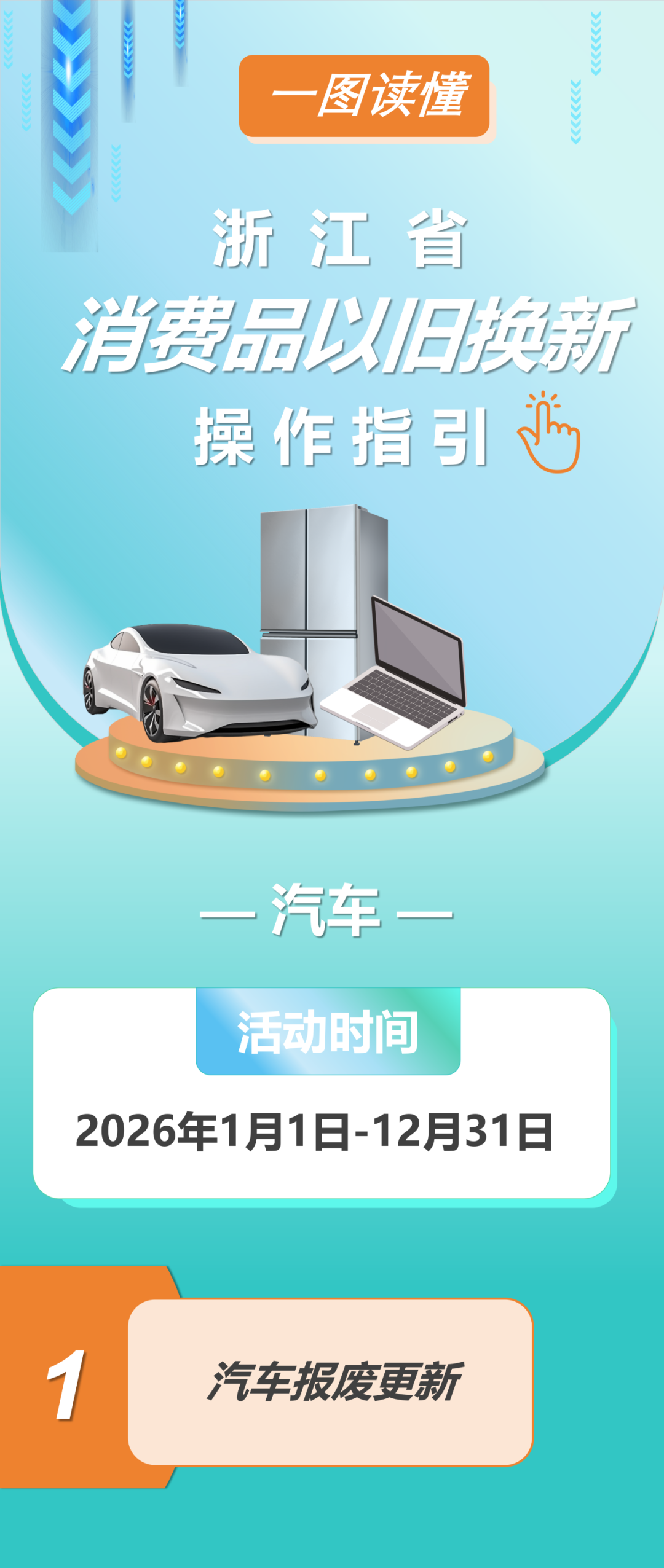
今起实施!2026年浙江消费品以旧换新,操作指引来了
Xin Lang Cai Jing· 2026-01-01 07:30
Group 1: Core Points - The Zhejiang province will implement a vehicle trade-in program from January 1, 2026, to December 31, 2026 [1][25] - The program aims to encourage consumers to replace old vehicles with new ones, providing subsidies for eligible purchases [3][18] Group 2: Subsidy Details - For scrapping and updating vehicles, personal consumers can receive a subsidy of 12% of the vehicle price, with a maximum subsidy of 20,000 yuan for new energy vehicles and 15,000 yuan for fuel vehicles [7][9][19] - The eligibility for the subsidy requires that the old vehicle must be registered in the applicant's name before January 8, 2025, and the new vehicle must be purchased within the program period [13][21] Group 3: Application Process - Consumers can apply for subsidies through platforms like Alipay and WeChat by searching for the "Zhejiang Auto Trade-in" mini-program [17][22] - Required documents for application include the scrapping certificate, vehicle deregistration certificate, sales invoice, and vehicle registration certificate, all of which must be obtained after January 1, 2026 [13][21] Group 4: Additional Consumer Products - The program also includes subsidies for household appliances such as televisions, refrigerators, washing machines, air conditioners, computers, and water heaters, with a subsidy of 15% of the actual sales price and a maximum of 1,500 yuan per item [30][31] - Consumers can participate in both online and offline activities to claim these subsidies, with specific guidelines for each method [32][43]

@北京消费者,家电、数码以旧换新补贴元旦开领
Xin Lang Cai Jing· 2025-12-31 13:47
Core Viewpoint - Beijing will implement a subsidy program for the replacement of old household appliances and digital products starting January 1, 2026, aimed at encouraging consumer spending in these sectors [1]. Subsidy Details - The subsidy will apply to six categories of household appliances (refrigerators, washing machines, televisions, air conditioners, water heaters, and computers) and four categories of digital products (mobile phones, tablets, smartwatches, and smart glasses) [1][10]. - The subsidy amount will be 15% of the final sales price after discounts, with a maximum of 1,500 yuan for household appliances and 500 yuan for digital products per item [1][10]. Qualification Process - Consumers can obtain subsidy qualifications through the "Jingtong" mini-program starting at 8 AM daily, with qualifications valid for the month of issuance [1][4]. - The program allows for both online and offline redemption, with specific platforms and stores designated for each [4][12][13]. Redemption Guidelines - For online purchases, consumers must complete the qualification process in the mini-program and then use the generated code on designated e-commerce platforms [6][7]. - For offline purchases, consumers must show the qualification QR code to participating retailers for verification [7]. Additional Information - The program includes a mechanism for reissuing qualifications if they expire without use, allowing consumers to reapply [1][4][16]. - The initiative is part of a broader effort to stimulate economic activity in the consumer electronics sector [1].

A. O. Smith Q1 Earnings Beat Estimates, Sales Decline Y/Y
ZACKS· 2025-04-29 16:00
Core Insights - A. O. Smith Corporation (AOS) reported first-quarter 2025 adjusted earnings of 95 cents per share, exceeding the Zacks Consensus Estimate of 90 cents, although this represents a 5% decrease year-over-year [1] - Net sales reached $963.9 million, surpassing the consensus estimate of $947 million, but showed a 1.5% decline year-over-year due to lower water heater volumes and decreased sales in China [1] Segmental Performance - North America sales decreased by 2.3% year-over-year to $748.7 million, slightly above the estimated $744.5 million, primarily due to lower water heater volumes [1] - Segmental earnings fell 6.8% year-over-year to $185.2 million, mainly attributed to reduced water heater volumes [2] - Sales in the Rest of the World segment were $226.7 million, remaining flat year-over-year, with sales in India increasing by 11% in local currency [2] Financial Metrics - Cost of sales was $588.5 million, down 0.9% year-over-year, while selling, general & administrative expenses rose by 0.2% to $192.6 million [4] - Gross profit decreased by 2.4% year-over-year to $375.4 million, resulting in a gross margin of 38.9%, down from 39.3% in the previous year [4] - Interest expenses increased to $2.9 million from $1.0 million in the year-ago quarter [4] Liquidity and Cash Flow - As of March 31, 2025, cash and cash equivalents totaled $173.0 million, down from $239.6 million at the end of December 2024 [5] - Long-term debt rose to $259.8 million from $183.2 million at the end of December 2024 [5] - Cash provided by operating activities in the first three months of 2025 was $38.7 million, compared to $106.6 million in the same period last year [5] Share Repurchase Activity - In the first quarter of 2025, A.O. Smith repurchased 1.8 million shares for $120.6 million, with 1.7 million shares remaining under the existing repurchase authorization [6] 2025 Outlook - A.O. Smith has affirmed its sales outlook for 2025, expecting net sales to be in the range of $3.8-$3.9 billion, compared to $3.82 billion in 2024 [7] - The company projects adjusted earnings per share to be between $3.60 and $3.90, down from $3.63 per share reported in 2024 [7] Zacks Rank - A.O. Smith currently holds a Zacks Rank 3 (Hold) [8]