
Wearable Device

Search documents
内存供应挑战持续:IDC大幅下调今年智能手机全球出货量,同比下滑近13%
Sou Hu Cai Jing· 2026-02-27 09:17
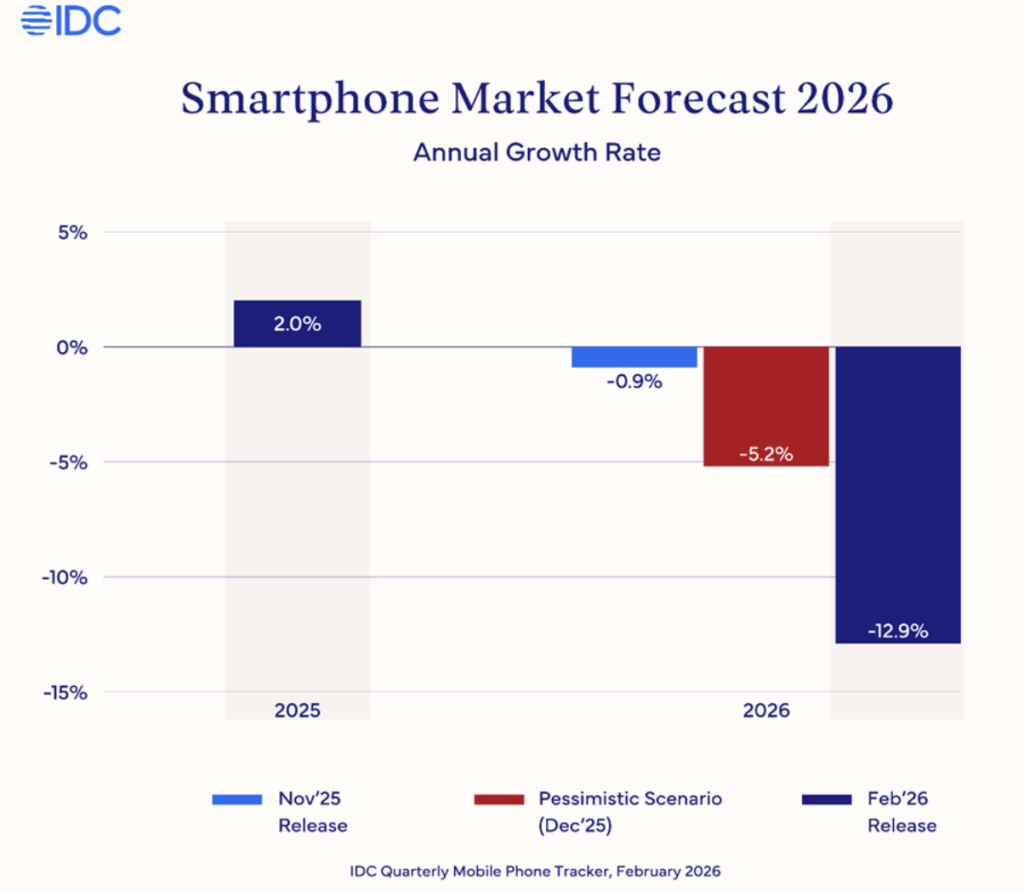
Core Insights - IDC has significantly revised down its forecast for global smartphone shipments in 2026 to approximately 1.1 billion units, a decrease from 1.26 billion units in the previous year, indicating a rare year-on-year decline of nearly 13% in the smartphone market [1] Group 1: Smartphone Market Outlook - The smartphone market is expected to decline by 12.9% in 2026, with a slight revenue decrease of 0.5%. A modest growth of 1.9% is anticipated in 2027, followed by a strong rebound of 5.2% in 2028 [4] - The ongoing memory supply challenges are projected to persist until at least 2026, potentially extending into 2027, with memory prices expected to remain elevated and not return to 2025 levels [4][5] Group 2: Memory Supply Crisis - The structural factors causing the memory shortage include surging demand for AI infrastructure and competition for DRAM and NAND flash capacity from consumer electronics [5] - IDC's Senior Research Director, Nabila Popal, emphasized that the current memory crisis is more significant than previous challenges such as tariffs and pandemic impacts, predicting a dramatic transformation in the smartphone market's scale, average selling price, and competitive landscape by mid-2027 [5] Group 3: Broader Market Implications - The crisis is expected to reshape not only the smartphone market but also the personal computer market, as well as the competitive dynamics of tablets, XR headsets, wearables, and gaming consoles [6]

龙华预计2025年GDP增长6%以上
Nan Fang Du Shi Bao· 2026-01-28 23:10
Economic Development - Longhua District is projected to achieve a GDP exceeding 330 billion yuan by 2025, with a growth rate of over 6% [2] - The district's industrial output is expected to surpass 720 billion yuan, with fixed asset investment nearing 100 billion yuan [2][3] - The total retail sales of consumer goods are anticipated to exceed 140 billion yuan, while foreign trade import and export volume is expected to stabilize at 500 billion yuan [2] Achievements During the 14th Five-Year Plan - Longhua District has shown significant growth, moving into the top tier of urban districts in China, with a GDP growth rate averaging 5.3% and nominal growth at 5.5% [3] - The industrial output has increased by 37.7% over five years, surpassing 720 billion yuan [3] - The digital economy has become a key driver, with core industries' total output exceeding 600 billion yuan, accounting for over 35% of the GDP [3] Infrastructure and Social Welfare - Over 300 billion yuan has been invested in key areas, leading to significant improvements in urban infrastructure and social welfare [4] - The district has opened 60 low-altitude logistics routes, accounting for one-fifth of the city's total, and has the highest number of low-altitude takeoff and landing facilities in the city [4] Investment and Consumption - Longhua District aims to enhance investment, consumption, and business environment, with 263 major projects and industrial investments of 28.3 billion yuan planned [5] - The district has organized 560 consumption promotion activities, with subsidies totaling 480 million yuan, directly boosting consumption by 1.15 billion yuan [5] Future Development Plans - The district's "15th Five-Year Plan" focuses on building a digital economy core area and a world-class semiconductor industry center [7] - By 2030, the GDP is expected to exceed 600 billion yuan, with fixed asset investment reaching 600 billion yuan over five years [7] - The plan emphasizes the importance of modern industrial systems, with a target for the digital economy's contribution to GDP to exceed 40% [8] Industry Upgrades and New Initiatives - The district plans to implement ten key initiatives in 2026 to enhance quality and efficiency, focusing on expanding consumer demand and optimizing the business environment [9] - Significant investments are planned in emerging industries, including telecommunications and smart devices, with expected outputs of 140 billion yuan and 200 billion yuan respectively [10]

塞浦路斯物联网使用率高于欧盟平均水平
Shang Wu Bu Wang Zhan· 2025-09-05 17:28
Core Insights - In 2024, 76.9% of the population aged 16-74 in Cyprus is using connected devices, surpassing the EU average of 70.9% [1] Device Usage Statistics - The highest usage rates of connected devices among EU member states are in the Netherlands (94.8%), Ireland (90.6%), and Denmark (87.0%), while the lowest are in Poland (46.1%), Bulgaria (50.8%), and Romania (56.6%) [1] - Greece has a usage rate of 56.8%, Italy 63.1%, and Germany 69.5% [1] Device Types - Smart TVs are the most widely used connected devices, accounting for 57.9% of usage [1] - Approximately 30% of users utilize wearable devices, and around 20% use gaming consoles or connected speakers [1] - Home automation applications are less common, with energy management systems, smart appliances, and security devices having usage rates of 14.2%, 12.8%, and 11.8% respectively [1] - The usage rates for connected cars, health devices, and smart toys are 10.5%, 7.9%, and 2.3% respectively [1]